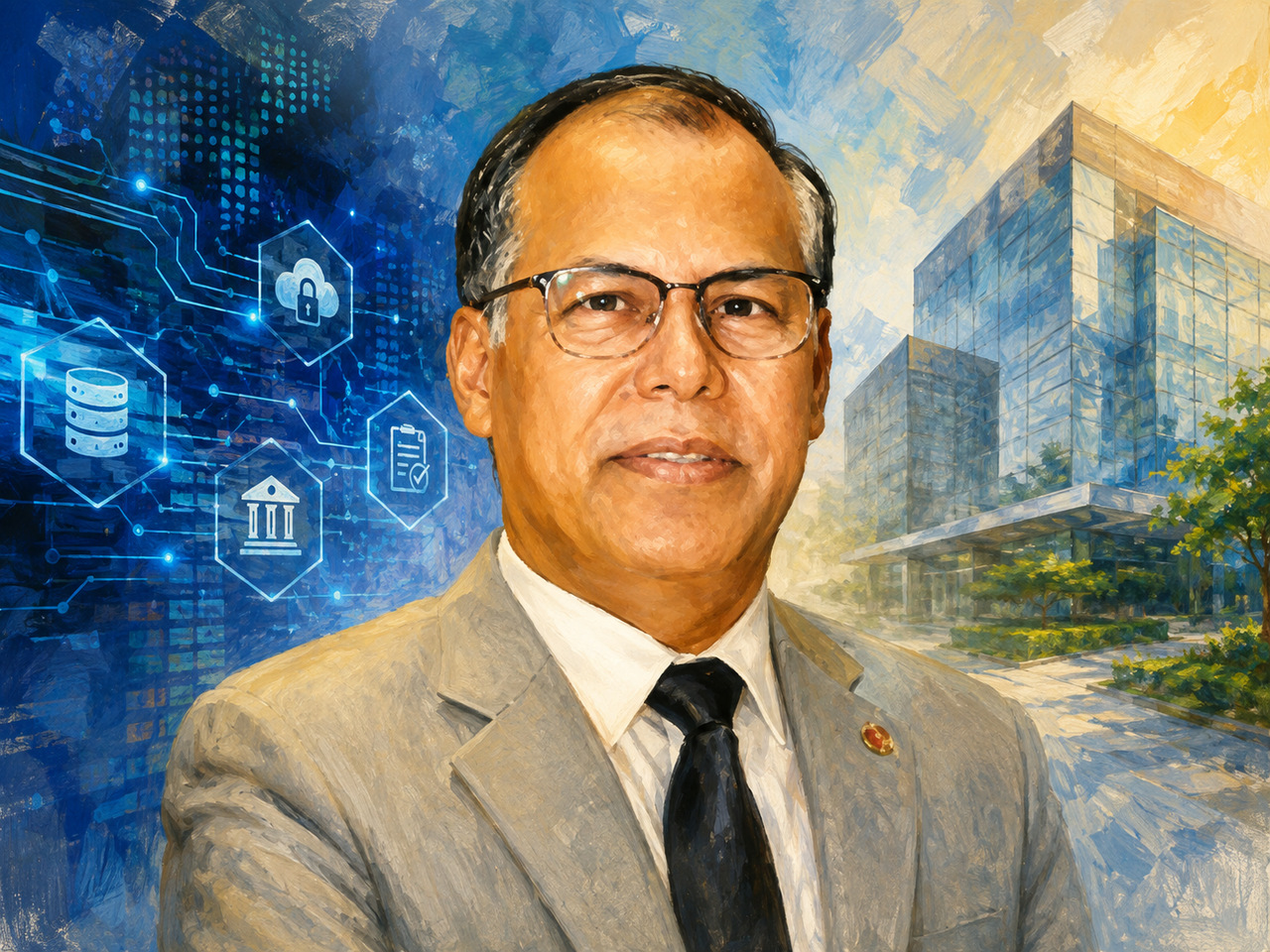

National E-Governance Services Limited (NeSL), India’s first Information Utility regulated by the Insolvency and Bankruptcy Board of India (IBBI), has appointed Umesh Kumar Singh as its Managing Director and Chief Executive Officer. Singh assumed charge on September 1, taking over at a time when digital repositories, authenticated financial information and paperless transactions are becoming increasingly important to India’s financial and insolvency ecosystem.
Singh brings more than 35 years of professional experience, including over three decades across technology, digital banking, financial inclusion, governance and financial services. His previous assignment was at the Central Registry of Securitisation Asset Reconstruction and Security Interest of India (CERSAI), where he served as Central Registrar and MD & CEO from February 2023 to August 2026.
His move to NeSL puts a technology and financial-sector veteran at the helm of an institution whose role sits at the intersection of digital infrastructure, financial information and regulatory processes.
From CERSAI Registries to NeSL’s Digital Infrastructure
Singh’s experience at CERSAI is particularly relevant to his new role.
During his tenure, he provided leadership to key registries including the Security Interest Registry, Central KYC Records Registry (CKYCRR) and BUDS Registry. The CKYCRR underwent a technology transformation during this period, with an emphasis on scalability, security, privacy and customer convenience, according to the company.
He also led the establishment of the BUDS Registry under the Banning of Unregulated Deposit Schemes Act, 2019. The registry was created to strengthen transparency and the institutional framework for dealing with unregulated deposit schemes.
Before joining CERSAI, Singh spent 25 years with Central Bank of India, working across technology, digital banking, business process re-engineering, financial inclusion, retail and corporate banking, transaction banking and banking operations.
That career has given him an unusual combination of banking and technology experience — two areas that are increasingly converging in India’s financial infrastructure.
What NeSL Does in the Financial System
NeSL’s role is not that of a conventional technology company.
As an Information Utility under the Insolvency and Bankruptcy Code, 2016, it operates as a repository for information relating to debt and claims submitted by financial or operational creditors and verified and authenticated by parties to the debt.
The objective is straightforward but important: creating a reliable digital record that can support financial and insolvency processes.
NeSL has also expanded into other paperless financial services. Its Digital Document Execution (DDE) platform enables digital e-stamping and e-signing, while its electronic Bank Guarantee solution seeks to replace several physical processes associated with issuing bank guarantees.
The company has also introduced an Electronic Insurance Surety Bond (e-ISB) solution, designed as a digital alternative to traditional guarantee instruments.
These services put NeSL in a broader digital-governance space, where the value of the platform depends not simply on technology but on the reliability and acceptance of the information and transactions it facilitates.
3.56 Crore DDE Transactions and a Growing Digital Footprint
NeSL says its DDE platform has now been adopted by 86 entities across 30 states, positioning the service as a Unified Contracting Interface for digital contracting.
As of July 2026, the platform had crossed 3.56 crore DDE transactions.
The scale is significant because it shows how digital infrastructure is moving beyond government-facing applications into everyday financial and commercial processes.
For banks, NBFCs and other financial institutions, digitising documentation can reduce dependence on physical paperwork while making execution and record-keeping easier to track. For a governance institution such as NeSL, that also raises the importance of security, authentication and system reliability.
That is likely to be one of the central responsibilities for Singh as he takes charge.
Singh’s Focus: Trust, Transparency and Technology
Commenting on his appointment, Singh described NeSL as a trusted digital institution within India’s financial and insolvency ecosystem and said his focus would be on strengthening reliable, secure and technology-driven financial information infrastructure.
He also emphasised transparency, efficiency and trust while pointing to continued innovation as the needs of stakeholders evolve.
That emphasis fits closely with the nature of NeSL’s business.
Digital governance systems are ultimately judged by what happens when information has to be relied upon — by a bank assessing a claim, a financial institution executing documentation, or stakeholders involved in an insolvency process.
The technology may sit in the background. The consequences of getting the information right, or wrong, do not.
A Leadership Transition at a Critical Digital Institution
Singh’s appointment comes as India’s financial ecosystem continues to move towards greater digitisation of records, contracting and regulatory processes.
NeSL’s existing footprint gives the new CEO a platform to build on, including its Information Utility operations, DDE platform, electronic bank guarantees and e-insurance surety bonds.
The immediate challenge will be turning that digital footprint into deeper institutional adoption while maintaining the standards of security, authentication and governance expected from financial infrastructure.
For Singh, the transition also brings together the major strands of his career — banking, technology, financial inclusion and public-sector digital infrastructure.
At NeSL, those strands converge around a relatively simple proposition: financial information is useful only when institutions can trust it.
That makes Singh’s new role less about digitising another set of processes and more about strengthening the infrastructure on which increasingly digital financial and insolvency processes depend.
Editorial Disclaimer:
This story is based on information provided by NeSL in its official release. TICE has edited and contextualised the material for editorial clarity and readability while retaining the facts and figures provided by the organisation.