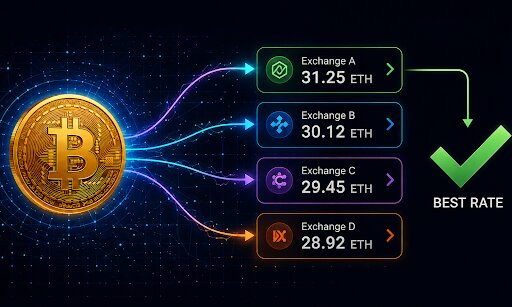
You enter the same amount and crypto pair on two platforms, yet one provider offers noticeably more of the destination asset than the other.
How can the same swap produce two different results?
A crypto swap quote is more than the market price of two assets. It reflects the conditions under which a provider can execute that specific transaction, including available liquidity, spread, network costs, routing, transaction size, rate type, and market conditions at the time of the quote.
For this reason, learning to compare crypto exchange rates means looking beyond advertised fees. What ultimately matters is how much of the destination cryptocurrency you are expected to receive under comparable transaction conditions.
Why Can the Same Crypto Swap Give You Different Results?

There is no single exchange rate that every crypto swap provider must offer. Each provider has its own liquidity sources, pricing structure, and execution process, which can change the final quote.
Liquidity and Transaction Size
Liquidity determines how easily a provider can execute a transaction at a competitive price. Since providers can access different liquidity sources, the same pair and amount may receive different quotes.
Transaction size also matters. A provider that offers an attractive rate for a $500 swap may not remain the best option for a $10,000 transaction because larger trades can interact differently with available liquidity.
This is why the best crypto swap rates cannot be determined from a provider’s general pricing alone. The actual amount you want to exchange matters.
Spread and Provider Pricing
The advertised fee tells only part of the story. A provider can charge a small visible fee while incorporating more of its margin into the exchange rate through the spread. Another provider may show a higher fee but offer a tighter spread and ultimately deliver more crypto.
As a result, comparing fee percentages without comparing the final quote can create the wrong impression about which offer is cheaper.
Network Costs and Routing
Once a swap is completed, the destination cryptocurrency still needs to be sent to your wallet. That transaction has a blockchain cost, and providers may estimate or account for payout-network costs differently. These differences can affect the amount reflected in the quote and, ultimately, the amount you receive.
The route used to complete the exchange can also affect the result. One provider may convert Asset A directly into Asset B, while another may use an intermediate asset before reaching the destination cryptocurrency. Different routes can access different liquidity and introduce different conversion costs.
Quote Timing and Rate Type
Crypto prices and liquidity change continuously, so a quote reflects conditions at a specific moment. If you compare one quote now with another several minutes later, market movement may account for part of the difference. A reliable crypto exchange rate comparison should therefore use quotes generated within a roughly comparable time window.
Rate type matters too. A fixed-rate quote generally locks the quoted exchange amount for a limited acceptance window, subject to the provider’s terms and deposit conditions. A floating rate, by contrast, depends on market conditions at the time the deposit is confirmed. Since these offers involve different pricing conditions, fixed and floating quotes should not be compared as if they were equivalent.
How to Compare Crypto Exchange Rates Properly
Before deciding which provider offers the better deal, make sure you are comparing the same transaction. When you compare crypto swap quotes, keep five variables consistent:
- Input amount: Use the amount you actually intend to swap, as pricing can vary with transaction size.
- Crypto pair: Compare exactly the same source and destination assets.
- Blockchain networks: Make sure both the source and destination networks match because network costs can affect the payout.
- Rate type: Compare fixed quotes with fixed quotes and floating quotes with floating quotes whenever possible.
- Quote timing: Request the offers within the same short period so that they reflect similar market conditions.
Once these variables match, the comparison becomes much more meaningful. The next question is what number you should actually compare.
Why Delivered Crypto Output Is the Metric That Matters
Suppose Provider A advertises a lower fee than Provider B. At first glance, Provider A appears cheaper. However, Provider A may also use a wider spread or account for network costs differently. Provider B could therefore offer a higher expected payout despite showing a larger visible fee.
Consider this simplified example:
| Comparison | Provider A | Provider B |
| Advertised fee | Lower | Higher |
| Spread | Wider | Tighter |
| Expected output | 9.92 units | 10.05 units |
The figures are illustrative, but they highlight the problem with comparing fees in isolation.
A more useful metric is delivered crypto output, meaning the amount of the destination cryptocurrency expected to reach your wallet. This gives you one common figure for comparing providers even when they structure their costs differently.
How Monivo Makes Crypto Swap Comparison Easier
Checking the same transaction manually across multiple providers can quickly become time-consuming. Monivo’s crypto swap comparison simplifies the process by bringing compatible provider quotes together in one place, under the same transaction parameters.
Monivo is a non-custodial crypto swap aggregator that requests quotes from connected providers based on the user’s selected assets, networks, amount, and rate type.
Providers are directly compared only when they return a usable quote for the requested swap. If a provider cannot support the transaction, it may appear as unavailable instead of showing an estimated price. Monivo then ranks compatible offers based on the amount of destination cryptocurrency expected to be credited to the user’s wallet.
This gives users a clearer way to compare crypto swap rates using actual provider quotes and expected output, rather than relying only on advertised rates or headline fees.
Monivo does not add a separate fee or markup to provider quotes. It may earn a commission from the liquidity provider when a swap is completed. Comparable offers are ranked by expected delivered output rather than by provider compensation.
Final Thoughts: Compare the Swap You Are Actually Getting
There is no single provider that offers the best crypto swap rates for every transaction. Quotes can vary based on the amount, assets, networks, liquidity, fees, and market conditions.
That is why a reliable crypto swap comparison should use the same transaction details. When you compare crypto exchange rates, look beyond the advertised fee and focus on the expected delivered crypto output. This gives you a clearer picture of which offer provides better value for your swap.
The post Why the Same Crypto Swap Can Cost More: How to Compare Crypto Exchange Rates Before You Trade appeared first on Ventureburn.