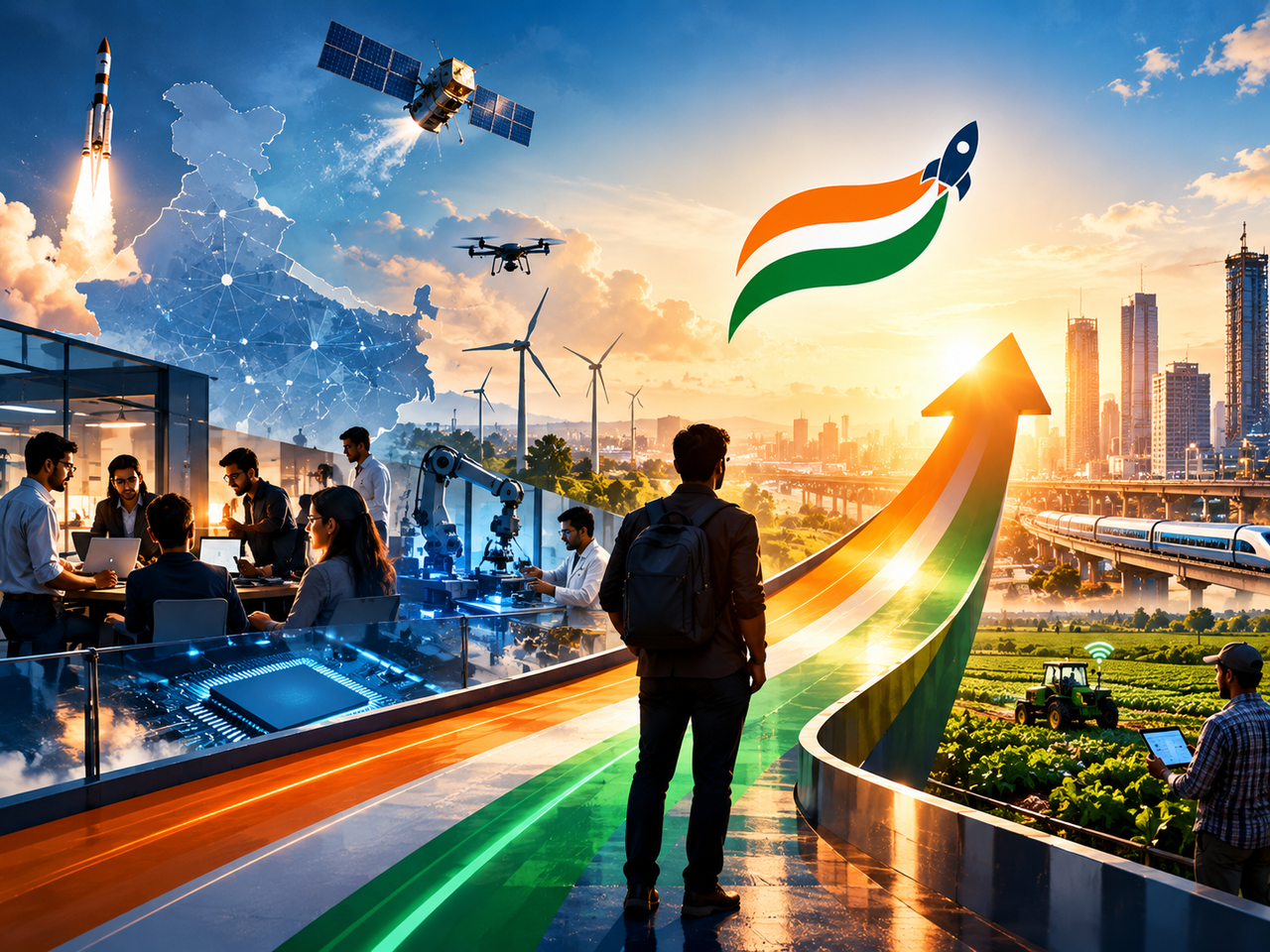

India’s startup ecosystem entered October with a signal that is easy to miss amid the weekly funding headlines: the centre of gravity is moving from raising money to proving that technology can become a business.
The week of September 28 to October 4 saw Indian startups raise fresh capital, but the more consequential developments were elsewhere. A defence-tech startup secured a ₹135 crore Air Force contract, a space startup prepared to put AI computing into orbit, a semiconductor venture partnered with a national research laboratory, and new programmes began pushing DeepTech founders from prototypes towards commercial deployment.
At the same time, startup funding moderated. Indian startups raised about $2.9 billion in Q3 2026, down from $3.5 billion in Q2 and $3.87 billion in Q1. Yet AI, EVs, fintech and DeepTech continued to attract significant investor attention.
The contrast is telling.
India may be entering a phase in which commercial traction, government procurement, industrial partnerships and access to real markets matter as much as another funding round.
The New Startup Test Is Becoming Commercialisation
Take the week’s defence-tech development.
Delhi-based Threye Interactive, a subsidiary of New Space Research & Technologies, secured a ₹135 crore Indian Air Force contract to develop indigenous Mirage 2000 part-task simulators under the Ministry of Defence’s iDEX framework. The technology will allow pilots to rehearse combat scenarios, weapon employment, threat responses and multi-aircraft missions without using operational aircraft.
That is a different kind of startup milestone from a Series A announcement.
The customer is not simply an investor. It is an institutional buyer with an operational requirement.
The same pattern is visible in space.
Hyderabad-based TakeMe2Space is preparing to launch MOI-1A, which it describes as India’s first orbital computing satellite. Instead of sending large quantities of raw satellite data back to Earth, the satellite will allow customers to upload AI models and process data in orbit before transmitting actionable insights. The company says it has already secured 23 customers.
Whether these technologies ultimately scale is still to be proven. But the direction is unmistakable: Indian DeepTech is increasingly being tested against real-world use cases rather than laboratory demonstrations alone.
Capital Is Becoming More Selective, Not Disappearing
The funding numbers provide an important counterpoint.
Q3’s $2.9 billion was lower than the first two quarters of 2026, but the composition of capital is arguably more revealing than the headline decline. Of the quarter’s funding, $1.89 billion came through 46 growth- and late-stage deals, while $1.01 billion was spread across 194 early-stage deals. AI startups alone attracted more than $635 million.
This suggests that India’s funding market is not shutting down. Investors are becoming more discerning about where capital can create durable value.
Arivihan’s $10 million Series A is a case in point. The Indore-based edtech startup plans to expand its AI-powered learning platform across states including Madhya Pradesh, Uttar Pradesh, Rajasthan and Bihar. Around 80% of its subscribers come from Tier-III cities and rural India, giving the funding story a distinctly different geography from the traditional metro-first startup narrative. Startup Scene in India_Bulletin…
Gravity, meanwhile, raised $15 million in equity and debt to build technology and distribution infrastructure for India’s fragmented premium interior-materials market, estimated at ₹3.5 lakh crore.
These are not merely stories about technology attracting capital. They are stories about technology being inserted into large, inefficient markets.
That may be the more durable opportunity.
DeepTech Is Getting Its Own Commercialisation Infrastructure
The ecosystem around DeepTech is also becoming more deliberate.
India is estimated to be mobilising a $25 billion potential investment pool for DeepTech, including government support and private capital, across AI, semiconductors, drones, advanced manufacturing and space technology. The immediate challenge, however, is not just funding research. It is turning research into products, customers and scalable companies. Several initiatives announced during the week point in that direction.
T-Hub launched Flashpoint, a venture studio that will initially focus on agritech and spacetech. Founders retain 100% ownership while receiving access to labs, testbeds, supply chains, industry networks and fundraising support.
GIMS in Greater Noida launched INDIA DESIGN, a hospital-led MedTech innovation initiative designed to take ideas from clinical problems through prototyping, validation, regulatory readiness, manufacturing and scale.
And IIM Kozhikode and Walmart Global Tech launched DEEP LEAP, a ₹2.89 crore, 12-month programme that will select 50 early-stage DeepTech ventures from around 1,500 applicants and provide seed or equity support, product validation, industry connections and go-to-market assistance.
Taken together, these developments point to an emerging layer of startup infrastructure: not just incubators that help founders start, but systems designed to help technologies survive contact with the market.
The Next Wave May Come From Outside the Usual Startup Map
There is another thread running through the week’s developments.
India’s next generation of startups is increasingly being built around problems outside the traditional consumer-internet playbook.
Arivihan is targeting students in smaller cities and rural India. TakeMe2Space is building for satellite applications across agriculture, mining, insurance and supply chains. Spintronics AI is working with CSIR-CEERI on GaN semiconductor technology with applications spanning EVs, renewable energy, telecommunications, defence and data centres.
NPrep is using AI to personalise nursing examination preparation and says its platform has data from more than 2.4 lakh learners.
The common thread is not simply AI.
It is applied technology solving a specific economic or institutional problem.
That distinction could become increasingly important as venture capital becomes more selective. Founders may find it harder to raise large rounds simply on the promise of a technology category. They will increasingly need evidence that the technology can reduce costs, improve productivity, create new markets or solve problems that existing systems cannot.
India’s Startup Ecosystem Is Building the Missing Middle
India has spent the past decade getting very good at creating startups, attracting venture capital and building digital consumer markets.
The harder challenge has always been what comes next: moving from invention to adoption.
The developments of this week suggest that the missing middle is beginning to take shape—through government procurement, corporate partnerships, research collaborations, venture studios, hospital-led validation and specialised DeepTech programmes.
India’s position at 38th in the WIPO Global Innovation Index 2026, while retaining its leadership in South Asia, adds another piece to the story. But rankings and funding numbers ultimately measure potential. Commercialisation measures whether that potential becomes economic value.
That may be the defining startup question for the next phase of India’s ecosystem:
Can Indian founders turn more of the country’s scientific, engineering and entrepreneurial capability into products that governments, businesses and consumers are willing to buy?
The answer will determine whether India’s next startup boom is simply bigger—or genuinely more valuable.