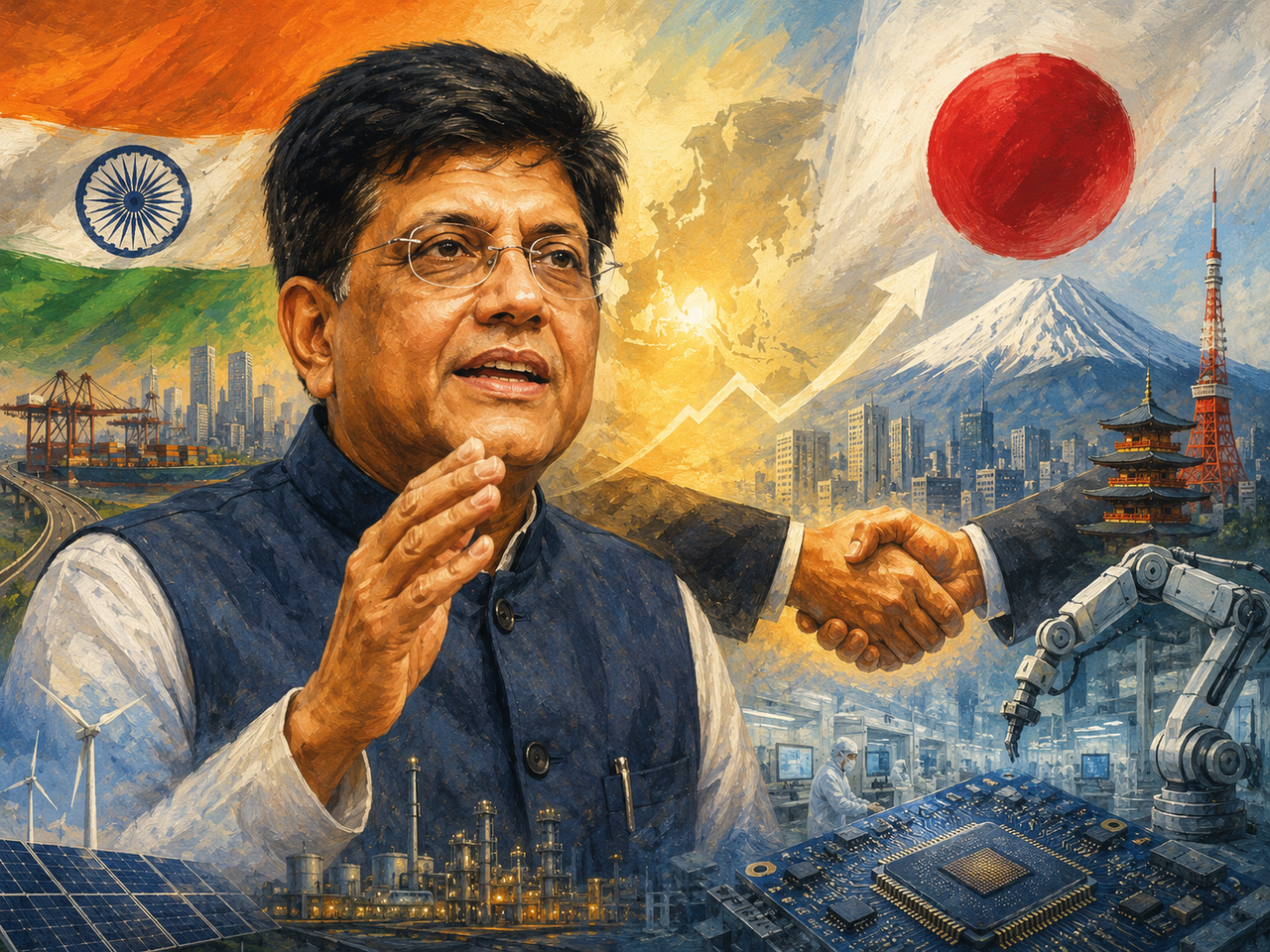

India is looking to turn its growing economic relationship with Japan into a deeper industrial partnership, with Commerce and Industry Minister Piyush Goyal using his latest visit to push Japanese companies and financial institutions to invest more aggressively in India’s next phase of manufacturing and technology growth.
Goyal concluded his Japan visit after meetings in Tokyo, Nagoya and Osaka with senior Japanese government officials, financial institutions and more than 30 major companies. He also led a delegation of more than 200 Indian business representatives from sectors including manufacturing, finance, steel and technology.
The pitch was broader than conventional foreign investment. Semiconductors, artificial intelligence, advanced manufacturing, startups, clean energy and resilient supply chains featured prominently in the discussions.
At the centre of the visit was a target agreed during Prime Minister Narendra Modi’s 2025 Japan visit: JPY 10 trillion in Japanese private investment in India over the next decade.
Goyal’s latest message to Japanese business was straightforward — India wants that capital to move faster.
/fit-in/580x348/filters:format(webp)/tice-news-prod/media/media_files/2026/08/27/goyal-japan-2026-08-27-16-00-21.jpeg)
From Investment Target to Industrial Partnership
The JPY 10 trillion target is ambitious, but the government believes the relationship is already moving in that direction.
During the visit, Goyal said Japanese companies had already invested around ₹1 lakh crore in India, suggesting that the investment target could be achieved considerably earlier than originally envisaged if the current momentum continues.
That changes the nature of the conversation.
The question is no longer simply how much Japanese money can come into India. It is where that capital can create the greatest industrial multiplier.
Goyal’s meetings with institutions including MUFG, Mizuho, Nomura, Nippon Life, Development Bank of Japan and Morgan Stanley MUFG Securities focused on increasing Japanese institutional participation in India’s infrastructure, manufacturing, technology and financial sectors.
There was a similar message in his meetings with Japanese industry.
At Keidanren, Japan’s largest business federation representing more than 1,500 companies, Goyal pushed for greater investment across manufacturing, advanced technology, clean energy, economic security and supply-chain resilience.
For India, Japanese capital offers something beyond financing. Japanese companies bring engineering capabilities, manufacturing processes, supplier networks and long-term industrial relationships that could help India move further up the manufacturing value chain.
/fit-in/580x348/filters:format(webp)/tice-news-prod/media/media_files/2026/08/27/goyal-in-japan-2026-08-27-15-59-09.jpeg)
Semiconductors Give the Partnership a New Strategic Edge
One of the most important parts of the visit was the semiconductor and AI dialogue.
India expects semiconductor demand to reach $150 billion by 2032 and is building its domestic ecosystem around six areas: chip design; semiconductor machinery and materials; fabrication; ATMP and OSAT; research and development; and talent development.
Goyal’s pitch to Japanese companies was built around complementarity.
India has a large pool of young engineering talent and an expanding domestic market. Japan brings advanced manufacturing, engineering and technology capabilities. Bringing those strengths together could create a semiconductor ecosystem that extends beyond chip assembly.
Japanese companies expressed interest in areas including semiconductor materials and equipment, power semiconductors, electronics, AI and related advanced technologies.
The discussions also moved into the less glamorous — but essential — infrastructure required to make semiconductor manufacturing work: reliable electricity, ultra-pure water, skilled manpower and supporting social infrastructure.
Emerging semiconductor clusters such as Dholera and Sanand could become important test cases for this partnership.
The semiconductor opportunity also connects naturally with AI. As computing requirements rise, countries are increasingly competing not just for AI talent and models but for the hardware, power infrastructure and supply chains underneath them.
That makes the India-Japan technology conversation considerably more strategic than a conventional investment pitch.
/fit-in/580x348/filters:format(webp)/tice-news-prod/media/media_files/2026/08/27/india-japan-2026-08-27-16-01-11.jpeg)
A New Bet on Deep-Tech Startups
The startup discussions added another layer to the relationship.
During the Tokyo startup session, India proposed creating a “Deep Tech Capital Corridor” between the two countries, along with a joint startup pitching platform.
The idea addresses a familiar problem for Indian deep-tech founders: research-intensive businesses often need patient capital and long development cycles before they become commercially viable.
Japan’s institutional and corporate capital could potentially fill part of that gap.
For India, the attraction is equally clear. Deep-tech companies in areas such as semiconductors, advanced materials, robotics, AI and industrial technology can strengthen domestic capabilities while creating intellectual property that is harder to replicate than conventional service businesses.
The proposed corridor is still an initiative rather than an established funding channel. Its significance will ultimately depend on whether it produces actual investments, technology partnerships and commercial contracts.
But it signals a shift in what India wants from the bilateral startup relationship — from market access to capital, research and technology collaboration.
/fit-in/580x348/filters:format(webp)/tice-news-prod/media/media_files/2026/08/27/goyal-japan1-2026-08-27-15-59-35.jpeg)
Nagoya Shows Where the Manufacturing Opportunity Lies
The choice of Nagoya for a separate business roadshow was significant.
The Chubu region is one of Japan’s major manufacturing centres, with deep strengths in automobiles, aerospace, machine tools, electronics and engineering.
More than 80 Japanese companies participated in the India-Japan Next Generation Economic Partnership roadshow organised with Chukeiren and other regional business organisations.
Goyal’s proposition was to connect these capabilities with India’s growing manufacturing base, including its Tier-II and Tier-III supplier ecosystem and MSMEs.
This could prove more consequential than attracting a handful of large factories.
India’s manufacturing ambitions depend heavily on the depth of its supplier network. Japanese companies that bring technology, quality systems and process expertise into smaller Indian suppliers can help build capabilities that spread across entire industrial clusters.
That is where the India-Japan relationship could move from individual corporate investments to an industrial ecosystem.
/fit-in/580x348/filters:format(webp)/tice-news-prod/media/media_files/2026/08/27/piyush-goyal-in-japan-2026-08-27-16-02-40.jpeg)
The Test Is Execution, Not the Size of the Target
India’s economic pitch to Japan rests on a favourable set of numbers and structural changes.
Goyal highlighted India’s 7.7% economic growth, its expanding middle class, digital economy, banking system and renewable-energy capacity. He also pointed to India’s ambition of becoming a $30 trillion economy by 2047.
But Japanese investors are likely to judge the opportunity on a more practical set of questions.
Can projects move from agreement to construction quickly? Can India provide reliable infrastructure at emerging industrial clusters? Can supplier ecosystems scale alongside large manufacturers? Can skilled talent keep pace with semiconductor and advanced manufacturing demand?
These questions matter because Japanese investment tends to be closely tied to long-term operational commitments. Capital alone does not create an industrial ecosystem.
Goyal’s Japan visit therefore represents an important evolution in India’s investment diplomacy. The government is seeking not just foreign capital, but industrial capabilities, technology partnerships, institutional investors and deeper integration into global supply chains.
The JPY 10 trillion target gives the relationship a measurable financial ambition. The semiconductor, AI, deep-tech and advanced manufacturing discussions give it a more strategic purpose.
The real measure of success will be what follows the meetings: factories, technology transfers, supplier partnerships, startup funding and new production networks.
If those begin appearing at scale, Japanese investment could become more than another source of foreign capital for India. It could help shape the country’s next industrial wave.