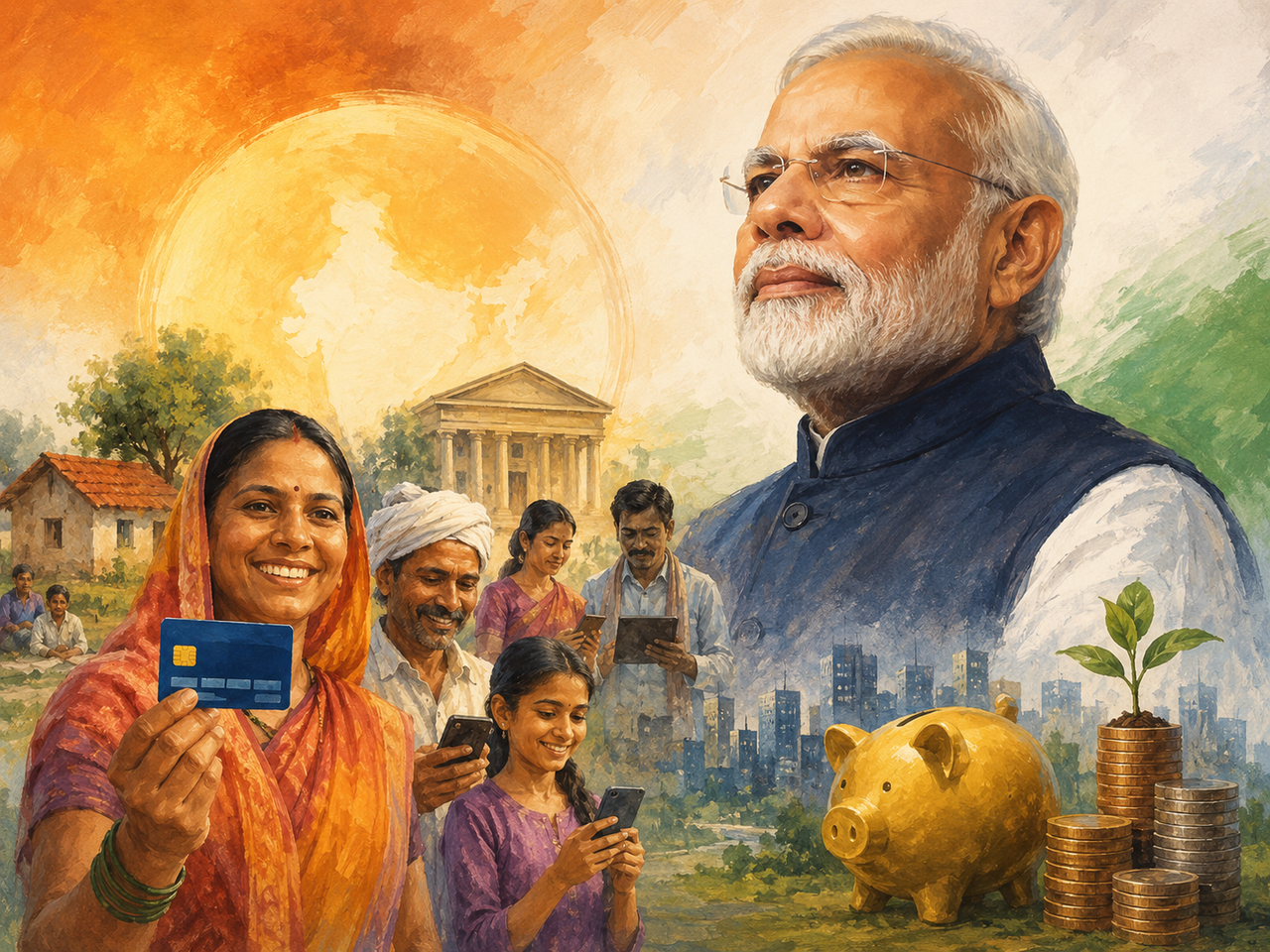

A bank account is easy to take for granted—until you have never had one. For millions of Indians, saving money safely, receiving government assistance directly, accessing insurance, or making digital payments was once constrained by geography and paperwork. The Pradhan Mantri Jan Dhan Yojana (PMJDY) was launched to change that.
Twelve years after its launch on August 28, 2014, the scale of the programme is substantial:
- Total Accounts: 59.09 crore PMJDY accounts opened (as of August 19, 2026).
- Total Deposits: ₹3,16,514 crore held across the system.
- Demographic Reach: 55.7% (32.92 crore) held by women; 77.8% (45.95 crore) in rural and semi-urban areas.
- Average Deposit Growth: Climbed 3.4x over 12 years to reach ₹5,356 per account.
The story, therefore, is no longer simply about opening bank accounts. It is about what has been built around them.
From Account Opening to Financial Participation
When PMJDY began, the immediate objective was to bring unbanked adults into the formal banking system.
The accounts came with no minimum balance requirement and no maintenance charges. Account holders were provided free RuPay debit cards carrying accident insurance cover of up to ₹2 lakh, along with access to an overdraft facility of up to ₹10,000, subject to eligibility.
The accounts also became a channel through which people could access other financial protection schemes, including the Pradhan Mantri Jeevan Jyoti Bima Yojana and Pradhan Mantri Suraksha Bima Yojana, as well as pension and credit facilities.
The numbers suggest that these accounts are becoming more financially meaningful over time.
According to the government, the number of PMJDY accounts has increased 2.3 times over the past 12 years, while deposits have risen 12.8 times. Average deposits per account have increased 3.4 times.
The government describes the rise in average balances as an indication of increased account usage and greater saving habits among account holders.
That is an important shift. The success of financial inclusion cannot ultimately be measured only by how many accounts exist. It also depends on whether those accounts become part of household financial behaviour.
Women and Rural India Remain Central to the Model
The distribution of PMJDY accounts is equally significant.
More than half are held by women, while nearly four out of five are located in rural and semi-urban areas.
That reflects the programme’s original focus on bringing people in far-flung parts of the country into the formal financial system.
For a rural household, a bank account can serve as the entry point for receiving government benefits, building savings and accessing insurance, pension and credit-linked services.
For women, account ownership creates a direct relationship with the formal banking system.
The figures do not, by themselves, tell us how every account is being used. They do show that the programme’s reach extends well beyond India’s traditional banking centres.
The JAM Trinity Changed the Delivery Architecture
The larger policy significance of PMJDY becomes clearer when it is viewed alongside the Jan Dhan-Aadhaar-Mobile (JAM) trinity.
Jan Dhan provides the bank account. Aadhaar provides the identity layer, while mobile connectivity supports communication and digital transactions.
Together, these systems have enabled the government to transfer welfare benefits directly into beneficiaries’ bank accounts.
The government’s description of JAM is straightforward: it provides a mechanism for direct and transparent delivery of financial assistance while reducing the role of intermediaries and delays.
For a country as large as India, that architecture has implications far beyond banking.
It gives government welfare programmes a direct financial channel to households that were previously harder to reach through the formal banking system.
RuPay Adds a Payment Layer
The expansion of RuPay cards provides another measure of the ecosystem’s scale.
As of August 19, 41.29 crore RuPay cards had been issued to PMJDY account holders.
The cards provide account holders with a formal payment instrument and support the broader shift towards digital financial transactions.
This is where the architecture starts to become more than a basic banking programme.
An account provides access. A payment instrument enables transactions. Savings create a financial cushion. Insurance and pension schemes provide protection. Credit can potentially provide the capital needed to expand an economic activity.
Each layer builds on the previous one.
The Next Challenge Is Deeper Inclusion
PMJDY has addressed the first barrier to financial inclusion: access to a bank account.
The next challenge is making that access deeper and more productive.
Accounts need to remain useful. Savings need to grow. Insurance and pension products need to reach people who need them. Credit must become available without creating new financial vulnerabilities. Digital financial literacy will also matter as more transactions move onto digital platforms.
The government’s latest assessment places PMJDY as an entry point to this wider financial ecosystem, with account holders gaining access to savings, insurance, pension and credit facilities, including loans such as those under MUDRA, subject to eligibility.
That could make financial inclusion increasingly relevant to entrepreneurship and household income generation, rather than limiting it to basic banking access.
Twelve Years Later, Jan Dhan Is More Than an Account
The most visible achievement of PMJDY is its scale: 59.09 crore accounts and ₹3.17 lakh crore in deposits.
But its larger significance lies in the infrastructure that has grown around those accounts.
Jan Dhan has become a foundational layer connecting millions of people to formal banking, government transfers, digital payments, insurance, pensions and potential access to credit.
The financial inclusion journey is not finished. Having an account is not the same as having financial security, and access does not automatically translate into economic opportunity.
But the governance change is harder to miss. The state now has a much more direct financial channel through which benefits can reach citizens, while citizens have a formal financial identity through which they can access a wider range of services.
Twelve years after the first accounts were opened, the bank account is no longer simply the destination of financial inclusion.
It has become one of the foundations of how the Indian state delivers.