
Yesterday, I posted a selfie video after watching an advertisement of Google Gemini with Shah Rukh Khan and also a similar advertisement was done by ChatGpt for selling chutney. that made me think about aspiration and entrepreneurship.
Manoj Singh (Founder TICE) who watched my selfie video messaged me:
“I think you should write an article on what you have said in today’s selfie video.”
So here goes.
For more than a decade, we have worked hard to make entrepreneurship aspirational in India.
And perhaps it was necessary.
We needed young people to believe that starting something of their own was a legitimate career choice. We needed families to accept entrepreneurship alongside engineering, medicine, management or a government job. We built startup missions, incubators, accelerators, funding platforms, competitions and celebrated founders as role models.
The startup movement did that remarkably well.
But I increasingly wonder whether we made the wrong thing aspirational. Because entrepreneurship is an outcome. And an uncertain one at that.
Starting a company doesn’t guarantee success. Raising funding doesn’t guarantee success. And being called a “Founder” certainly doesn’t guarantee success.
So why should every young person aspire to become an entrepreneur?
Why shouldn’t we make innovation aspirational?
Why not make creativity aspirational?
Why not celebrate the ability to imagine, build, communicate, design, experiment, question, collaborate and solve?
Why not make skills and capabilities aspirational?
Because these remain valuable irrespective of where someone eventually works.
A creative young person doesn’t necessarily have to start a company. She could transform the company she joins. An innovator could become an entrepreneur or a scientist, filmmaker, designer, teacher, policymaker, engineer, researcher or artist.
And yes, some will eventually become entrepreneurs. Perhaps better entrepreneurs.
I say this as someone who has spent more than 25 years as an entrepreneur and several years working within India’s startup ecosystem.
-Entrepreneurship can be exhilarating. But it can also be uncertain, lonely and unforgiving.
Yet somewhere along the way, we started presenting becoming a founder itself as an achievement.
Maybe we need to shift the aspiration one step backwards.
Instead of telling every young person, “Become an entrepreneur,” perhaps we should say:
Become curious.
Become creative.
Learn to build.
Learn to communicate.
Learn to solve.
Learn to fail and try again.
Learn to turn imagination into something real.
Then let entrepreneurship be one of the choices available to them.
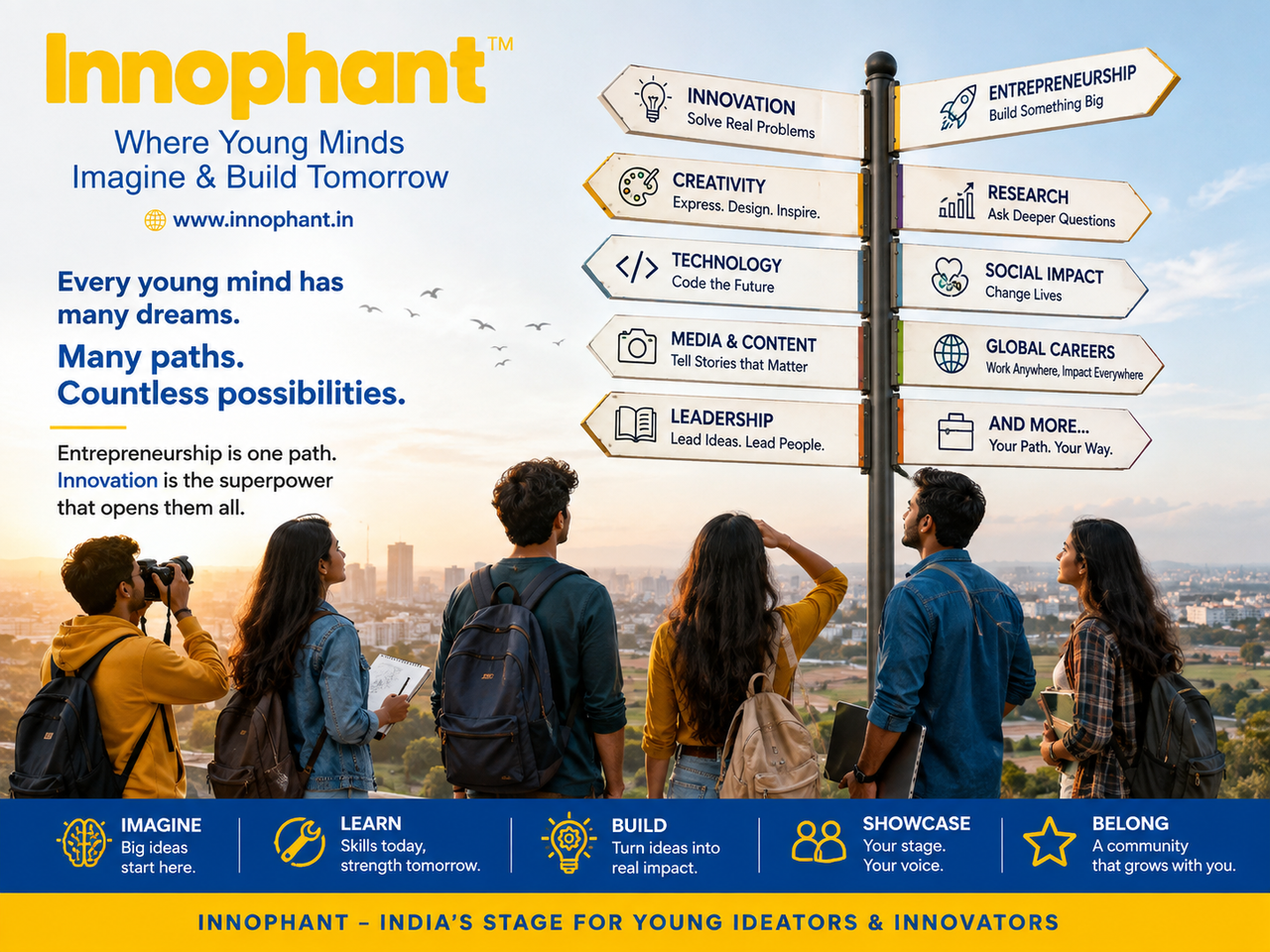
This thinking is also at the heart of why we are building Innophant – a youth innovation and entertainment platform designed to give young minds a place to imagine, learn, build and showcase what they can create.
Our ambition isn’t to turn every young person into a startup founder. It is to help make innovation itself aspirational.
India certainly needs more entrepreneurs.
But India needs something even bigger: millions of young people with the skills, imagination and confidence to create value, wherever they choose to work.
Not everyone can or should become an entrepreneur.
But everyone can learn to innovate. “Sab Entrepreneur Nahin Banenge, but har bachcha Innovator ban Sakta hai”
Perhaps that is what we should make aspirational.
If that idea resonates with you, follow what we’re building at Innophant – Where Young Minds Imagine & Build Tomorrow.