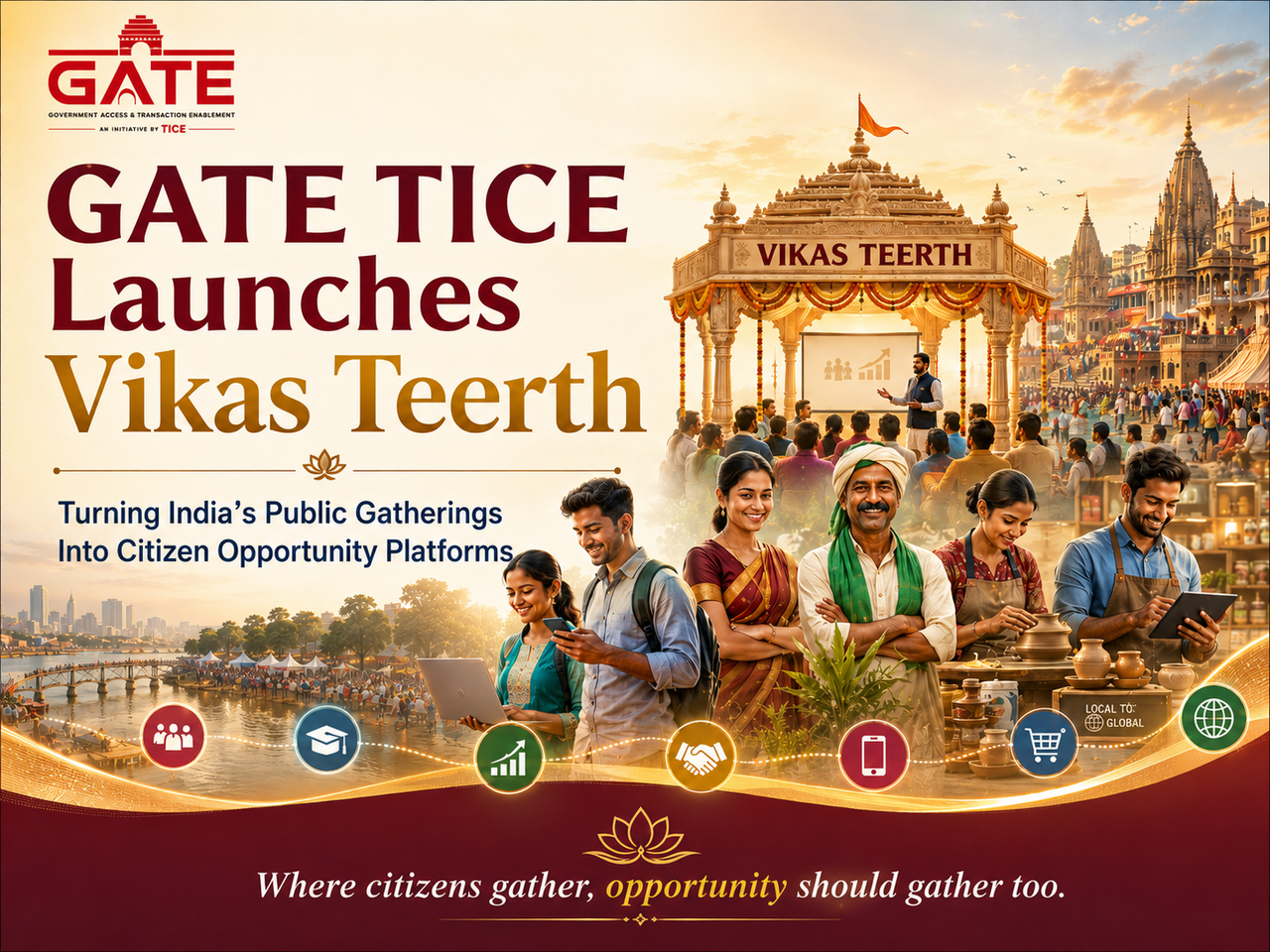

India is a country of gatherings. Every year, 100+ millions of citizens travel for pilgrimages, melas, yatras, temple festivals, cultural congregations. These gatherings are among the largest citizen-contact opportunities in the world.
Yet, most of them are still treated as temporary events.
People arrive, participate, receive basic services, return home and the opportunity to connect them with long-term development pathways is often lost.
To address this gap, GATE TICE has launched Vikas Teerth, a citizen-opportunity initiative designed to convert India’s large public gatherings into platforms for skilling, entrepreneurship, market access, government scheme awareness, livelihoods and measurable development outcomes.
At its core, Vikas Teerth asks a simple but powerful question:
What if every major public gathering also became a gateway to opportunity?
Taking Opportunity Where Citizens Already Gather
GATE: Government Access & Transaction Enablement by TICE, works at the intersection of public procurement, market access, entrepreneurship and government-linked opportunity creation.
With Vikas Teerth, GATE TICE is extending that mission from institutional access to citizen access.
The idea is not to create another government scheme. India already has several schemes and institutional programs across MSMEs, skilling, agriculture, women entrepreneurship, startups, digital inclusion, artisan development, financial access and self-help groups.
The real gap is often not the absence of schemes.
The gap is awareness, access, trust, documentation, handholding and follow-through.
Vikas Teerth is designed to become that missing bridge.
From Teerth to Vikas
Traditionally, a Teerth represents a sacred crossing: a place of faith, renewal and transformation. Vikas Teerth expands that idea for modern India.
It imagines public gatherings not only as places where citizens come for darshan, faith, culture or community participation, but also as spaces where they can discover pathways to jobs, skills, entrepreneurship, support, digital empowerment, market access, financial inclusion and institutional schemes.
In simple terms, Vikas Teerth converts mass footfall into mass empowerment.
The Physical-Digital-Human Model
Vikas Teerth is designed as a physical-digital-human facilitation ecosystem.
-It is not merely a kiosk.
-It is not merely a campaign.
-It is not merely an app.
-It is not merely an information desk.
It brings together on-ground facilitation, multilingual citizen support, digital follow-up and outcome tracking.
The model is built around five key pillars.
1. Opportunity Mandap
A dedicated physical facilitation space where citizens can discover opportunities related to employment, skilling, entrepreneurship, agriculture, MSMEs, women-led enterprises, artisans, digital access and government schemes.
The objective is not brochure distribution. The objective is guided discovery.
2. Vikas Chaupal
Short, practical and interactive knowledge sessions that explain real opportunities in simple language.
These can cover areas such as apprenticeships, digital payments, GeM onboarding, ONDC access, agri-value addition, credit readiness, women entrepreneurship, MSME formalisation, market access, skilling programs and local enterprise creation.
3. Seva Setu
A human-led facilitation layer powered by trained volunteers or field guides who help citizens understand eligibility, documents, registration steps, applications and next actions.
This is where trust is created. For many citizens, a scheme becomes meaningful only when someone explains it patiently in their language.
4. Setu Digital
A simple digital layer that extends the engagement beyond the event through WhatsApp follow-ups, QR-based registration, multilingual information, document checklists, scheme-matching, reminders and training links.
Technology supports the citizen journey, but does not replace human facilitation.
5. Outcome Dashboard
A measurable impact layer that tracks not only how many people visited, but what happened after they engaged.
How many citizens were counselled?
How many registered?
How many were linked to skilling?
How many MSMEs or artisans were onboarded?
How many women-led groups were connected to enterprise support?
How many farmers were linked to market access?
How many applications moved forward after 30, 60 or 90 days?
This makes Vikas Teerth a development-intelligence platform, not just an event activation.
Who Vikas Teerth Serves
The strength of Vikas Teerth lies in its inclusiveness.
It can serve youth looking for jobs, apprenticeships and skills; women entrepreneurs and self-help groups seeking credit, training and market access; farmers looking for value addition and better linkages; artisans seeking visibility and digital commerce; small traders and MSMEs looking for formalisation and procurement access; and rural or tribal communities that need schemes explained in accessible formats.
It also creates opportunities for startups, skilling partners, banks, CSR foundations, local institutions, civil society groups and government departments to work together around measurable citizen outcomes.
A Scalable Public Innovation Platform
While the model is especially relevant for large pilgrimage and cultural gatherings such as Kumbh, Vikas Teerth has been designed as a scalable platform for public events across India.
It can be adapted for:
Kumbh Melas, temple towns, yatras, district fairs, rural haats, tribal festivals, tourism circuits, agriculture expos, MSME camps, CSR livelihood programs, skilling drives, university festivals and government outreach campaigns.
In an agriculture region, it can focus on farmers, FPOs and agri-value chains.
In an industrial town, it can focus on apprenticeships, MSMEs and manufacturing skills.
In a pilgrimage city, it can focus on tourism, hospitality, local enterprise and devotional economy.
In a tribal region, it can focus on welfare access, crafts, forest produce and community enterprises.
In a youth hub, it can focus on innovation, employment and future skills.
This flexibility gives Vikas Teerth national scalability.
Why This Matters for India
India’s next wave of growth will not come only from metros, large corporations or elite institutions. It will come from small towns, district economies, rural belts, women-led collectives, farmer groups, artisans, youth jobseekers, local manufacturers, first-generation entrepreneurs and communities that are ready for opportunity but often lack access.
For many citizens, aspiration already exists. What is missing is the bridge.
Vikas Teerth aims to build that bridge by taking opportunity to places where citizens already gather.
From Attendance to Outcomes
One of the biggest shifts Vikas Teerth proposes is a change in measurement. Public gatherings are often measured by footfall.
Vikas Teerth asks whether they can also be measured by outcomes. Not just how many people came. But how many people discovered a pathway.
How many were guided.
How many were registered.
How many were linked.
How many were followed up.
How many actually benefited.
This approach can help governments, CSR partners, institutions and local ecosystems convert large citizen gatherings into long-term development assets.
With Vikas Teerth, GATE TICE is launching a new citizen-opportunity platform for India’s public gatherings.
The idea is simple, but powerful:
Where citizens gather, opportunity should gather too.
Vikas Teerth will connect faith with livelihood, culture with enterprise, public events with institutional access and citizen participation with measurable development, where a citizen discovers the next step towards their future.
Vikas Teerth is GATE TICE’s attempt to make that future accessible.
If interested to know more write to us on editorial@tice.news