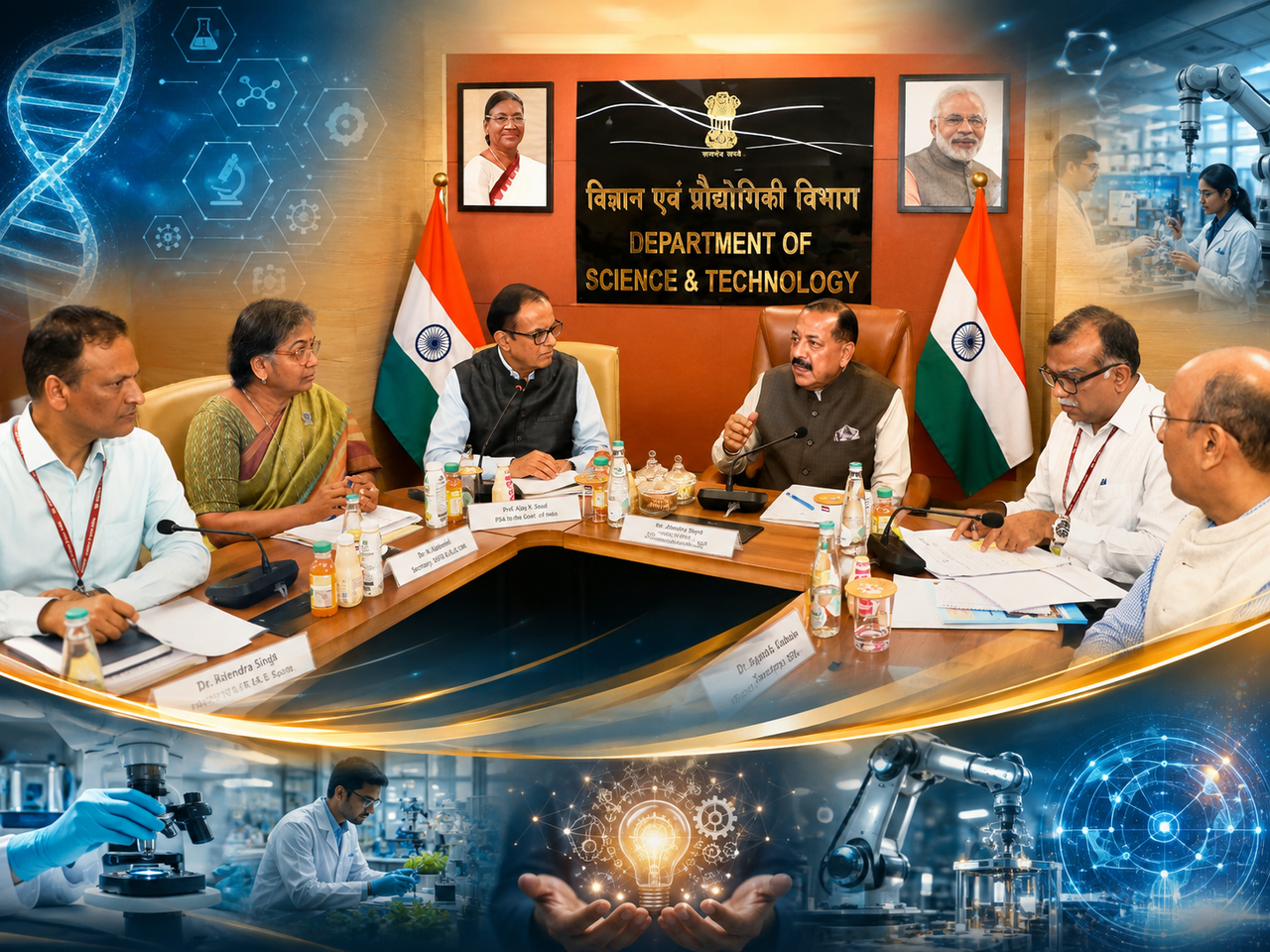

India’s Research, Development and Innovation (RDI) Fund is moving from policy design to actual deployment, with funds already disbursed to some selected companies and the government preparing to appoint a second layer of fund managers within the next two weeks.
The development emerged from the monthly review of science and technology ministries chaired by Union Minister of State for Science & Technology Dr Jitendra Singh on August 19. The review also brought a new focus to one of the most difficult questions around public funding for private innovation: how do you move money quickly enough to help deep-tech companies without compromising safeguards around taxpayers’ money and private capital?
The government says it is trying to solve both sides of that equation.
The RDI Fund framework is being tightened around conflict-of-interest safeguards and due diligence, while officials have also been asked to make fund disbursal faster and more responsive. At the same time, the scope of sectors eligible for support is being reviewed to accommodate emerging strategic technologies, including artificial intelligence.
That makes the latest review more than an administrative progress report. It offers an early indication of how India intends to use public capital to pull private investment deeper into research, technology development and commercialisation.
/fit-in/580x348/filters:format(webp)/tice-news-prod/media/media_files/2026/08/20/jitendra-singh-2026-08-20-09-36-59.jpg)
The First Test Is Not Raising Money. It Is Moving It
The RDI Fund is designed around a relatively simple proposition: government funding should help attract private capital into areas where the technology risk is high and conventional financing may be reluctant to enter.
But putting that proposition into practice is considerably harder.
Officials told the minister that disbursals to some selected firms have already been completed, while payments to the remaining selected companies are being processed. The first round of application assessment has also been completed, with positive recommendations ready for eligible applications.
Dr Jitendra Singh has now pushed for faster timelines.
The reason is obvious. For a startup or technology company working on a complex product, a delayed investment can be almost as damaging as a rejected one. Research teams have salaries to pay, prototypes to build and laboratories to operate. Technology windows can also close quickly.
The minister was told that 50% of the investment is expected to come from private equity sources, making the fund a shared financial responsibility rather than a government-only exercise. He stressed that due diligence cannot be compromised, but timely release of funds is equally important if companies are expected to move ahead.
That balance will be one of the first real tests of the RDI architecture.
India Is Expanding the Definition of Strategic Technology
The other significant change is happening on the sectoral side.
Inter-ministerial consultations have been conducted to widen the areas that can receive support under the RDI framework. Ministries were asked to identify technologies of national importance that may not have been adequately covered by the original sector list.
An expert committee subsequently recommended expanding the scope.
The logic is straightforward: technology cycles are moving faster than policy cycles.
Artificial intelligence is a case in point. A framework designed around yesterday’s strategic technologies can quickly become outdated when new areas emerge. The review specifically recognised the need for flexibility as technologies evolve, including AI.
For India, this flexibility could be important.
Deep-tech companies often operate in areas where commercial applications are still developing. Their technologies may eventually find use in defence, healthcare, manufacturing, energy, agriculture or space, but identifying those applications at the beginning is not always easy.
A broader RDI framework gives policymakers more room to back technologies before their commercial market becomes obvious.
/fit-in/580x348/filters:format(webp)/tice-news-prod/media/media_files/2026/08/20/dr-jitendra-singh-2026-08-20-09-38-35.jpg)
The Missing Link Is Often Commercialisation
India has never been short of publicly funded scientific research.
The harder problem has been moving promising technologies from laboratories into the market.
The review meeting offered an interesting snapshot of that challenge through Sah-SANKALP, a resource book featuring technologies developed through government-supported research.
Of the 60 technologies showcased, 56 have already been deployed at the grassroots level, while 41 have reached Technology Readiness Levels of 8 or 9—an indication that they are close to, or have reached, practical deployment.
There is also evidence of market interest. CSIR has reported interest from enterprises and entrepreneurs in 38 of the technologies, with potential users being connected to the relevant laboratories.
Those numbers point to a familiar gap in India’s innovation ecosystem.
Creating technology is one challenge.
Finding someone willing and able to use it at scale is another.
The RDI Fund’s significance will ultimately be judged by whether it can narrow that distance—from research to prototype, prototype to product, and product to market.
The Government Wants Science to Become Easier to Discover
The review also covered something that is often treated as peripheral to innovation policy: communication.
The government wants science ministries and laboratories to coordinate more closely on communicating research achievements, technology transfers and industry collaborations. The emphasis is shifting towards short-form digital content and platforms capable of reaching researchers, entrepreneurs, industry and citizens directly.
A proposed digital library of science and technology success stories would create a common repository of validated material from government laboratories and institutions. The proposed format includes short videos of around two to three minutes that individual laboratories could contribute.
It is a small but telling change.
Scientific discovery has little economic value if potential users do not know it exists.
For startups and industry, knowing which technologies are available, which laboratories developed them and how they can be licensed or adopted can be as important as the technology itself.
/fit-in/580x348/filters:format(webp)/tice-news-prod/media/media_files/2026/08/20/jitendra-singh-meeting-2026-08-20-09-37-40.jpg)
The Next Phase Will Test Whether Public Capital Can Create Private Innovation
The government is also preparing for the Emerging Science, Technology and Innovation Conclave (ESTIC) 2026, scheduled for October 27–29 at Bharat Mandapam in New Delhi.
Three Nobel laureates and three other international award recipients have confirmed participation. The exhibition is expected to have up to 150 stalls, including government departments, an ESTIC Innovation Booth, sponsors and selected deep-tech startups. More than 120 invitations have been issued, with 73 acceptances recorded so far.
Other initiatives reviewed during the meeting include the Swachh Sagar Surakshit Sagar Campaign 2026, planned across 111 beaches, and the proposed monthly ‘Vigyan Ki Baat’ lecture series beginning August 29.
But the RDI Fund remains the more consequential experiment.
India is trying to make private capital a larger participant in research and development while retaining public oversight over how that capital is deployed.
That creates an unusual policy challenge. The government has to be cautious enough to protect public money, but agile enough not to make the innovation process bureaucratic.
The success of the RDI Fund will therefore not be measured simply by how much money it disburses.
It will be measured by what that money unlocks.
If public capital can bring private investors into difficult technologies, help companies cross the gap from research to commercialisation and do so without compromising transparency, India may have found a more effective way to finance its next generation of deep-tech businesses.
The real test begins when the money leaves the government system and reaches the laboratory, the startup and ultimately the market.