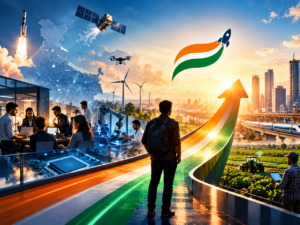

India’s startup and business ecosystem is navigating a phase of measured recovery and structural transformation. While capital is cautiously returning, regulatory oversight is tightening and sectors like AI, EV, and climate tech are emerging as clear front-runners. At the same time, government policy continues to play a defining role in shaping competitive dynamics across industries.
Here’s a detailed look at the top developments shaping India Inc today.
Top News of the Day
1. Government Moves Closer to Digital Competition Law
India is accelerating efforts to introduce a Digital Competition Bill, aimed at regulating large technology platforms and preventing anti-competitive practices. The proposed framework is expected to introduce ex-ante regulations, meaning Big Tech companies may be required to comply with rules before violations occur—marking a shift from reactive to preventive regulation.
For startups, this could be a significant unlock. Founders have long raised concerns about platform dominance, preferential treatment, and data control by global tech giants. If implemented effectively, the law could create fairer market access, especially in e-commerce, app ecosystems, and digital advertising.
2. Early-Stage Funding Shows Signs of Revival
After a prolonged funding winter, India’s startup ecosystem is showing early signs of capital recovery, particularly in seed and Series A rounds. Several startups across SaaS, AI, and fintech infrastructure have closed fresh rounds, indicating that investors are re-entering the market—but with sharper filters.
Unlike the 2021 funding boom, investors are now prioritising unit economics, revenue visibility, and sustainable growth. While late-stage funding remains cautious, this renewed early-stage activity suggests that innovation pipelines are active again, setting the stage for the next wave of scalable startups.
3. RBI Maintains Balanced Policy Outlook
The Reserve Bank of India is maintaining a cautiously optimistic stance on monetary policy, supported by stable inflation trends and resilient economic indicators. While there is no immediate signal of aggressive rate cuts, the central bank’s approach suggests predictability—something businesses and investors value highly.
For startups and SMEs, this means borrowing costs may remain stable in the near term, enabling better financial planning. The RBI’s stance also reflects confidence in India’s macroeconomic fundamentals amid global uncertainty.
4. EV Ecosystem Gets Fresh Policy Tailwinds
India’s electric vehicle ecosystem continues to gain momentum, backed by new policy incentives and stronger state-level adoption frameworks. The focus is now shifting beyond vehicle sales to infrastructure development—particularly battery technology, charging networks, and fleet electrification.
Startups operating in EV infrastructure are seeing increased investor interest, while logistics and mobility players are accelerating EV integration into their fleets. This signals a transition from early adoption to ecosystem-scale expansion.
5. Indian AI Startups Gain Global Investor Attention
India’s AI startup ecosystem is witnessing a surge in global investor interest, especially in areas like generative AI, enterprise automation, and vernacular AI solutions. With India’s large and diverse user base, startups are uniquely positioned to build AI products tailored for non-English and mass-market use cases.
Investors are particularly bullish on B2B AI applications, where startups are solving for efficiency, cost optimisation, and workflow automation. This trend positions AI as not just a buzzword, but a core driver of the next startup growth cycle.
6. ONDC Expands Footprint Across Retail and Logistics
The Open Network for Digital Commerce continues to scale its ecosystem by onboarding more sellers, logistics providers, and buyer apps. The government-backed initiative is steadily building an interoperable e-commerce network, aimed at reducing the dominance of centralized platforms.
For small businesses and kirana stores, ONDC offers greater visibility and control over digital commerce participation, while startups are exploring new opportunities in network enablement, logistics tech, and seller services.
7. Fintech Faces Increasing Regulatory Tightening
India’s fintech sector is entering a phase of heightened regulatory scrutiny, particularly in digital lending. Authorities are pushing for greater transparency, stricter KYC norms, and clearer customer disclosures, following concerns around predatory practices.
While this may slow down aggressive growth strategies, it is expected to strengthen long-term trust in the ecosystem. Startups with strong compliance frameworks are likely to emerge as category leaders in a more regulated environment.
8. IPO Market Shows Signs of Reopening
India’s IPO pipeline is gradually building up, with several late-stage startups preparing for public listings in late 2026 or early 2027. Improved market sentiment and stronger public market performance are encouraging companies to revisit listing plans that were previously delayed.
However, unlike earlier cycles, companies are expected to go public with clear profitability roadmaps and stronger financial discipline, reflecting a more mature approach to public market entry.
9. PLI Scheme Continues to Attract Global Manufacturers
India’s Production Linked Incentive (PLI) schemes are gaining traction, drawing global manufacturing players in sectors like electronics, semiconductors, and renewable energy. As companies look to diversify supply chains beyond China, India is positioning itself as a strategic manufacturing hub.
This shift is also creating opportunities for deeptech and industrial startups, particularly in supply chain innovation, automation, and component manufacturing.
10. Startup Layoffs Begin to Stabilise
After nearly two years of restructuring and cost-cutting, layoffs across the startup ecosystem are showing signs of stabilisation. Companies have largely completed their efficiency-driven corrections, focusing now on sustainable growth rather than hyper-scaling.
This marks a psychological shift within the ecosystem—from survival mode to measured expansion and operational discipline.
11. Edtech Reinvents Itself with Hybrid Learning Models
India’s edtech sector is undergoing a strategic reset, with startups increasingly adopting hybrid models that combine offline centres with digital platforms. This shift is driven by the need to rebuild consumer trust, improve outcomes, and ensure consistent revenue streams.
Companies are also focusing on outcome-based learning and test prep, moving away from broad, high-burn expansion strategies seen during the pandemic years.
12. Climate Tech Emerges as a Strong Investment Theme
Climate tech is fast becoming one of the most attractive sectors for venture capital, with startups working across clean energy, carbon tracking, EV infrastructure, and sustainable agriculture gaining traction.
As ESG commitments strengthen globally, investors are looking at India as a high-impact, high-growth market for climate innovation—making this space one to watch closely in the coming years.
Conclusion
Today’s developments highlight a clear trend: India’s startup ecosystem is moving from excess to efficiency, from hype to durability. With stronger regulatory frameworks, sector-specific momentum, and a renewed focus on fundamentals, the ecosystem is entering a more resilient and globally competitive phase.
The next wave of growth will likely be led not just by capital, but by credibility, compliance, and category-defining innovation.