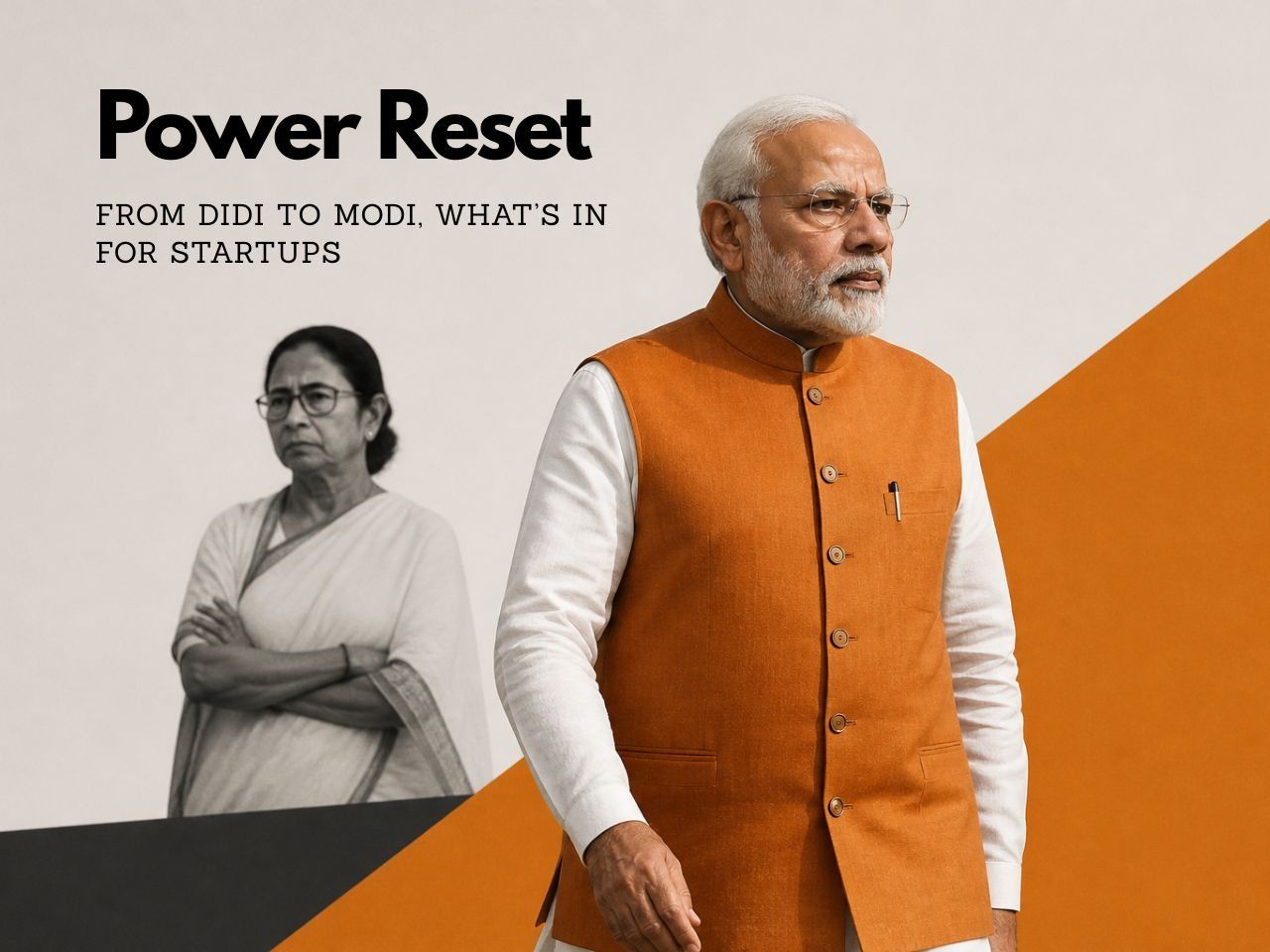

The West Bengal Elections 2026 Results have triggered a historic political shift, with the Bharatiya Janata Party (BJP) unseating Mamata Banerjee and ending the decade-long dominance of the All India Trinamool Congress (TMC).
The outcome marks more than a change in leadership—it signals a potential economic reset. With the incoming government expected to align closely with Prime Minister Narendra Modi’s national growth agenda, West Bengal’s startup ecosystem may be entering its most decisive phase of expansion.
A High-Growth Ecosystem That Hit a Ceiling
Even before the political transition, West Bengal had quietly built one of India’s fastest-growing startup ecosystems.
The state hosts 5,240+ DPIIT-recognised startups, including 2,728 women-led ventures, making it one of the most inclusive innovation ecosystems in the country. Kolkata ranks 9th nationally and features among the top 300 global startup cities.
The growth metrics are compelling:
- 45.6% annual growth rate (2025)
- $250+ million raised (2014–2024)
- Strong sectoral presence across food-tech, fintech, deep-tech, logistics, and D2C
Startups such as Wow! Momo, StockEdge, SastaSundar, and Snap-E Cabs have already established Bengal’s credibility on India’s startup map.
At the macro level, the state economy reinforces this momentum:
- GSDP growth: 7.62% (above national average)
- Unemployment: 4.14% (well below India’s 7.93%)
- Labor participation: Higher than the national average
Yet, despite strong fundamentals, a ceiling remained.
No unicorns.
Limited Series B funding.
Persistent regulatory friction.
West Bengal was growing—but not scaling.
BJP’s Victory Changes the Startup Equation
The BJP’s victory in the 2026 elections could prove to be the inflection point the ecosystem has long awaited.
For years, founders and investors argued that policy alignment with the Centre would unlock Bengal’s full potential. With BJP now in power both in Delhi and Kolkata, that alignment becomes structural.
Early signals suggest a pivot toward a more aggressive pro-business framework. Three shifts are expected to redefine the startup landscape:
Capital Access Will Expand
The lack of growth-stage capital has been Bengal’s biggest bottleneck. Greater integration with national funding mechanisms and global investors could unlock stronger Series B and late-stage funding pipelines.
Faster, Simpler Governance
Entrepreneurs have consistently cited bureaucratic delays. A streamlined, digitized, and time-bound regulatory system could significantly improve the ease of doing business.
Expansion Beyond Kolkata
While Kolkata remains dominant, the next wave of growth is expected from Tier-2 and Tier-3 cities, driven by district accelerators and enhanced digital infrastructure.
However, the transition brings its own challenges.
The Mamata Banerjee-led TMC government focused heavily on welfare and grassroots delivery. Moving toward a more market-driven model will test administrative capacity—especially with public debt nearing ₹7.7 lakh crore. The success of this shift will depend not on intent, but on execution.
A Breakout Decade in the Making
If policy intent translates into consistent execution, West Bengal could be on the verge of a startup surge.
Key sectors are primed for expansion:
- Food-tech & D2C: Scaling to global markets
- Fintech: Strengthening through national integration
- Deep-tech & AI: Leveraging institutions like IIM Calcutta and IIT Kharagpur
- EV & Logistics: Accelerating with India’s mobility transition
The long-standing absence of a billion-dollar startup may also be addressed. With improved capital access and investor confidence, industry experts believe West Bengal could produce its first unicorn within the next 3–5 years.
As India’s 6th largest economy, West Bengal already has the scale and sectoral diversity to support this transition. However, its per capita income remains below the national average, underscoring the need for high-growth sectors to drive inclusive prosperity.
The 2026 election outcome, therefore, represents more than a political shift—it marks a potential economic inflection point. The ecosystem is built, the talent is ready, and the growth momentum is visible. With policy alignment now falling into place, West Bengal stands at a rare moment where execution alone will determine whether it merely grows—or emerges as one of India’s most powerful and unexpected startup engines.