You connect your wallet, set up a trade, and hit confirm, then you see it. A $25 fee to swap $100 worth of tokens. If you have ever wondered what is a gas fee in crypto, it is exactly this sudden cost. Or worse: you try to mint an NFT during a hot launch and the gas fee alone costs more than the NFT itself. This is the experience that frustrated Ethereum users for years and sent millions of traders looking for alternatives.
What is a Gas Fee in Crypto? (Meaning & Definition)
A gas fee is the cost you pay to have a transaction processed on a blockchain network. The gas fee meaning originates from Ethereum, where “gas” describes the unit of computational effort required to execute an operation sending tokens, interacting with a smart contract, or minting an NFT.
Think of gas fee meaning like postage. When you mail a package, the postal service charges based on weight and destination. On a blockchain, you pay based on how much computational work your transaction demands. Simple token transfers cost less. Complex multi-step smart contract interactions cost considerably more.
What is gas in crypto at a technical level? It’s a metering system that allocates network resources fairly. Without what is gas in crypto, anyone could flood the network with endless transactions for free, grinding it to a halt. Crypto gas fees prevent spam by making every computation cost something, paid in the network’s native coin.
How Do Crypto Gas Fees Work?
Every time you interact with a blockchain swapping tokens, providing liquidity, buying an NFT, or sending ETH to another wallet your transaction must be validated and added to a block. The validators who do that work are compensated with gas fees. Without that incentive, they’d have no reason to process your transactions ahead of anyone else’s.
Why Do Gas Fees Exist? (Validators & EVM)
The Ethereum Virtual Machine (EVM) is the engine running every smart contract on Ethereum. Every line of code it executes costs a fixed amount of gas. The more complex your transaction, the more EVM operations it triggers, and the higher your gas fee in crypto becomes.
After Ethereum’s EIP-1559 upgrade in August 2021, the fee structure changed significantly. Every transaction now has two components: a base fee set automatically by the network based on demand and permanently burned from ETH’s supply and an optional priority fee or “tip” paid directly to validators for faster block inclusion. The base fee adjusts automatically: when blocks are consistently full, it rises; when blocks are empty, it falls.
Supply and Demand (Network Congestion)
Blockchain block space is finite. Ledger’s Solana vs Ethereum performance guide puts Ethereum’s mainnet throughput at roughly 15–30 transactions per second. When demand from users, DeFi protocols, and NFT launches exceeds that capacity, transactions queue up in the mempool.

Image from CoinLaw
Why Are Ethereum Gas Fees So High?
The direct answer to why gas fees are so high on Ethereum is that it is the most used smart contract blockchain in the world, running on infrastructure that processes far fewer transactions than it receives requests for during peak periods.
CoinLaw’s gas fee volatility report shows DeFi protocols consume over 40% of Ethereum block space due to the computational complexity of their smart contract operations. Median DeFi transaction costs stayed above $5 in 2025 even as simple transfers dropped below $1. The more a transaction asks the EVM to do, the more gas it burns.
That said, ETH gas fees have come down within what is gas fee in crypto. CoinLedger’s Ethereum fee research shows average gas prices were around 72 gwei in early 2024. After the Dencun upgrade in March 2024, they fell roughly 95% down to 2.7 gwei by 2025. February 2025 average fees were $0.76, compared to $24.25 in February 2021, a decline of over 96% in four years.

Image from CoinLedger
How Are Gas Fees Calculated? (Gwei to Gas Fee Example)
The formula behind gas fee crypto transactions is:
Gas Fee = Gas Used × (Base Fee + Priority Fee)
Bitget’s ETH gas fee guide shows that each transaction type has a fixed gas unit requirement. A standard ETH transfer requires 21,000 gas units. A token swap runs between 100,000 and 150,000 units. An NFT mint can exceed 200,000 units depending on the contract logic. All these are involved in what is gas fee in crypto.
Here’s a real example using 2025 network conditions:
- Transaction: Sending 1 ETH to another wallet (21,000 gas units)
- Base fee: 10 gwei (network-set)
- Priority fee: 2 gwei (your tip for faster confirmation)
- Calculation: 21,000 × 12 = 252,000 gwei = 0.000252 ETH
- Cost at $4,000 ETH: approximately $1.01 total
Gas Fees Across Popular Blockchains
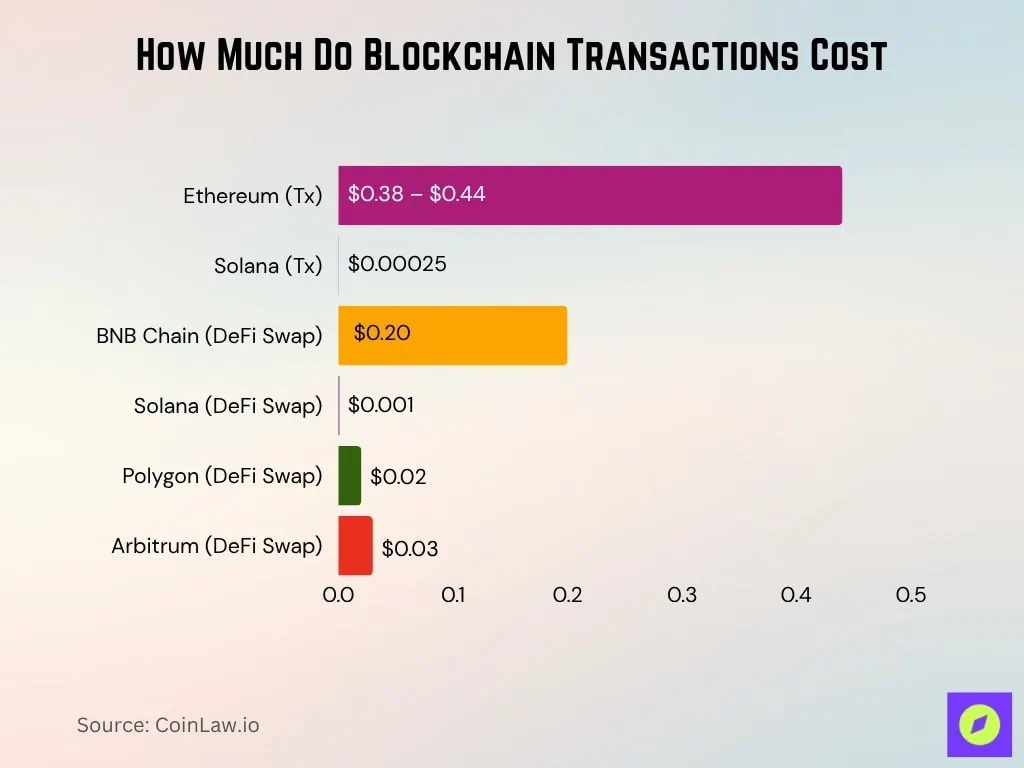
One of the most practical things to understand about crypto gas fees is how dramatically they vary across blockchains. Based on August 2025 data from a comprehensive gas fee comparison across chains, here is how the major networks compare:
- Ethereum mainnet: $0.44 average per transaction. Higher for DeFi and NFT interactions.
- Arbitrum (Ethereum L2): $0.0088 per standard transaction. DeFi swaps cost around $0.03. CoinLaw’s L2 gas fee statistics show Arbitrum averaged ~0.1 gwei throughout 2024.
- Polygon: $0.0009 average. CoinLaw’s Polygon vs Ethereum report shows over 83% of Polygon transactions cost less than $0.01.
- BNB Chain: $0.05–0.20 depending on complexity. DeFi swaps average $0.20.
- Avalanche: $0.01–0.10 per transaction.
- Solana: $0.00025 per transaction. Spark’s blockchain fee comparison confirms Solana holds the lowest L1 fees of any major network.

Image from Spark
5 Ways to Reduce and Avoid High Gas Fees Crypto
High Ethereum gas fees aren’t inevitable. These five strategies make a measurable difference in what you actually pay.
1. When Are ETH Gas Fees Lowest? (Timing Your Trades)
Timing is the simplest and most immediately accessible way to cut ETH gas fees. Network congestion follows predictable patterns tied to global trading hours.
Bitget’s gas tracker data shows fees are consistently lowest between 2:00 AM and 6:00 AM UTC, when US, European, and Asian markets are all relatively quiet.
2. Use Layer 2 Solutions (Arbitrum, Optimism)
To know why are gas fees so high, moving to a Layer 2 is the single biggest lever for reducing crypto gas fees. Arbitrum, Optimism, and Base are all Ethereum-compatible, the same wallet, the same applications, at a fraction of the cost.
3. Choose Low-Fee Blockchains
For some use cases, the simplest answer to high gas fee crypto costs is choosing a structurally cheaper chain. If you’re trading frequently or sending micro-transactions, Solana’s $0.00025 per transaction makes it far more cost-efficient than any Ethereum-based solution for high-frequency activity.
Polygon is the go-to for NFTs and payments at scale. BNB Chain is cheap for DeFi if you’re comfortable with its more centralized validator set. Checking out the best exchange for crypto arbitrage can also help you identify multi-chain platforms that let you route trades through the cheapest network for any given transaction.
4. Monitor Gas Trackers & Heatmaps
To know why are gas fees so high, gas trackers give you real-time visibility into current Ethereum gas fees and help you choose the right moment to transact.
5. Adjust Your Gas Limit Manually
Most wallets set a gas limit automatically, but you can override it manually for non-time-sensitive transactions. Setting a lower priority fee or even zero tip during low-congestion periods means your transaction confirms at the base fee only, with no extra cost for speed you don’t need.
Conclusion: Managing Your Crypto Gas Costs
What is a gas fee in crypto, ultimately? It’s the price of computation, the fee that keeps validators running, the network secure, and the blockchain functional. Without gas fees, blockchains couldn’t exist in their current form.
The good news is that Ethereum gas fees in 2025 are a fraction of what they were at their 2021 peak. CoinLedger’s research confirms the 96% decline over four years. Layer 2 networks have made Ethereum-level security accessible at near-zero cost. Alternative L1s offer even cheaper options for specific use cases.
Whether you’re doing your first on-chain swap or managing a high-frequency DeFi strategy, understanding crypto gas fees is foundational.
FAQs About Gas Fees in Crypto
What is a gas fee in crypto in simple terms?
A gas fee is a payment you make to validators for processing your transaction on a blockchain. The more computational work your transaction requires, the higher the gas fee in crypto you pay. Think of it as a processing charge tied directly to transaction complexity.
What is gas fee on Ethereum specifically?
It is a cost paid in ETH, denominated in Gwei, calculated as the gas units used multiplied by the sum of the base fee and your priority tip. The base fee is burned, while the priority fee goes to the validator who includes your transaction.
Why are gas fees so high sometimes?
What are gas fees in crypto are so high when network demand exceeds block space. During NFT launches, DeFi events, or major market moves, thousands of users compete for limited transaction slots. That competition drives up what are gas fees in crypto, making the overall Ethereum gas fees spike for everyone on the network.
The post What is a Gas Fee in Crypto? (Meaning & How to Save) appeared first on Ventureburn.