By Jonatan Randin, Senior Market Analyst, PrimeXBT
A figure went round earlier this year claiming whales had bought roughly 270,000 BTC inside thirty days. It got picked up everywhere. It also resurfaced at least three times over several months with a different date attached each time, and tracing it back leads to an aggregator nobody would cite for anything else. No named wallet size. No methodology. Just a large number that confirmed what people already wanted to believe.
That is roughly the state of accumulation coverage in both of the markets worth examining here.
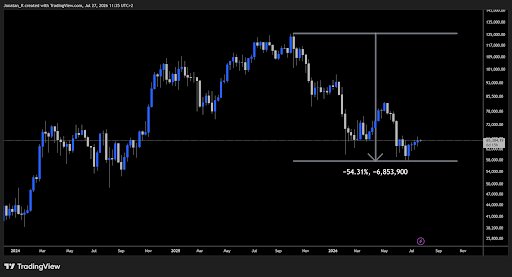
Bitcoin (BTC) is down around 54% from its October 2025 peak above $125,000. Gold (XAU) is off roughly 29% from the intraday record of $5,595.47 set on 29 January. Two very different assets, both having a difficult year, and in both cases the reassurance offered against the price action is identical. The patient money is still buying.
It probably is. That isn’t really the issue. The issue is how little of it anyone can actually see.

Image from TradingView.

Image from TradingView.
The Comparison Everyone Reaches For
The gold roadmap argument has become hard to avoid. It runs something like this.
Central banks became the dominant buyer of gold from 2022 onwards. They buy to meet reserve targets rather than to make a return, so their demand is largely indifferent to price. Early on, buyers who did care about price sold into that demand and kept a lid on things. Once that selling dried up, the price moved.
Applied to Bitcoin, spot exchange-traded funds (ETFs) and corporate treasuries take the central bank role, which places the market somewhere mid-process with the acceleration still ahead.
The mechanism holds up. The harder questions are whether Bitcoin has the buyer this requires, and whether gold’s buyer is as steady as the framework needs it to be.
Who Is Actually Buying Bitcoin
Long-term holders, meaning wallets that have held coins for at least 155 days under Glassnode’s definition, have moved from net selling back to net buying. The 30-day net position change is positive, somewhere in the region of 50,000 to 100,000 BTC.
Worth setting against the comparable phases in November 2024 and May 2025, when the same measure ran close to 400,000 BTC.
The breakdown by wallet size is where it gets more interesting. Glassnode’s Accumulation Trend Score rates each group of holders by balance and recent buying on a scale of zero to one:
- Under 1 BTC: around 0.8 to 0.9
- 100 to 1,000 BTC: around 0.8 to 0.9
- 1 to 10 BTC and 10 to 100 BTC: around 0.6 to 0.7
- 1,000 to 10,000 BTC: around 0.5 to 0.6
- Above 10,000 BTC: close to neutral

Image from Glassnode.
The buying weakens as the wallets get larger. The addresses that actually justify the word whale have been more or less sitting on their hands, and the accumulation drawing the headlines is coming mostly from the smallest wallets on the network. That is a different story. Arguably a better one, depending on the value placed on retail conviction. It just isn’t the one being reported.
The ETF Channel Is Not a Patient Buyer
June was the worst month on record for US spot Bitcoin ETFs, with roughly $4.5 billion pulled. Citi cut its twelve-month inflow forecast to zero.
Then it turned. By late July, Glassnode was describing ETF flows as positive again, in what it called the strongest positioning shift of the year, with shorts closing out and hedges coming off alongside.

Image from CoinGlass
Both readings are accurate, a few weeks apart, and that is the difficulty with placing ETFs in the central bank role. Reserve managers do not behave this way. A source of demand that swings from record outflow to the year’s strongest inflow shift inside a month is following price rather than absorbing it.
Gold’s Price-Insensitive Buyer Sold 129 Tonnes
The gold side of the comparison has a problem of its own.
In Q1 2026, central banks sold 129 tonnes. Türkiye accounted for 60 of that in March alone. Net reported purchases across every reporting institution came to 16 tonnes.
Sixteen.
The World Gold Council’s own estimate for the same quarter is 244 tonnes of net buying, up from 208 tonnes in Q4 2025. So which figure is real?
Both are technically true. Reporting purchases to the International Monetary Fund (IMF) is voluntary. There is no obligation, a good deal goes undeclared, and the World Gold Council builds the higher number by working backwards from London over-the-counter (OTC) activity and trade flows through the Swiss refineries. That is a defensible method and it is probably closer to the truth than 16 tonnes. It remains a reconstruction, and it circulates as though somebody counted.
Nobody Mentions That Central Banks Used to Sell
The other omission in the roadmap version concerns what central banks were doing before 2022.
Selling. Consistently, for around two decades. Enough of it that fifteen European central banks signed the Washington Agreement in September 1999 purely to cap collective sales at 400 tonnes a year, because uncoordinated disposals were driving the price into the floor. Gold bottomed near $250 an ounce in that period. Not until 2010 did central banks become reliable annual net buyers.

Image from Visual Capitalist. Data: Metals Focus, Refinitiv GFMS, World Gold Council, as at 31 December 2022.
So the institutions now credited with putting a floor under gold are the same ones that spent twenty years holding the ceiling down. Nothing about the institutions changed. Their reserve policy did.
For anyone using gold’s ownership as a model for Bitcoin’s, that is the part of the model that matters most, and it is the part that gets left out.
Two Markets, Two Different Blind Spots
The two markets fail to show the buyer in completely opposite ways, which is easy to miss when they get compared.
Gold settles privately, through dealers and vaults, so the transaction itself is hidden and flows have to be worked out afterwards from refinery throughput and OTC activity. Bitcoin settles in public, so every transaction is visible permanently and it still isn’t possible to say with confidence who sits behind any of it, because the groupings shift when exchanges reshuffle wallets, when custodians consolidate addresses, or when an address gets relabelled. One market hides the trade. The other hides the trader.
A smaller version of the same problem shows up in the price data. Gold prices for about 23 hours a day, five days a week, while Bitcoin never stops, so any comparison between the two depends on how you treat the hours when one of them is closed. Bitcoin’s weekend moves have no gold counterpart to be measured against.
That is beginning to change. Gold 24/7 pricing has appeared across a growing number of venues, which means exposure can be adjusted while the traditional market is shut rather than waiting for Sunday’s reopening and accepting whatever level appears. It does not make the Monday gap disappear, since the underlying market still reprices when it returns and weekend conditions are typically thinner than weekday ones. But a market long defined by its opening hours is gradually becoming one that never fully closes, which narrows a structural difference between gold and Bitcoin that used to be taken for granted.
PrimeXBT is among the brokers offering 24/7 Gold trading, allowing traders to move between Bitcoin and Gold within the same platform while keeping a crypto-native workflow through crypto-denominated accounts. For traders comparing the two assets as complementary stores of value, the ability to trade both on a similar schedule removes one of the practical differences that historically separated them.
What This Adds Up To
Accumulation data tells you selling has stopped. It does not tell you a bottom is in. The two get conflated constantly, and Glassnode’s own framing is careful on the point: shifts from selling to buying tend to appear during periods of weakness, as long-term investors build while shorter-term participants reduce risk. That describes exhausted sellers. It says nothing about who arrives next, or when, or at what price.
None of this amounts to a call. The absorption through June appears real and both markets may well be building a base. The narrower point is that the accumulation story is being asked to carry more weight than the underlying data can hold, in both of them.
When the next headline of this kind goes past, three questions are worth asking. Which size of holder. Measured how. And set against what flows moving the other way.
The answer is usually less impressive than the headline.
Trade Bitcoin and Gold 24/7 with PrimeXBT.
About PrimeXBT
PrimeXBT is a global multi-asset broker and crypto asset service provider trusted by traders in more than 150 countries. The platform bridges traditional and digital markets within one integrated environment, redefining versatility and innovation in online trading. Clients can access Forex, CFDs on indices, commodities, shares, crypto, and Crypto Futures, as well as buy, store and exchange cryptocurrencies. This unified experience extends across both the native PXTrader 2.0 platform and MetaTrader 5, supported by advanced risk-management tools and a wide range of funding options in crypto, fiat and local payment methods. Since 2018, PrimeXBT has focused on empowering traders through broad multi-asset access, fair and transparent conditions, professional-grade technology and dedicated human support. By combining expertise, trust and a client-first approach, PrimeXBT sets a benchmark of excellence in the financial industry and provides traders with the tools they need to trade, grow and succeed with confidence.
Disclaimer: The content provided here is for informational purposes only and is not intended as personal investment advice and does not constitute a solicitation or invitation to engage in any financial transactions, investments, or related activities. Past performance is not a reliable indicator of future results. The financial products offered by the Company are complex and come with a high risk of losing money rapidly due to leverage. These products may not be suitable for all investors. Before engaging, you should consider whether you understand how these leveraged products work and whether you can afford the high risk of losing your money. The Company does not accept clients from the Restricted Jurisdictions as indicated on its website / T&Cs. Some products and services, including MT5, may not be available in your jurisdiction. The applicable legal entity and its respective products and services depend on the client’s country of residence and the entity with which the client has established a contractual relationship during registration.
The post PrimeXBT: What “Accumulation” Really Tells You About Bitcoin and Gold Right Now appeared first on Ventureburn.