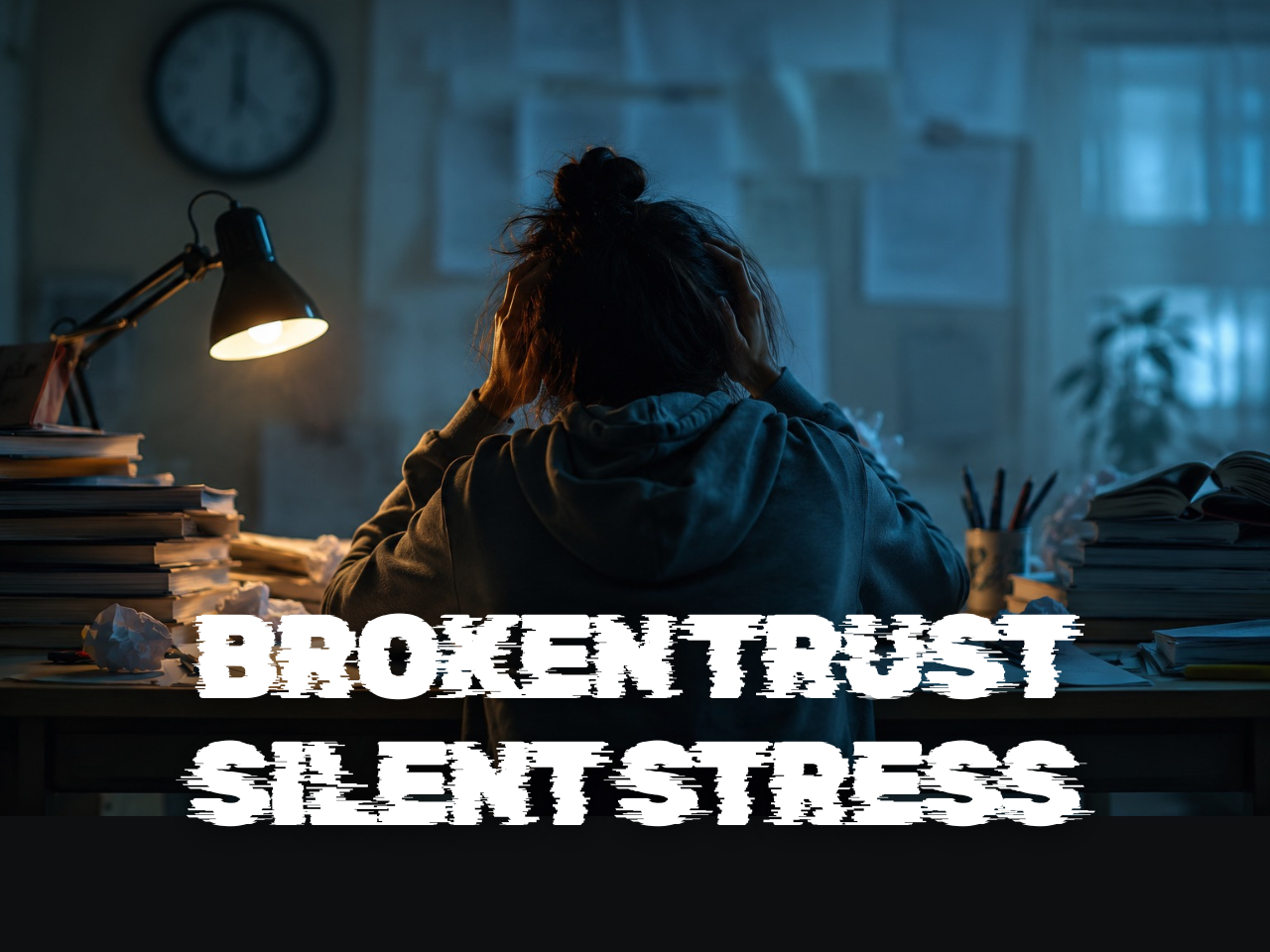

Examination paper leaks have once again become a national talking point.
Every time allegations of leaked question papers surface, public attention quickly turns to investigations, accountability and examination reforms. Politicians demand answers. Authorities promise action. Social media erupts with anger. News debates focus on who is responsible and how future breaches can be prevented.
These conversations matter.
Yet amid the outrage, one group often finds itself missing from the centre of the discussion: the students.
For millions of young people, competitive examinations represent years of preparation, family sacrifices and hopes for a better future. When the integrity of those examinations is called into question, the consequences extend far beyond scores, rankings and admission lists.
They reach the mind.
Anxiety, uncertainty, loss of confidence and emotional exhaustion are increasingly becoming the hidden costs of examination scandals. While paper leaks are often treated as administrative failures, their impact on student mental health receives far less attention.
Ananya, a 20-year-old dental aspirant, knows exactly what that feels like.
A Dream Interrupted
Ananya had spent nearly eighteen months preparing for a highly competitive entrance examination.
Her daily routine revolved around lectures, mock tests, revision schedules and relentless self-discipline. Like thousands of students across the country, she viewed the examination as a gateway to her future.
When she finally completed the exam, she felt a sense of relief. Months of preparation had culminated in a single day.
Then the reports began to emerge.
News channels suggested that the question paper may have been leaked. Social media filled with speculation. Discussions of cancellations and re-examinations dominated public discourse.
But Ananya was not thinking about investigations or policy failures.
She was struggling with a far more personal question:
“If the system fails, does my hard work still matter?”
Her question reflects a reality faced by countless students whenever examination integrity is compromised.
More Than an Administrative Failure
Paper leaks are often discussed as governance failures, legal violations, or institutional lapses. While these dimensions are important, they do not fully capture the experience of students.
For many young people, competitive examinations represent years of preparation, financial investment, family expectations, and personal sacrifice. When the credibility of an examination is compromised, students experience not only disappointment but also uncertainty, helplessness, frustration, and a loss of confidence.
From a psychological perspective, uncertainty is one of the strongest triggers of stress.
A poor examination result may be painful, but it provides closure. Students know where they stand and what they need to improve. A paper leak offers no such certainty. Instead, students are left waiting for decisions they cannot influence—whether the examination will be cancelled, repeated, or accepted as valid.
This prolonged ambiguity can significantly intensify emotional distress.
Why Uncertainty Hurts So Much
Medical and psychological research has consistently shown that uncertainty can be more stressful than bad news itself.
When outcomes remain unclear, the brain continues searching for answers and possible threats. Stress pathways remain activated. Cortisol and other stress hormones remain elevated, affecting both mental and physical well-being.
This is why students caught in paper leak controversies often describe a familiar pattern. Sleep becomes disrupted. Concentration weakens. Anxiety lingers long after the examination day has passed. Some struggle to focus on future preparation because they remain emotionally tied to an examination whose status is still uncertain.
Over time, emotional exhaustion can begin to replace determination.
For vulnerable individuals, these symptoms may progress into more significant mental health concerns, including anxiety disorders and depressive symptoms. The psychological burden becomes even greater when students are required to repeat months of intensive preparation because examinations are postponed or cancelled.
/fit-in/580x348/filters:format(webp)/tice-news-prod/media/media_files/2026/06/10/paper-leak-effect-2026-06-10-22-06-35.png)
When Self-Esteem Becomes a Casualty
Perhaps the most overlooked consequence of paper leaks is the damage they inflict on self-esteem.
Students often build confidence around effort, discipline, and achievement. They believe that persistence and hard work will eventually produce results.
Examination irregularities challenge that belief.
When students perceive that unfair advantages may have been obtained by others, they may begin questioning not only the fairness of the system but also their own place within it. Over time, frustration can evolve into self-doubt.
The issue extends far beyond academics.
Self-esteem influences motivation, resilience, decision-making, and psychological well-being. A student who loses confidence in the fairness of the system may gradually lose confidence in themselves.
When Hard Work No Longer Feels Enough
One of the most damaging effects of paper leaks is the way they weaken motivation.
Psychologists have long observed that motivation is sustained when people believe their efforts will lead to meaningful outcomes. Students preparing for competitive examinations live by this principle. Every hour spent studying is an investment in a future they hope to build.
Paper leaks disrupt that fundamental relationship.
When students see months of preparation thrown into uncertainty by factors beyond their control, many begin questioning whether continued effort is worthwhile. What starts as disappointment can gradually turn into emotional fatigue. Some struggle to return to their previous study routines. Others experience procrastination, disengagement, or academic burnout.
The effects can persist long after an examination is rescheduled.
A leaked paper can be replaced.
Lost confidence is much harder to restore.
What Students Can Hold On To
While students cannot control institutional failures, they can take steps to protect their mental well-being.
The first and perhaps most important reminder is that a compromised examination cannot erase acquired knowledge, discipline, critical thinking skills, or personal growth. Preparation itself remains valuable.
Students may also benefit from focusing on process-based goals rather than outcomes alone. Completing study targets, mastering difficult concepts, and maintaining consistency can help restore a sense of control during uncertain times.
Equally important is caring for physical and mental health. Regular exercise, adequate sleep, balanced nutrition, and mindfulness practices can help reduce stress and strengthen emotional resilience.
Seeking support should never be viewed as weakness. Conversations with parents, teachers, mentors, friends, or mental health professionals can often prevent frustration from becoming overwhelming.
Students should also be mindful of excessive exposure to rumours and speculation. During periods of uncertainty, social media can amplify anxiety rather than provide clarity. Relying on verified information and official updates is often healthier than constantly chasing new developments.
Students Cannot Carry This Burden Alone
When an examination system fails, the responsibility should not quietly shift to students.
Young people are often told to be resilient, adapt, and move on. Resilience is important. But resilience cannot become an excuse for institutional failures.
Educational institutions and policymakers have a responsibility not only to strengthen examination security but also to protect student well-being during periods of uncertainty.
Timely communication, transparent decision-making, accessible counselling services, and stronger support systems can significantly reduce emotional distress. Students deserve clarity, empathy, and reassurance—not prolonged silence.
Paper leaks are not merely administrative incidents. They affect the emotional health of an entire generation of students striving to build their futures.
What Gets Lost Between the Headlines
Every paper leak eventually becomes yesterday’s news.
The television debates end. Investigations continue. Public attention moves on to the next controversy.
Students, however, do not move on so easily.
Many continue carrying the stress, uncertainty, and disappointment long after the headlines disappear. Some recover quickly. Others spend months rebuilding confidence in a system they once trusted.
As a public health professional, I believe this is the part of the story we often miss.
Examination reforms are necessary. Stronger security systems are necessary. Accountability is necessary.
But so is protecting the mental well-being of the young people whose futures depend on these examinations.
An examination may determine a score or a rank.
What ultimately shapes a student’s future is the belief that effort still matters.
The moment young people begin to lose that belief, the damage extends far beyond any examination hall.
About the Author
/fit-in/580x348/filters:format(webp)/tice-news-prod/media/media_files/2026/05/20/dr-swati-kandpal-2026-05-20-21-10-53.png)
Dr. Swati Kandpal, BDS, MPH, is a Public Health Professional, researcher and health writer with over five years of experience in health and wellbeing. She writes on public health, mental wellness and holistic healing, focusing on evidence-based, practical and compassionate health awareness.
References: Lyndon MP, Strom JM, Alyami HM, et al. The relationship between academic assessment and psychological distress among medical students: A systematic review. Perspectives on Medical Education. 2014;3:405–418.