
For years, Khadi was largely seen as a symbol of India’s freedom movement — deeply respected, culturally significant, but often viewed as a traditional sector operating on the margins of the modern economy.
That perception is now changing at an unprecedented pace.
Behind the quiet growth of India’s rural economy, the Khadi and Village Industries Commission (KVIC) has emerged as one of the country’s most significant grassroots economic engines, creating jobs, supporting women entrepreneurs, empowering artisans and pushing rural manufacturing into the mainstream.
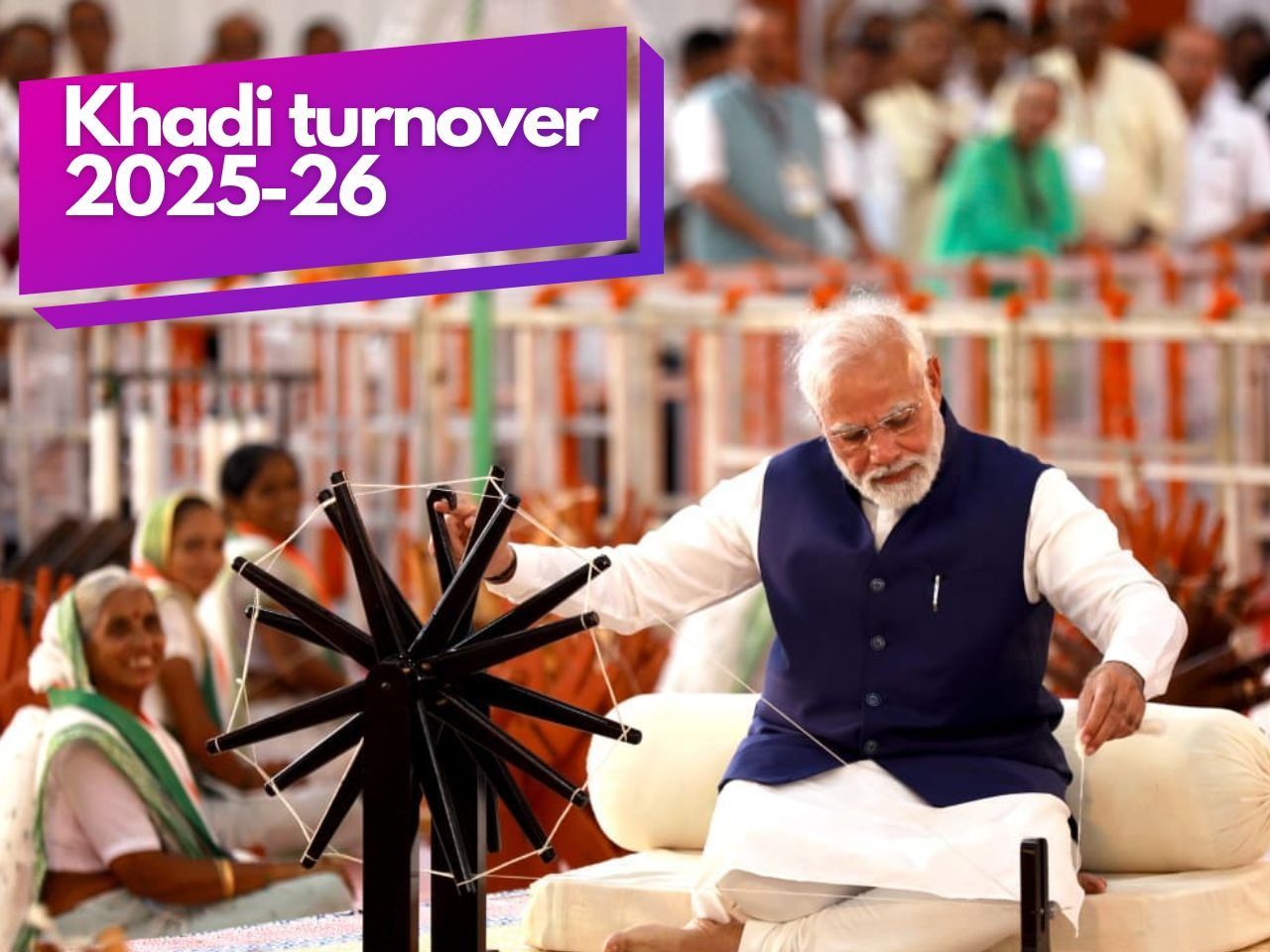
In a landmark milestone for the sector, KVIC has recorded its highest-ever performance across production, sales and employment generation during FY 2025-26, with the Khadi and Village Industries ecosystem crossing a historic turnover of Rs 1.87 lakh crore for the first time.
The achievement signals something much bigger than just strong annual numbers. It reflects the growing commercial relevance of India’s rural economy at a time when the country is increasingly focusing on self-reliance, local manufacturing and grassroots entrepreneurship.
The provisional figures, released at Gandhi Darshan in Rajghat, New Delhi, show how a sector once associated mainly with hand-spun fabrics has now evolved into a massive employment and enterprise ecosystem touching millions of lives across rural India.
A Sector That Expanded Five Times in Just Over a Decade
According to KVIC data, total sales of Khadi and Village Industries products surged to Rs 1,87,105 crore in FY 2025-26, compared to Rs 31,154 crore in 2013-14. That marks a massive growth of nearly 501 percent over the last 12 years.
Production also saw a sharp jump during the same period, rising from Rs 26,109 crore to Rs 1,25,296 crore, reflecting growth of almost 380 percent.
KVIC Chairman Manoj Kumar described the achievement as a major milestone towards the vision of Viksit Bharat@2047, saying the growth reflects the strengthening of rural entrepreneurship and self-reliance across the country.
Officials attributed the expansion to policy pushes such as Aatmanirbhar Bharat, Vocal for Local and Local to Global, along with increasing public support for indigenous and locally manufactured products.
But beyond the policy slogans, the numbers reveal a deeper shift taking place in India’s rural business ecosystem.
Village Industries Are Becoming a Massive Rural Growth Story
While Khadi continues to remain the emotional and cultural face of the movement, the biggest growth is now coming from village industries.
From food processing and honey production to pottery, handmade goods, rural manufacturing and small-scale enterprises, village industries have become one of the strongest contributors to local economic activity in rural India.
The figures show that production in the village industries segment increased from Rs 25,298 crore in 2013-14 to Rs 1,21,322 crore in FY 2025-26 — a growth of around 380 percent.
Sales in the segment rose from Rs 30,073 crore to Rs 1,79,236 crore during the same period, registering an increase of nearly 496 percent.
More importantly, the sector is now becoming a major employment generator.
Employment under village industries increased from 1.19 crore people in 2013-14 to nearly 1.99 crore people in FY 2025-26.
That scale is significant, especially at a time when rural livelihood generation and non-farm employment have become central economic priorities for India.
KVIC said rising demand for traditional and locally manufactured products under initiatives like Aatmanirbhar Bharat and Ghar-Ghar Swadeshi has strengthened rural manufacturing ecosystems and local markets across the country.
Employment Crosses the Historic 2 Crore Mark
Perhaps the biggest takeaway from the latest data is the scale of employment generation.
Total cumulative employment under Khadi and Village Industries activities has now crossed 2 crore people for the first time, reaching 2.04 crore in FY 2025-26, compared to 1.30 crore people in 2013-14.
That represents growth of nearly 56 percent over the past 12 years.
At a time when India is aggressively pushing entrepreneurship-led economic growth, KVIC’s expanding footprint highlights how rural enterprise ecosystems are quietly becoming one of the country’s largest livelihood creators.
Unlike high-growth startup sectors concentrated in urban centres, the KVIC ecosystem operates deep inside rural India — where access to capital, market linkages and infrastructure has historically remained limited.
The growing scale of the sector now shows how policy support, local manufacturing demand and grassroots entrepreneurship are combining to create sustainable rural economic opportunities.
PMEGP Emerges as a Large-Scale Rural Entrepreneurship Platform
A major contributor to this growth has been the Prime Minister’s Employment Generation Programme (PMEGP), which continues to support rural entrepreneurs through financial assistance and enterprise development.
During FY 2025-26 alone, KVIC established 66,494 new units under PMEGP. For these enterprises, margin money subsidy worth Rs 2,457 crore was disbursed against loans amounting to Rs 7,375 crore.
These businesses collectively generated employment opportunities for over 7.31 lakh people during the financial year.
Since the launch of PMEGP, the scale of the programme has become massive.
According to KVIC data, over 10.84 lakh units have been established across India so far under the scheme. Loans worth Rs 80,705 crore have been facilitated with margin money subsidy support of Rs 29,623 crore, creating employment opportunities for nearly 97.95 lakh people.
For India’s rural economy, PMEGP is increasingly functioning as more than just a subsidy programme. It is becoming an entrepreneurship pipeline that enables small local businesses to emerge in semi-urban and rural markets.
Technology and Toolkits Are Modernising Rural Enterprise
Another notable aspect of KVIC’s growth story is the increasing focus on modernisation and productivity enhancement through the Gramodyog Vikas Yojana.
Under the scheme, more than 3.23 lakh machines, equipment and toolkits have been distributed to artisans and entrepreneurs so far.
These include electric pottery wheels, bee boxes, agarbatti manufacturing machines, footwear repair kits, paper plate making machines and toolkits for electricians, plumbers, tailors and mobile repair technicians.
During FY 2025-26 alone, KVIC distributed 37,769 machines and equipment to rural artisans and entrepreneurs.
The focus on modern tools reflects an important shift in the government’s approach towards rural industries — moving from welfare-driven assistance towards productivity-led economic participation.
For many artisans and micro entrepreneurs, access to better equipment directly impacts production capacity, product quality and earning potential.
Women Are Becoming the Backbone of the Khadi Ecosystem
One of the strongest themes emerging from KVIC’s latest performance data is the growing role of women entrepreneurs and artisans.
During FY 2025-26, nearly 79,682 trainees received training under various KVIC programmes. Out of these, 47,382 were women, accounting for almost 59 percent of total trainees.
Under PMEGP alone, 28,180 women entrepreneurs established business units during the year, generating employment opportunities for over 3.09 lakh women.
KVIC also noted that women now constitute more than 80 percent of the nearly five lakh artisans working in the Khadi sector.
This makes the Khadi ecosystem one of the country’s largest women-led rural employment platforms.
At a time when women-led entrepreneurship is becoming a major policy focus, the data indicates that rural enterprise ecosystems may already be creating large-scale participation opportunities far beyond urban startup hubs.
Khadi Itself Is Seeing a Strong Revival
While village industries drove much of the overall growth, the Khadi textile segment itself also witnessed remarkable expansion.
Khadi production increased from Rs 811 crore in 2013-14 to Rs 3,974 crore in FY 2025-26, registering growth of around 390 percent.
Sales of Khadi textiles jumped from Rs 1,081 crore to Rs 7,869 crore during the same period, reflecting a sharp increase of nearly 628 percent.
Officials said continuous promotion of Khadi by Prime Minister Narendra Modi has played a major role in expanding consumer acceptance and strengthening the market for indigenous products both domestically and internationally.
Over the last decade, Khadi has gradually repositioned itself from being viewed purely as a symbolic product to becoming part of India’s broader sustainable and conscious consumption movement.
Rising Wages Reflect Growing Rural Demand
The growth of the sector is also translating into higher earnings for artisans.
KVIC reported that wages paid to artisans increased from Rs 4 per hank in 2013-14 to Rs 15 per hank in FY 2025-26 — a rise of around 275 percent.
Government procurement of Khadi and Village Industries products reached Rs 92.08 crore during the year, while exhibition and marketing activities generated sales worth Rs 30.83 crore.
Even Khadi National Flags recorded rising demand.
Sales increased from Rs 0.87 crore in 2013-14 to Rs 2.35 crore in FY 2025-26, reflecting the growing impact of campaigns such as Har Ghar Tiranga and increasing public engagement with Khadi products.
More Than Just Khadi
What makes KVIC’s latest milestone particularly important is that it reflects the growing commercialisation of India’s rural economy.
The sector today is no longer limited to spinning wheels and handwoven fabric. It represents a large and expanding ecosystem of rural manufacturing, micro-enterprises, women-led businesses, artisan networks and grassroots entrepreneurship.
At a time when India is trying to create inclusive economic growth beyond metropolitan startup hubs, KVIC’s numbers suggest that some of the country’s biggest entrepreneurship stories may actually be unfolding in villages, small towns and rural production clusters.
And with turnover now crossing Rs 1.87 lakh crore and employment surpassing 2 crore people, the Khadi and Village Industries ecosystem is increasingly emerging not just as a cultural movement — but as one of rural India’s most powerful economic growth engines.