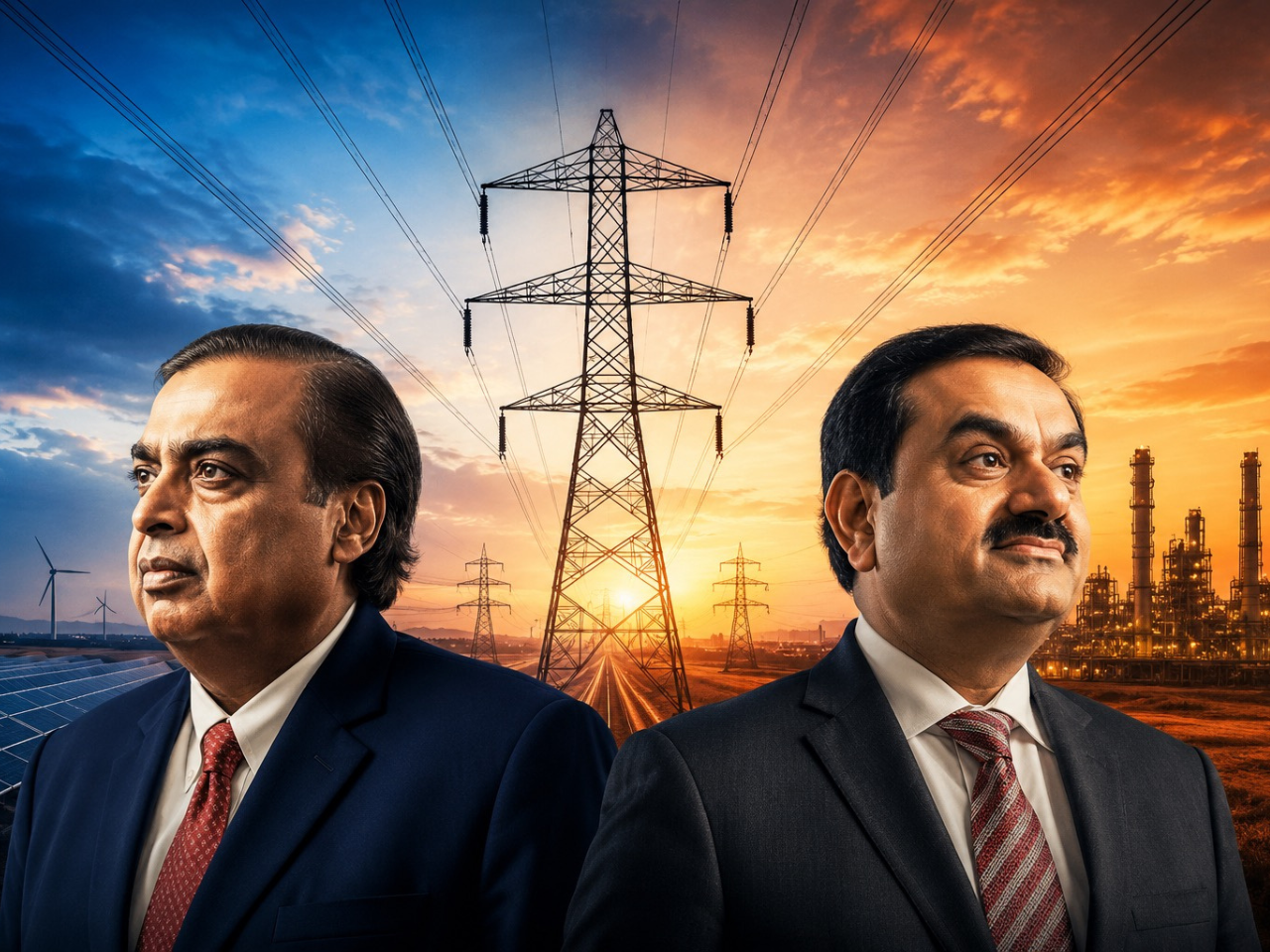

Two of India’s biggest business groups are quietly building separate electricity highways across Gujarat—and almost nobody is talking about it.
One will be part of the national transmission network. The other will be a dedicated private corridor built for captive use.
Together, they offer a glimpse into how India’s clean energy transition is reshaping not just power generation, but also the infrastructure that carries electricity across the country.
The story gained wider attention after finance commentator Jayant Mundhra highlighted the parallel transmission developments in a widely discussed LinkedIn post. His central question was simple yet compelling: What does it mean when one of India’s largest private companies decides to build its own power transmission corridor instead of relying on the public grid?
A ₹3,815-crore project—and a different path
The first project is already decided.
Adani Energy Solutions Ltd. (AESL) won the bid to develop the Navinal (Mundra) Phase-I Part-B1 and Part-B2 Transmission Project, an interstate transmission scheme valued at around ₹3,815 crore. The project includes a 765 kV double-circuit transmission line stretching roughly 170 kilometres between Halvad and Jamnagar, strengthening power evacuation and supporting the rapidly expanding industrial ecosystem in the region.
The project attracted bids from several major players, including Reliance Industries, Power Grid Corporation of India (PGCIL) and Sterlite Power, before Adani emerged as the successful bidder.
According to Mundhra’s analysis, Reliance appears to have responded by pursuing a different strategy—building a dedicated transmission corridor for its own captive requirements.
A private grid for a private industrial ecosystem
Reliance Industries is developing one of the world’s largest integrated renewable energy and manufacturing ecosystems in Gujarat.
Its renewable energy generation assets are coming up in Kutch, while its green energy manufacturing complex—including solar modules, batteries, green hydrogen and energy storage—is being built in Jamnagar.
Instead of depending entirely on the public transmission network, Reliance is reportedly constructing a dedicated captive transmission corridor connecting its renewable generation assets with its manufacturing facilities.
Unlike the interstate transmission project awarded to Adani, the proposed Reliance network is intended for the company’s own captive requirements.
As Mundhra observed in his LinkedIn post:
“Two giants. One corridor of land. Two completely different power infrastructures, running in parallel.”
The two projects may pass through the same broad geography, but they are designed for very different purposes.
/fit-in/580x348/filters:format(webp)/tice-news-prod/media/media_files/2026/07/15/jayant-mundhra-2026-07-15-11-19-38.png)
Why build a separate transmission network?
For most renewable energy developers, connecting to the national grid is the standard approach. Transmission infrastructure is typically developed by government-owned utilities or through tariff-based competitive bidding, allowing multiple generators and consumers to share common assets.
A dedicated captive transmission corridor represents a very different strategy.
Such infrastructure requires substantial investment in transmission towers, substations, right-of-way, civil works and regulatory approvals. Companies generally pursue this route only when they expect sustained, large-scale power consumption over several decades and seek greater operational control over electricity supply.
Mundhra argues that the decision also reflects the growing importance of execution certainty. In his post, he points to delays in grid infrastructure and renewable energy curtailment experienced in some renewable-rich regions as one of the reasons why a company may choose to invest in its own transmission assets.
Jamnagar is becoming more than a refining hub
For decades, Jamnagar was synonymous with the world’s largest refining complex.
Today, it is evolving into something much larger.
Reliance is investing heavily in what it describes as an integrated clean energy ecosystem spanning renewable power generation, solar manufacturing, battery production, green hydrogen and energy storage. That transformation is driving demand for reliable, high-capacity power infrastructure.
At the same time, public transmission networks across Gujarat are expanding to accommodate growing renewable energy capacity flowing from regions such as Kutch and Khavda.
The result is an unusual picture: two large transmission systems developing in parallel across the same industrial landscape—one serving the wider electricity network, the other dedicated to a single corporate ecosystem.
More than a corporate rivalry
It is tempting to frame this as another chapter in the long-running Reliance-Adani rivalry. But the infrastructure tells a bigger story.
India’s renewable energy ambitions are moving at an unprecedented scale. As power generation shifts to resource-rich regions and manufacturing clusters emerge hundreds of kilometres away, transmission infrastructure is becoming as strategic as generation capacity itself.
Whether more industrial groups eventually build dedicated power corridors or continue relying on shared transmission networks will depend on economics, regulation and execution.
Mundhra ends his analysis with an observation that captures the significance of the moment:
“Building your own transmission line is what sovereign entities do. Countries build national grids. State utilities build regional grids. Private companies apply for connectivity and use shared infrastructure. Reliance is operating at a scale where shared infrastructure is insufficient for what they are planning.”
That observation is ultimately a matter of perspective. But it also raises a larger question for India’s infrastructure future: as industrial projects grow bigger and more energy-intensive, will dedicated private transmission networks become the exception—or the next frontier?
Only time will answer that. For now, Jamnagar is quietly becoming the testing ground.
Editorial Attribution: This article is inspired by a LinkedIn post by Jayant Mundhra, whose observations brought attention to the parallel transmission infrastructure being developed around Jamnagar. TICE News independently researched publicly available information, company announcements and industry reports, and has expanded the subject with additional editorial context. Quotations from Mr. Mundhra’s original post are reproduced with attribution.