
India’s deep-tech ecosystem is reaching a point where having good ideas is no longer enough. The harder question is what happens after the research paper, prototype or patent—who funds it, who builds it, who buys it and whether it can eventually compete outside India.
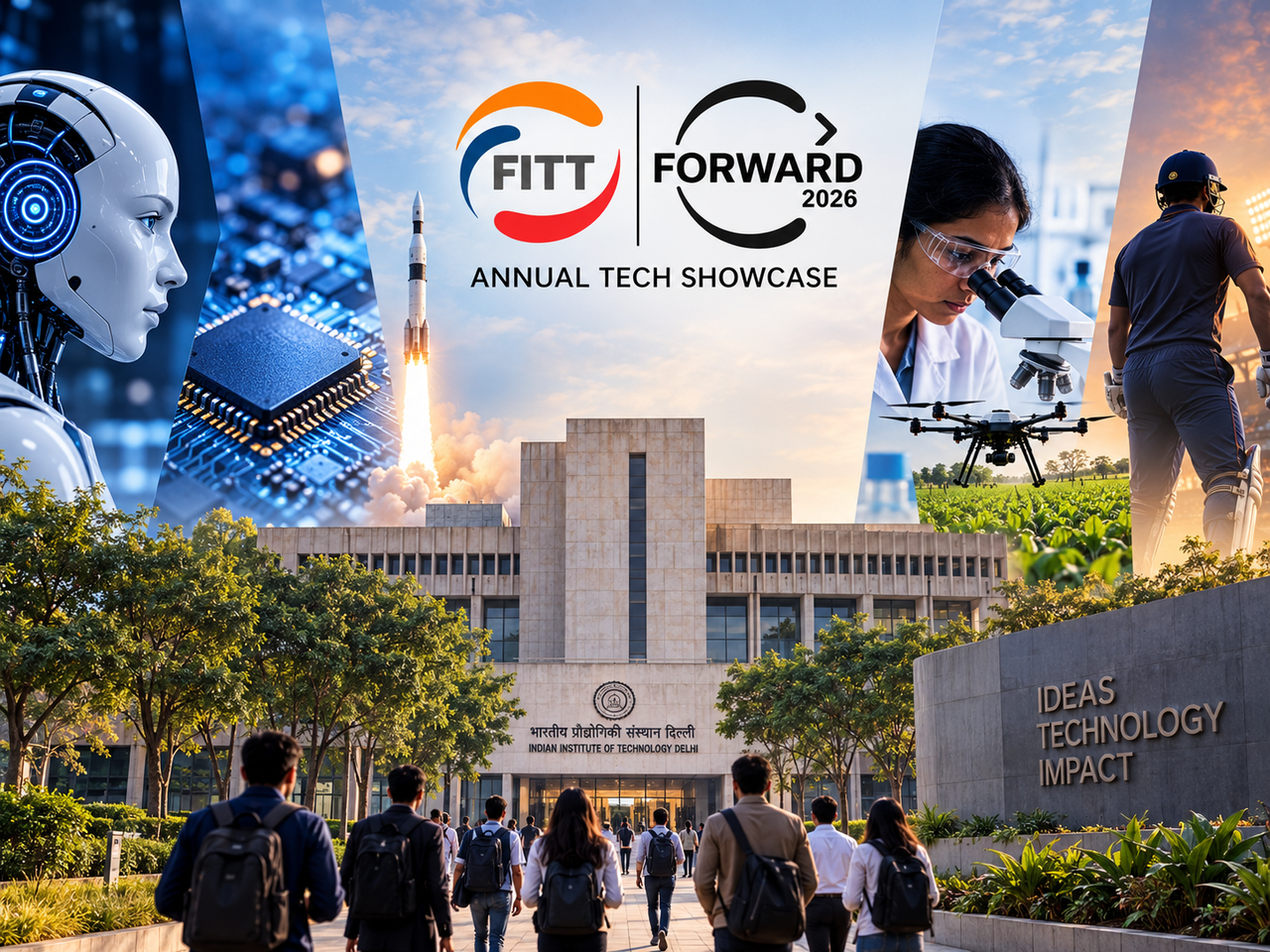
That question ran through the second edition of FITT Forward 2026, the two-day deep-tech summit organised by the Foundation for Innovation and Technology Transfer (FITT) at IIT Delhi.
The summit brought together founders, investors, researchers, policymakers and industry leaders working across AI, semiconductors, advanced manufacturing, agriculture, space, biotechnology and SportsTech.
Dr. Nikhil Agarwal, describing the purpose of the summit, put the ambition plainly:
“FITT Forward 2026 is designed to move the conversation from India’s ability to innovate to its ability to own and scale the technologies that will shape the next decade.”
That shift—from invention to ownership—is becoming increasingly important as India tries to build companies around technologies that require considerably more time and money than conventional software ventures.
/fit-in/580x348/filters:format(webp)/tice-news-prod/media/media_files/2026/09/12/from-innovation-to-global-scale-2026-09-12-14-20-51.jpeg)
AI Is No Longer Just an Adoption Story
The summit began with one of the biggest questions facing India’s technology industry: Can India build AI for 1.4 billion people—and for the world?
CyberMedia Group Chairman and Managing Director Pradeep Gupta moderated the discussion with Prof. Mausam of IIT Delhi, MeitY scientist Kavita Bhatia and Microsoft India and South Asia executive Sandeep Aurora.
For India, the opportunity is obvious. The country has a huge user base, a deep pool of engineers and researchers and a rapidly expanding startup community working with AI.
But building serious AI technology brings another set of requirements—computing infrastructure, specialised talent, proprietary technology and enough capital to stay in the game while products and models mature.
That led naturally into a discussion on deep-tech funding, with S.P. Singh, nodal officer in charge of the RDI Fund, joining investors Praveen Ganapathy, Kunal Bhanot and Deepak Sharma.
The funding model for deep-tech looks very different from that of a typical digital startup. A company developing a semiconductor, biotech platform or advanced industrial technology may have to clear years of technical and regulatory hurdles before reaching meaningful commercial scale.
For investors, the challenge is therefore not simply finding the next promising founder. It is being prepared to stay with the company long enough for the technology to become a business.
Semiconductors Put the Scale Question on the Table
The discussion became more physical in the afternoon, with advanced manufacturing and semiconductors taking centre stage.
The panel brought together Marmik Bhatt of Monk9 Tech, Priya S. Kapur of Sona Comstar, Taranjit Kukal of Cadence Design Systems, Dr. Shailendra Singh of Maruti Suzuki and Manu Iyer of BlueHills Capital. Former Tech Mahindra CEO Kiran Deshpande moderated the session.
Semiconductors are an obvious strategic priority for India, but the opportunity comes with demanding economics. Building an ecosystem requires specialised skills, reliable supply chains, manufacturing capabilities and customers capable of absorbing production at scale.
The same question appeared in a very different setting during the “From Farm to Future” agritech session.
Indian agriculture offers a vast domestic market for technology. The bigger opportunity may be creating solutions that can travel to other countries facing similar challenges.
That is where deep-tech becomes more than a technology story. It becomes a question of whether a solution developed for an Indian market can find a much larger market elsewhere.
IITs Want to Push More Ideas Out of the Lab
India’s startup numbers are already substantial, with more than 200,000 recognised startups and over 120 unicorns, according to the summit.
Deep-tech, however, is measured differently.
A company can have an excellent founding team and strong technology and still struggle to cross the gap between research and a product that an industry customer is willing to deploy.
FITT’s work sits directly in that space.
According to the organisation, it had incubated more than 280 startups, facilitated over ₹450 crore in cumulative funding and commercialised 25 global patents as of its 2025 edition.
Prof. Vivek V. Buwa, DDSP at IIT Delhi, explained the role of the institution and FITT:
“FITT focuses on IP creation, licensing technology and startups, while IIT Delhi focuses on creating the infrastructure for young entrepreneurs. Together, they provide the ecosystem, resources and support needed to transform ideas into practical innovations and eventually successful ventures.”
For India’s research institutions, that transition is critical. A patent sitting inside an institution has value. A patent embedded in a growing company that has customers, revenue and international reach has considerably more economic impact.
The difference lies in what happens between the two.
Why SportsTech Is Finding Its Way Into the Deep-Tech Conversation
One of the more unexpected conversations at FITT Forward came from outside the traditional technology ecosystem.
Former India cricketer and investor Bhuvaneshwar Kumar spoke about his move into entrepreneurship and investing during a fireside conversation with Sachin Marya, Editorial Director at Entrepreneur India & APAC.
His interest in SportsTech is partly personal.
“Sports mein there’s a lot of chance for technology. It has really taught me a lot in life, especially when I was injured and couldn’t show up to the stadium. I am here today as an investor and not as a sportsman. I believe there is a lot of scope for technology in sports.”
Sports is increasingly becoming a technology market in its own right, covering areas such as athlete performance, injury prevention, training, equipment and fan engagement.
That interest also translated into a concrete initiative at the summit. TechnoSport and AIC-IIT Delhi signed an MoU to build a dedicated SportsTech accelerator. FITT also signed another agreement with World of Innovation.
The significance is less about sport itself and more about the widening range of industries looking for technology-led solutions.
The Investor Conversation Is Moving Beyond Pitch Decks
The summit’s closed-door Demo Day brought selected startups—including women-led, student-led and rural innovation teams—directly in front of investors.
That format matters because deep-tech founders have a different story to tell.
The proposition is rarely just “here is our app and here is our user growth.” It may involve a new material, a medical technology, a satellite system, an industrial process or a semiconductor design.
The people evaluating those businesses therefore need to understand not only the technology, but also the route to manufacturing, certification, customers and returns.
This is where the presence of industry alongside investors becomes important.
Prof. Rangan Banerjee, Director of IIT Delhi, captured that broader shift:
“The next wave of Indian innovation will not be defined by one sector or one technology—it will emerge at the intersection of research, entrepreneurship, capital and national priorities.”
It is a useful description of what India is trying to build: not simply more startups, but a system in which research can find capital, capital can find viable technology and technology can find a market.
India’s Deep-Tech Test Starts After the Prototype
FITT Forward 2026 covered a wide field, with the second day turning to space, healthcare, biotechnology, institutional capital and SportsTech before the FITT Forward Innovation Awards.
But the discussions ultimately point to one commercial test.
India has built considerable capacity to discover, engineer and experiment. The next challenge is turning that capability into businesses with valuable intellectual property, durable revenue and customers in markets beyond India.
That will take more than startup funding.
It will require universities that can work closely with industry, investors willing to support longer development cycles, companies prepared to become early customers and founders capable of taking technology all the way from the laboratory to production.
For India, that may be the real measure of the deep-tech decade ahead.
Not how many ideas are generated, but how many become companies that the world wants to buy from.