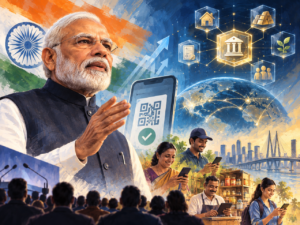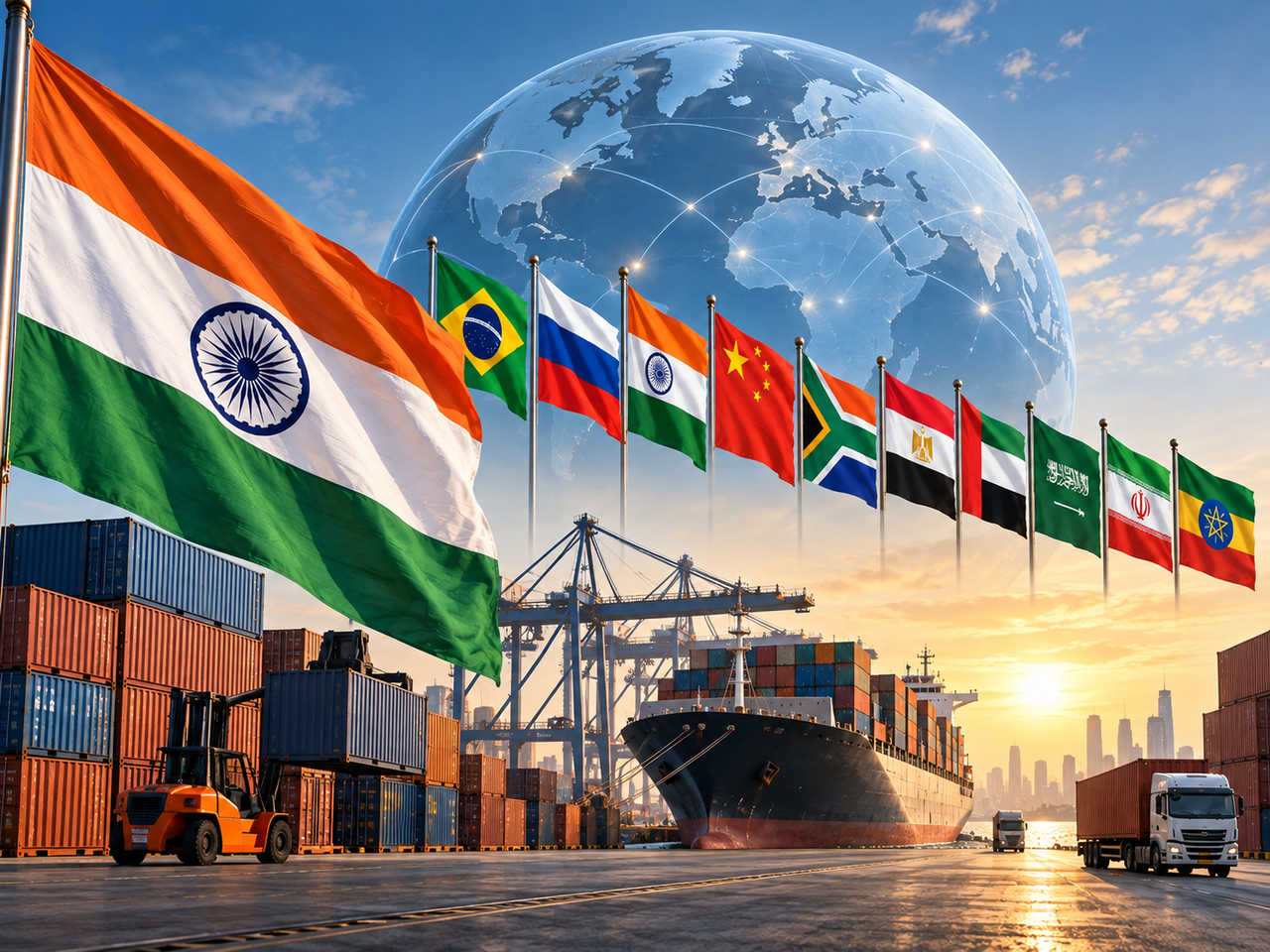

India is hosting BRICS at a moment when the bloc has never looked bigger—or more commercially important. Yet its own trade numbers expose a problem New Delhi cannot talk around: India buys far more from BRICS countries than it sells to them.
In FY2026, India’s merchandise trade with its BRICS partners generated a $226.1 billion deficit, with imports of $321.8 billion against exports of $95.7 billion. The 10 BRICS partner nations accounted for nearly 42% of India’s merchandise imports, but only about 22% of its exports.
That gap sits uneasily alongside India’s push to use its 2026 chairship to deepen trade, strengthen MSME cooperation, expand digital payments, improve logistics and mobilise development finance.
The opportunity is obvious. Turning it into exports is not.
| Indicator | FY2026 / Current | Commercial Context |
|---|---|---|
| India’s BRICS Trade Deficit | $226.1 billion | Driven heavily by imports from China, Russia and UAE |
| India’s BRICS Imports | $321.8 billion | Nearly 42% of India’s merchandise imports |
| India’s BRICS Exports | $95.7 billion | About 22% of India’s merchandise exports |
| NDB Gross Financing | $42.9 billion | Nearly 140 projects during 2022–26 |
| Expanded BRICS Footprint | 11 full members | Around 40% of global GDP and 49.5% of world population |
BRICS Has the Markets. India Has to Win Them.
The expanded BRICS grouping covers major economies and fast-growing markets across Asia, Africa, the Middle East and Latin America.
On paper, that is a formidable export opportunity.
On the ground, it is a collection of very different markets.
An Indian engineering company selling into Brazil faces a different set of requirements from a pharmaceutical exporter entering Egypt. A machinery maker targeting South Africa has different distribution and financing needs from a software company trying to build business in the Gulf.
That matters because BRICS does not create one common market.
India still has to compete market by market, product by product.
The trade deficit shows where the imbalance currently lies. China, Russia and the UAE are important sources of imports, while Indian exports have not kept pace.
A larger BRICS therefore does not automatically solve India’s export problem. In fact, expansion makes the challenge more urgent: there are more potential customers, but also more competitors and more complicated markets to navigate.
The opportunity will depend on whether Indian companies can offer something buyers want at a price, quality and level of service they can accept.
Development Finance Can Open Doors. Companies Still Have to Walk Through Them.
The New Development Bank (NDB) is one of the clearest signs that BRICS is building financial muscle alongside its political influence.
Between 2022 and 2026, the bank approved $42.9 billion across nearly 140 projects, covering clean energy, transport, water and social infrastructure. That exceeded its earlier $30 billion target.
The NDB has also expanded local-currency financing, including an RMB 80.5 billion Panda Bond programme and its first Lotus Bond issuance in Macao SAR.
For Indian companies, this could create opportunities.
Infrastructure spending creates demand for equipment, engineering services, technology, construction and specialised manufacturing. But financing a project and winning the resulting business are two different things.
Indian companies still need to qualify, bid and compete.
That is particularly important for a country trying to move up the value chain. If BRICS-funded projects are largely supplied by companies from elsewhere, India may end up participating in the financing ecosystem without capturing enough of the resulting trade.
The commercial prize lies in connecting capital to Indian capability.
MSMEs Are Where the Export Ambition Gets Tested
Large companies can afford the cost of entering unfamiliar markets. Smaller businesses usually cannot.
For an Indian MSME, the barriers can start before the first sale: finding a genuine buyer, checking a distributor, understanding local regulations, meeting certification standards, arranging trade credit and managing delayed payments.
This is where India’s focus on MSMEs under BRICS could have a practical payoff.
The proposed BRICS Business Facilitation Mission seeks to improve B2B buyer-seller connections, provide market intelligence and help businesses navigate regulations. Other proposals, including a BRICS MSME Cooperation Portal and Startup Innovation Fund, are intended to improve access to partners and finance.
The value of such initiatives will not be measured by how many companies register on a portal.
It will be measured by what happens afterwards.
If a manufacturer in Gujarat finds a distributor in Brazil, if a component maker in Pune wins a contract in South Africa, or if an Indian startup converts a BRICS connection into recurring overseas revenue, the machinery is working.
That is the level at which BRICS cooperation becomes economically meaningful.
Payments Could Be the Missing Link
Trade also depends on something much less visible than summits and declarations: getting paid efficiently.
India is pushing for greater interoperability between digital payment systems and central bank digital currencies across BRICS economies.
The immediate value is not necessarily a common BRICS currency. It is cheaper and faster settlement.
Cross-border transactions can involve several intermediaries, foreign-exchange spreads and settlement delays. Those costs are especially painful for smaller exporters operating with limited working capital.
More efficient digital payment rails could reduce some of that friction:
Multiple intermediaries → FX costs → delayed settlement
could gradually become
Fewer intermediaries → faster settlement → better cash flow
For exporters, faster payment can mean less money tied up in receivables and greater room to compete on price.
It is a relatively unglamorous reform, but potentially one of the more useful ones.
The Real BRICS Scorecard Is India’s Export Performance
India’s 2026 chairship has already generated more than 350 high-level meetings across 25 cities.
The diplomatic scale is considerable. But the economic scorecard will be much simpler.
Are Indian manufacturers winning more contracts across BRICS? Are MSMEs finding customers they could not previously reach? Are Indian technology and pharmaceutical companies gaining market share? Is development finance creating procurement opportunities for Indian businesses? Are payment reforms making cross-border trade easier?
Those are the outcomes that will determine whether India has converted its BRICS influence into economic value.
The bloc now represents roughly 40% of global GDP and 49.5% of the world’s population. That is a market few Indian policymakers can afford to ignore.
But size alone does not create exports.
India’s $226.1 billion BRICS trade deficit is a reminder that influence and competitiveness are not the same thing.
For New Delhi, the next phase of BRICS is therefore less about making the bloc bigger and more about making Indian business better at selling into it.
The strongest proof that the strategy is working will not be another declaration. It will be a change in the direction of trade.