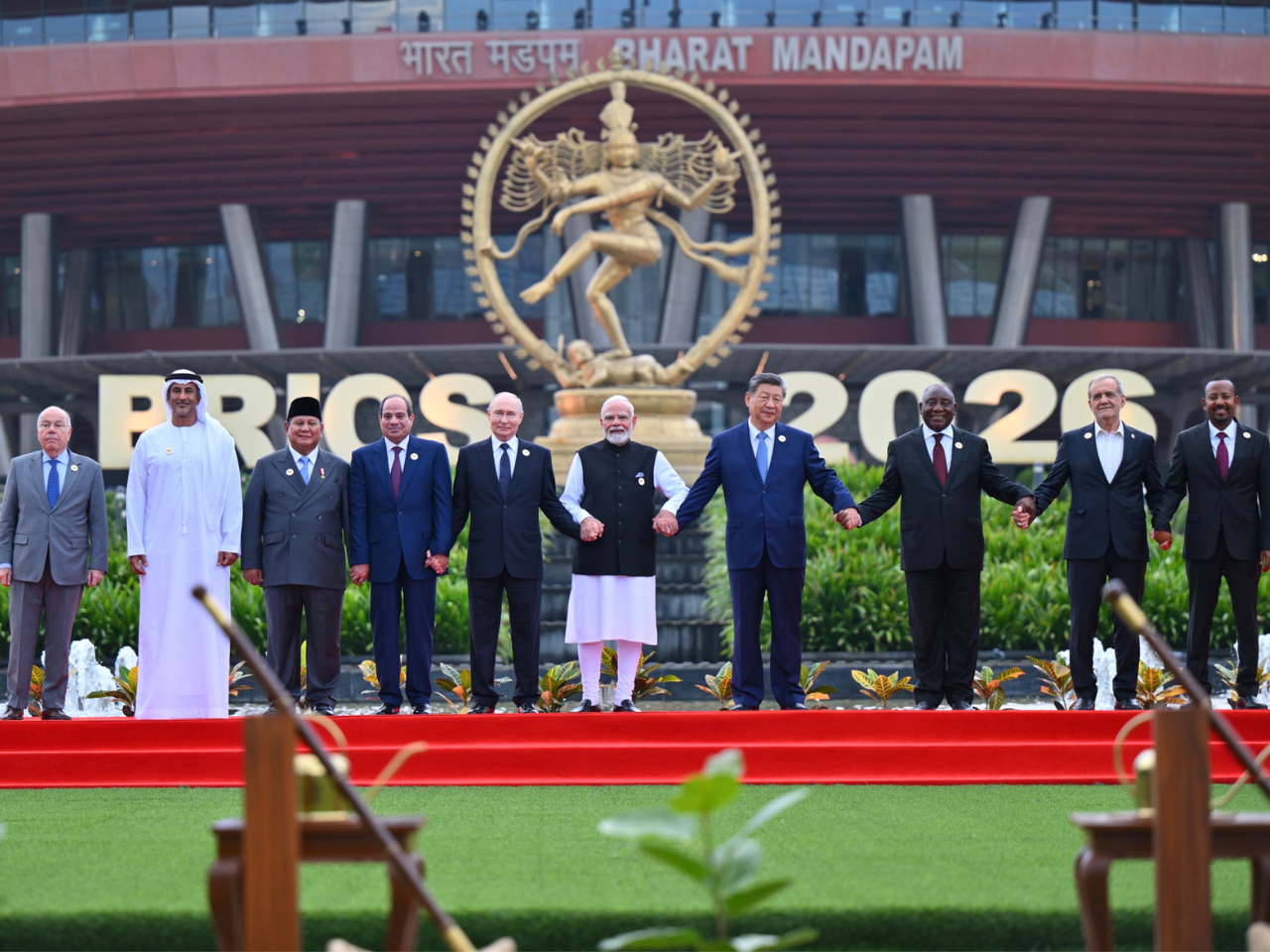

The BRICS New Delhi Declaration puts a distinctly practical layer on India’s 2026 chairship, with trade, technology, finance, supply chains and access to capital featuring prominently alongside the bloc’s familiar call for a larger voice for emerging economies.
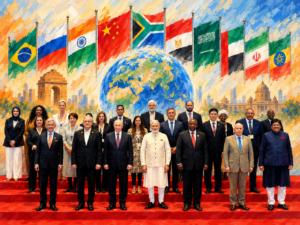
Issued as leaders met in New Delhi for the 18th BRICS Summit, the declaration marks the group’s 20th anniversary and sets out a broad agenda covering economic cooperation, global governance, technology, energy, agriculture, health, climate and security. India’s chairship theme—“Building for Resilience, Innovation, Cooperation and Sustainability”—runs through the document.
More than 400 BRICS-related meetings and engagements were held across 30 Indian cities during the year, involving governments, businesses, experts and other stakeholders, according to the declaration.
The result is a document that goes well beyond diplomatic language. For businesses, some of its most consequential provisions sit in the less headline-grabbing areas: how quickly money moves across borders, whether smaller companies can access trade finance, how supply chains are built and whether emerging technologies can move across markets.
/fit-in/580x348/filters:format(webp)/tice-news-prod/media/media_files/2026/09/12/modi-with-putin-and-china-at-brics-2026-09-12-19-07-13.jpg)
Trade Is Where BRICS Has to Deliver
The declaration takes aim at one of the biggest constraints on intra-BRICS commerce: the difficulty of moving goods, money and companies across different regulatory systems.
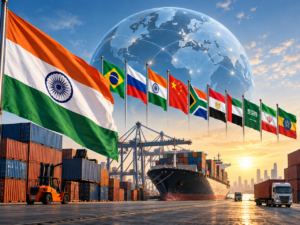
Leaders backed work on more resilient global value chains, digitisation of trade processes, technology transfer, intellectual property protection and better connectivity. They also called for greater participation by emerging and developing economies in higher-value segments of global manufacturing and production.
For smaller businesses, access to finance is an equally important part of that equation.
The declaration acknowledges affordable finance as a major bottleneck for MSMEs trying to enter international trade and global value chains. It welcomes principles for improving credit assessment of export-oriented MSMEs and a proposed mechanism to help businesses unlock working capital through invoice discounting.
That could prove more consequential for businesses than another broad statement on increasing trade.
A large multinational can usually absorb the cost and complexity of entering a new market. A smaller exporter cannot. For an MSME, a delayed payment, expensive working capital or cumbersome documentation can be enough to make an export order commercially unattractive.
The declaration is therefore moving the conversation closer to the mechanics of trade.
/fit-in/580x348/filters:format(webp)/tice-news-prod/media/media_files/2026/09/12/modi-with-putin-and-x-2026-09-12-19-07-52.jpg)
The Payment Question Is Still Open
BRICS has spent years discussing ways to make cross-border payments easier. The New Delhi declaration keeps that work alive without presenting a single monetary solution for the group.
The BRICS Payment Task Force has been examining interoperability between payment and messaging systems, while members are also discussing settlements and investments in local currencies. The stated objective is straightforward: cross-border payments that are faster, cheaper, more accessible, efficient, transparent and secure.
That matters because trade integration depends on more than removing tariffs.
If a business can find a buyer in another BRICS market but faces friction in receiving payment, managing currency exposure or complying with different financial systems, the commercial connection remains incomplete.
The declaration also advances work around a proposed New Investment Platform, while a separate BRICS Multilateral Guarantees initiative is being developed with the potential to mobilise private capital and reduce financing costs for development projects.
The emphasis is increasingly on creating financial infrastructure around the trade relationship rather than simply announcing higher trade ambitions.
/fit-in/580x348/filters:format(webp)/tice-news-prod/media/media_files/2026/09/12/brics-leaders-delhi-2026-09-12-19-08-38.jpg)
Technology Is Becoming Part of BRICS Economic Policy
The technology agenda in the declaration is broader than AI.
BRICS members backed greater cooperation in science, technology and innovation, including research infrastructure, quantum technologies and knowledge sharing. The declaration also records the proposed development of a BRICS digital public infrastructure repository, along with pilot projects for digital public infrastructure solutions across member countries.
AI receives its own treatment.
The leaders recognise its potential to drive economic growth and sustainable development while calling for cooperation around access to AI resources, safety, security, inclusiveness, reliability and trustworthy AI. The declaration also commits members to implementing the BRICS Leaders’ Statement on the global governance of artificial intelligence.
For India, this creates an interesting export opportunity.
Digital public infrastructure is an area where India has developed systems at population scale. The declaration’s language around repositories and pilot projects suggests an effort to turn that experience into a platform for cooperation with other developing economies.
The focus is not simply on selling technology. It is on sharing architectures, capabilities and experience.
/fit-in/580x348/filters:format(webp)/tice-news-prod/media/media_files/2026/09/12/brics-leaders-delhi-declaration-2026-09-12-19-09-17.jpg)
Critical Minerals, Energy and Manufacturing Move Closer Together
The declaration also connects the technology race to the physical resources needed to support it.
BRICS leaders highlighted the importance of reliable and diversified supply chains for critical minerals, recognising their role in energy technologies and energy security. They also backed cooperation on hydrogen standards and certification and welcomed work on smart grids and energy storage.
The industrial agenda runs alongside it.
BRICS members welcomed the BRICS Incubator Network and further consideration of a BRICS Startup Innovation Fund, while continuing work through the Partnership on the New Industrial Revolution. The declaration also calls for greater engagement among startups and SMEs and stronger technology cooperation.
This creates a potentially important chain: minerals feed manufacturing, manufacturing supports technology deployment, and startups can provide some of the solutions needed across the system.
Agriculture is being approached in a similar way. The declaration supports further discussions on a BRICS Grain Exchange, alongside cooperation on digital agriculture, agroecology and regenerative agriculture.
The common thread is diversification of supply and production rather than dependence on a single market or source.
/fit-in/580x348/filters:format(webp)/tice-news-prod/media/media_files/2026/09/12/brics-leaders-delhi-declaration-2026-2026-09-12-19-10-09.jpg)
BRICS Wants a Larger Voice in the Global System
The economic agenda sits within a much bigger political project.
On its 20th anniversary, BRICS reiterated its call for reform of global governance and stronger representation for emerging markets and developing countries. The declaration specifically backs reform of the UN Security Council and notes that China and Russia support the aspirations of Brazil and India to play a greater role in the UN, including the Security Council.
The group also renewed its push for changes to the governance of the IMF and World Bank, arguing that the institutions should better reflect the weight of emerging and developing economies in the global economy.
On trade, BRICS reaffirmed support for a rules-based multilateral system centred on the WTO while criticising the spread of unilateral tariffs and non-tariff measures that it says are disrupting global commerce and supply chains.
That position is particularly relevant at a time when companies are having to rethink where they source, manufacture and sell.
/fit-in/580x348/filters:format(webp)/tice-news-prod/media/media_files/2026/09/12/pm-modi-brics-2026-09-12-19-11-29.jpg)
From Statements to Systems
The most interesting feature of the New Delhi declaration may therefore be its attention to infrastructure behind economic integration.
Payments. Trade documentation. MSME finance. Supply chains. Critical minerals. Digital public infrastructure. Research networks. Startup funding. Transport connectivity.
These are not necessarily the most dramatic subjects on a summit stage. They are, however, the systems that determine whether businesses can actually operate across borders.
The declaration also gives the New Development Bank a larger role in this architecture, encouraging it to expand resource mobilisation, local-currency financing and support for infrastructure and economic integration. India’s chairship also saw the launch of a BRICS-NDB Knowledge Portal to share development experiences and policy innovations.
The political ambition of BRICS has been visible for years. The New Delhi declaration suggests that the next test will be more mundane—and potentially more important.
Can the bloc make it easier for a company in one BRICS country to finance, manufacture, sell and get paid in another?
If the answer begins to move from aspiration to execution, the economic significance of BRICS could become considerably larger than the declarations themselves.