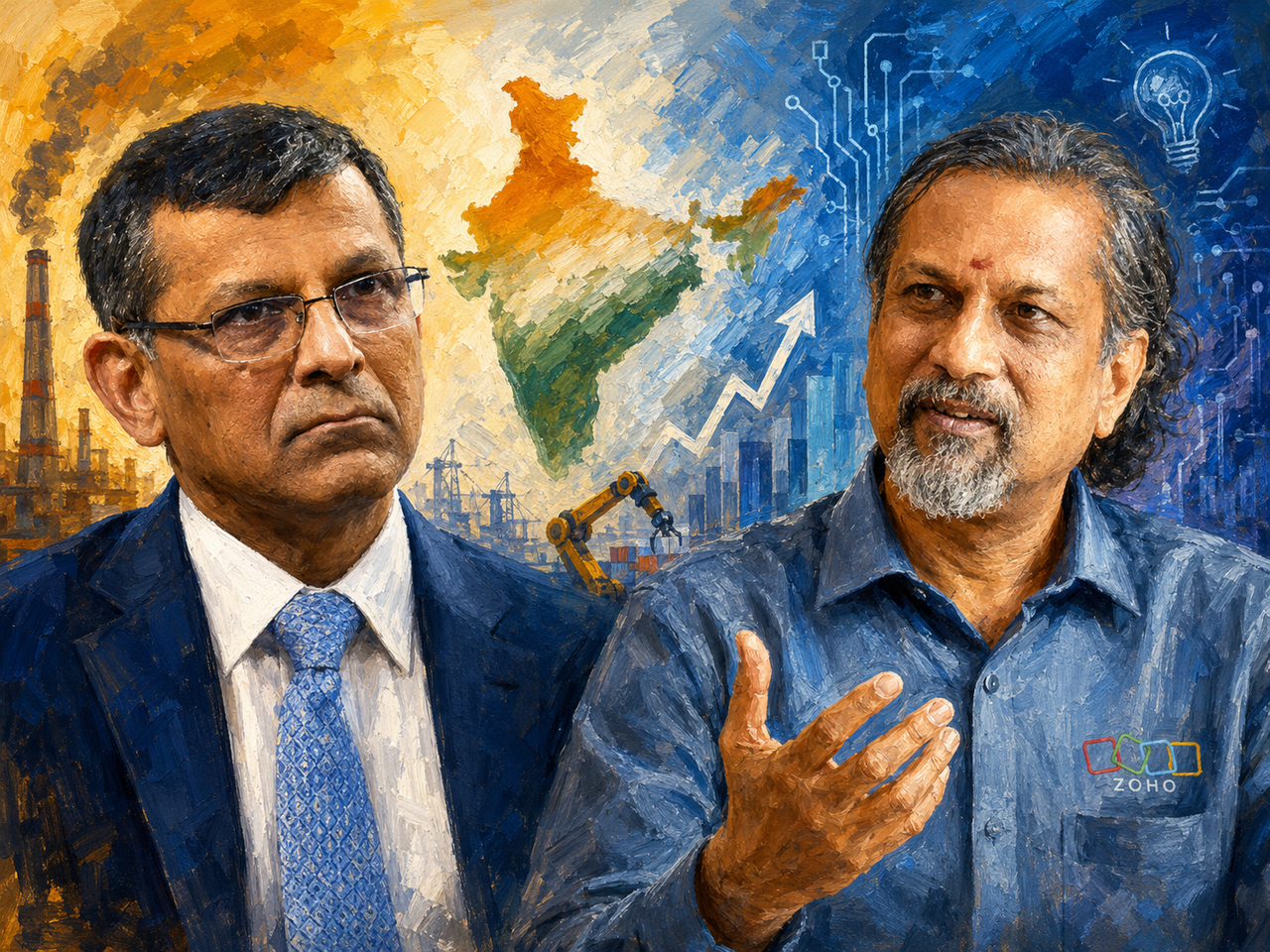

India’s manufacturing debate is shifting from how many factories the country can build to how much value it can capture from them. That question sits at the heart of a growing disagreement between Zoho Chief Scientist Sridhar Vembu and economist Raghuram Rajan over jobs, manufacturing, technology and India’s path to prosperity.
Their arguments differ sharply. Rajan believes the old East Asian factory-led growth model has become harder to replicate because manufacturing is increasingly automated and India faces formidable competition from China and Vietnam. He has argued that services and human capital must play a much larger role in creating jobs.
Vembu’s concern starts elsewhere: if India continues to perform manufacturing and technology work without owning enough of the underlying intellectual property, the country may create output without capturing enough of the economic value.
That makes this debate bigger than manufacturing versus services. It is about who sits at the profitable end of the value chain.
The iPhone is more than an assembly story
Vembu illustrated his argument through an iPhone manufacturing example, comparing the purchasing power of workers doing broadly similar factory work in India and China.
His point was not really about the price of an iPhone. It was about why similar work can command very different economic rewards.
For Vembu, the answer lies beyond the factory floor. Higher wages ultimately depend on higher productivity and higher-value activity — research, engineering, design, intellectual property and ownership of technology.
That argument has become more relevant as Vembu has also questioned the ability of both IT and large-scale manufacturing to create jobs at the pace India needs. In August, he said the IT industry, including Zoho, had not created many new jobs in recent years, while AI and data-centre spending was absorbing resources that might previously have gone towards hiring. He also warned that automation means large-scale manufacturing may not generate as many jobs as policymakers expect.
The implication is uncomfortable: India cannot solve its employment challenge simply by producing more — it needs to produce more value per worker.
Rajan’s warning about the factory-first model
Rajan approaches the problem from a different direction.
The traditional East Asian model worked because countries such as Japan, South Korea, Taiwan and later China used relatively low-cost labour to build export manufacturing, accumulated capital, improved skills and gradually moved into more sophisticated production.
But Rajan argues that the starting conditions have changed.
Manufacturing is now far more automated. A modern electronics factory can use sophisticated machinery even in a relatively low-wage economy. At the same time, India is competing with established manufacturing ecosystems in China and increasingly with countries such as Vietnam and Bangladesh.
That changes the economics of simply offering cheap labour.
Rajan uses the iPhone value chain to explain the problem. Product conception and design sit at one end; marketing, distribution and services sit at the other. Assembly occupies the middle — and that middle has become intensely competitive.
His argument, therefore, is not that India should abandon manufacturing.
It is that manufacturing should not be mistaken for the entire development strategy.
Where Vembu and Rajan actually disagree
The difference becomes clearer when industrial policy enters the conversation.
Rajan has long been cautious about governments trying to pick industrial winners through subsidies, protection and state-directed investment. His concern is that industrial policy can distort competition and encourage lobbying rather than productivity.
Vembu is more willing to argue for deliberate intervention to build domestic technological and industrial capabilities. His broader economic thinking places considerable weight on deep technology, R&D and Indian ownership of innovation. He has argued that deep-tech capability can create prosperity that extends beyond the technology sector itself.
Yet reducing the two positions to “Rajan against manufacturing” and “Vembu for manufacturing” would miss the point.
Rajan himself has said manufacturing still has opportunities in India. His concern is that it will not, by itself, absorb the country’s next generation of workers at the scale once seen in East Asia. He sees greater potential in services, human capital and manufacturing-related services.
Vembu, meanwhile, is not simply arguing for more factories. His emphasis is increasingly on deep technology and domestic value creation.
The disagreement is therefore really about the route India should take from labour to productivity, and from productivity to ownership.
India’s policy challenge is already moving up the chain
India’s own industrial policy is beginning to reflect this more complicated ambition.
The government is continuing to push manufacturing through industrial parks and infrastructure, including the ₹33,660-crore BHAVYA scheme for 100 plug-and-play industrial parks.
At the same time, policy attention is moving beyond basic assembly. A recent NITI Aayog report identified chemicals, telecom and networking equipment, textiles and solar PV manufacturing as strategic sectors in India’s ambition to become a global manufacturing hub, with an emphasis on value-chain opportunities and operational efficiency.
That shift matters.
The real test of India’s manufacturing strategy will not simply be the number of factories announced, the investment committed or the products stamped Made in India.
It will be whether Indian firms increasingly control the technology, engineering, brands, patents and supply chains behind those products.
From Made in India to Owned by India
This is where the Vembu-Rajan debate becomes useful.
India probably cannot afford to choose between manufacturing and services. It needs both. Manufacturing can create industrial capabilities and supply chains; services can generate jobs and leverage India’s human capital. Technology can connect the two.
But there is a missing link: ownership.
A country can host a sophisticated factory without owning the product. It can provide thousands of engineers without owning the IP they develop. It can become a major export base while a disproportionate share of the value is captured elsewhere.
That is the structural question India now needs to confront.
The next phase of the country’s industrial strategy should therefore be measured not only by capacity created, but by capability owned.
India’s manufacturing challenge may not be to build more assembly lines. It may be to turn those assembly lines into stepping stones towards engineering, R&D, intellectual property and globally competitive Indian companies.
The transition India ultimately needs is not simply from imports to manufacturing.
It is from manufacturing to ownership.
In a recent interview, Dr Raghuram Rajan says we are getting only low paying manufacturing jobs in Tamil Nadu. He also opposes industrial policy at the national level. Let me explain the intrinsic contradiction between these two ideas.
Let us consider the iPhone factory in Tamil…
— Sridhar Vembu (@svembu) September 4, 2026
Editorial Note
This article is based on public comments and arguments made by Sridhar Vembu and Raghuram Rajan. TICE has distinguished attributed opinions and illustrative arguments from independently established economic data and presented the debate in its broader policy context.