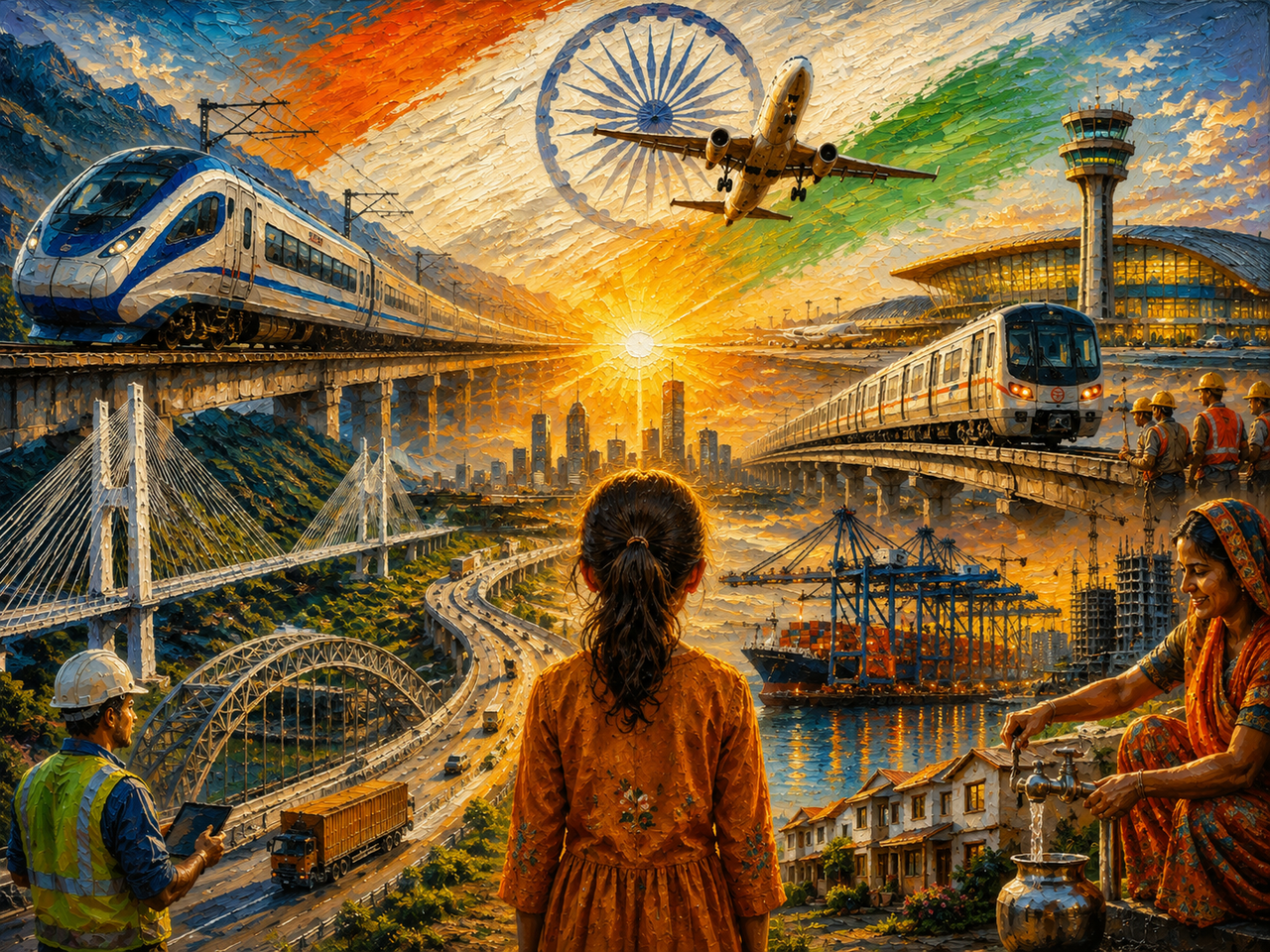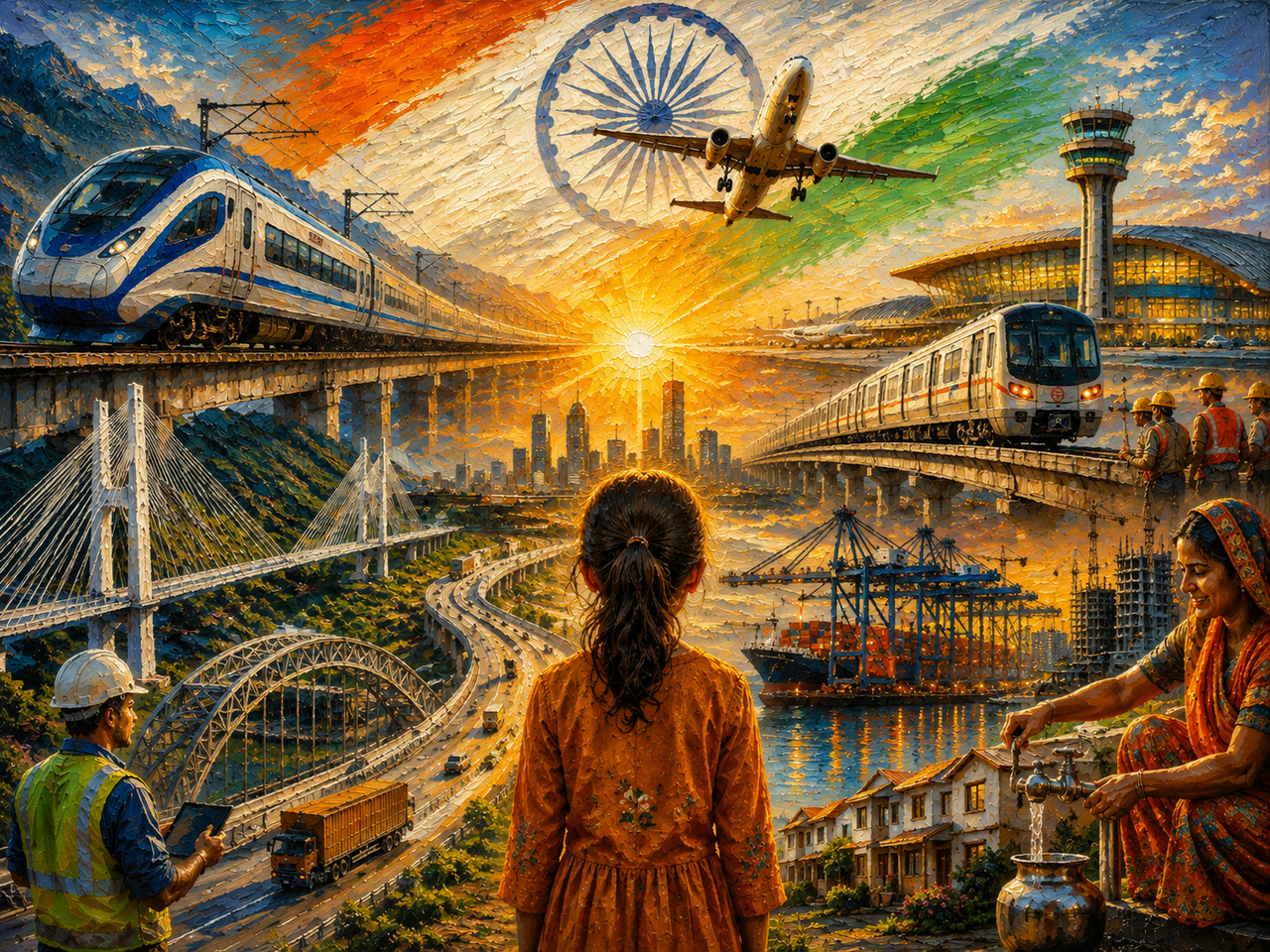

When India became independent in 1947, infrastructure meant roads, railway tracks, dams, and public buildings. In 2026, infrastructure means something much larger.
It means a farmer receiving tap water at home, a manufacturer identifying industrial land through a digital platform, a passenger boarding a Vande Bharat train, a student flying from a Tier-3 city under the UDAN scheme, and a truck moving seamlessly across highways, ports, rail networks, and industrial corridors.
As India prepares to celebrate its 80th Independence Day, the country’s infrastructure story is no longer about building individual assets—it is increasingly about building integrated systems. That shift is visible in the numbers: public capital expenditure has increased from ₹2 lakh crore in FY2014-15 to ₹12.2 lakh crore in FY2026-27.
For decades, India’s infrastructure strategy focused on connectivity. Today, it is increasingly focused on capacity—a distinction that may define India’s growth story over the next two decades.
/fit-in/580x348/filters:format(webp)/tice-news-prod/media/media_files/2025/06/10/jXXN9vKfWxu2b2cWloD7.jpg)
Railways Are No Longer Just a Transport Network
Few sectors illustrate this transformation more clearly than Indian Railways. The railway budget has increased from ₹32,000 crore in 2014-15 to ₹2.78 lakh crore in FY2026-27. But the real story is how the network is being redesigned:
- Electrification & Fleet: Rail electrification reached 99.6% as of July 2026 (up from ~20% before 2014). The network now operates 162 Vande Bharat trains, two Vande Bharat Sleeper services, and 72 Amrit Bharat services.
- Safety & Innovation: Kavach Version 4.0 has been commissioned across 2,633 route kilometres, while India’s first indigenously developed Hydrogen Fuel Cell Trainset began operations on the Jind-Sonipat route.
- High-Speed Infrastructure: Construction continues on the 508-km Mumbai-Ahmedabad High-Speed Rail Corridor, designed for speeds of 350 km/h.
For decades, Indian Railways was associated with capacity constraints. Today, it is being repositioned as a technology-driven mobility platform.
Roads, Bridges, and Tunnels Are Redrawing India’s Geography
Infrastructure is deeply geographical. A bridge can reshape a regional economy, a tunnel can shorten supply chains, and a highway can create entirely new growth corridors. India’s road network has expanded to 63.73 lakh kilometres—the second largest in the world.
The national highway network expanded by nearly 61%, increasing from 91,287 km in FY2014 to 1,46,572 km in March 2026, while four-lane and higher-category highways grew from 18,371 km to 45,516 km.
Beyond sheer distance, landmark engineering projects have altered physical barriers once considered permanent:
- Chenab Bridge: The world’s highest railway arch bridge.
- Anji Khad Bridge: India’s first cable-stayed railway bridge.
- Pamban Bridge: India’s first vertical-lift railway sea bridge.
- Strategic Connectivity: The Z-Morh, Atal, and Dr. Syama Prasad Mukherjee Tunnels have established all-weather connectivity through critical mountain passes.
India is no longer building infrastructure around cities alone—it is building across terrain.
/fit-in/580x348/filters:format(webp)/tice-news-prod/media/media_files/2026/08/13/india-at-80-modi-2026-08-13-12-45-48.png)
Airports, Metros, and Waterways Are Expanding Mobility
Air travel in India was historically concentrated in metropolitan centers, but that model has shifted dramatically. The UDAN scheme has connected 95 airports, heliports, and water aerodromes through 679 routes, serving over 1.68 crore passengers. Total operational airports grew from 74 in 2014 to 165 by July 2026. The modified UDAN scheme, approved with an outlay of ₹28,840 crore, aims to develop 100 new airports and 200 modern helipads.
Urban mobility is evolving at a similar pace. India’s metro network expanded from 248 km across five cities in 2014 to over 1,155 km across 26 cities in 2026, serving more than 1.15 crore daily passengers. Innovations like Kolkata’s underwater metro and the Kochi Water Metro demonstrate an increasing willingness to adapt transportation models to local geography.
The Infrastructure Story Is Becoming an Industrial Story
For decades, infrastructure development and industrial development moved along separate tracks. Today, they form an integrated strategy through the PM GatiShakti National Master Plan, which coordinates infrastructure planning across 58 ministries using over 3,291 data layers.
As of August 2026, 396 infrastructure projects worth ₹18.66 lakh crore have been evaluated, 256 sanctioned, and 198 actively under implementation. Industrial capacity is expanding alongside transport infrastructure:
- Industrial Land: Over 4,220 industrial parks are mapped on the India Industrial Land Bank.
- Plug-and-Play Facilities: 272 operational plug-and-play parks are active, with 100 new parks planned under the BHAVYA scheme.
- Smart Cities: 20 industrial smart cities across seven corridors are actively strengthening manufacturing ecosystems.
Infrastructure is no longer being built simply to move goods; it is being built to power production.
/fit-in/580x348/filters:format(webp)/tice-news-prod/media/media_files/2026/08/13/india-infrastructure-story-2026-08-13-12-39-52.png)
The Real Transformation Is Happening Inside Indian Homes
While bridges and expressways command headlines, some of the most consequential investments directly impact everyday living standards:
- Jal Jeevan Mission: Rural tap-water coverage expanded from 3.23 crore households in 2019 to 15.91 crore households by August 2026, supported by JJM 2.0’s enhanced ₹8.69 lakh crore outlay.
- Housing (PMAY): Over 99.25 lakh urban houses and 3.13 crore rural houses have been completed. Notably, 96% of houses under PMAY-U 2.0 and nearly 75% under PMAY-G are registered to women or under joint ownership.
- Urban Development: Projects worth ₹2.79 lakh crore have been sanctioned under AMRUT 1.0 & 2.0, while 7,790 Smart Cities projects worth ₹1.56 lakh crore are complete.
At 80, India Is Building Capacity, Not Just Connectivity
The fundamental shift in India’s infrastructure story lies in strategic integration. Railways link directly to sea ports, ports connect to industrial corridors, industrial parks feed into national highways, and digital platforms coordinate multi-agency execution.
The previous economic model focused on building standalone assets. The current model builds interconnected ecosystems. As India enters its 80th year of independence, infrastructure has evolved into the bedrock of its long-term economic strategy.