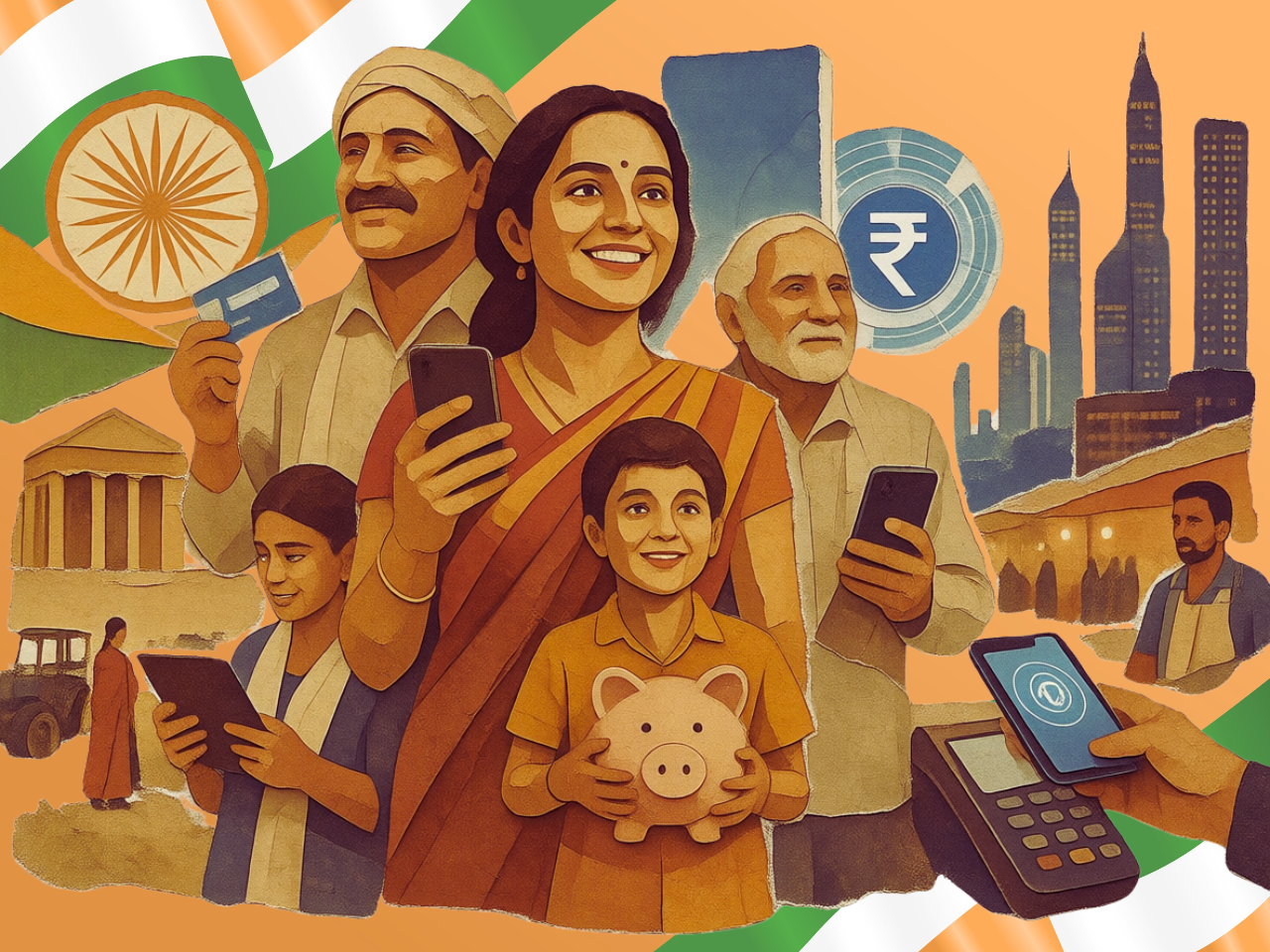

As India prepares to celebrate its 80th Independence Day, one of the country’s biggest development stories isn’t unfolding in a stock exchange, a startup boardroom, or a manufacturing plant—it is happening in places most economic reports rarely visit.
A woman in a village receiving a government benefit directly into her bank account. A street vendor accepting a digital payment through a QR code. A small entrepreneur applying for a collateral-free loan. A farmer using institutional credit instead of depending entirely on informal borrowing.
Over the past decade, India has quietly redrawn its financial map:
- Account Ownership: Nearly 89% of Indian adults now own a formal bank account.
- Financial Inclusion Index: The RBI’s index has risen from 43.4 in 2017 to 70.
- Digital Scale: UPI transactions have expanded nearly 12,000 times in less than a decade.
The statistics are impressive, but they only tell part of the story. The larger narrative is about access, participation, and the changing relationship between citizens and money.
For much of independent India’s history, financial inclusion simply meant opening more bank accounts. That definition no longer works. Today, the relevant questions are different: Can a farmer access affordable credit? Can a street vendor build a formal financial identity? Can a woman save, invest, buy insurance, and receive government support through a single ecosystem? Those questions define India’s next phase of financial inclusion.
The Distance Between a Village and a Bank Has Almost Disappeared
For decades, access was the biggest obstacle. Bank branches were concentrated in cities and large towns, forcing rural households to travel long distances for basic banking. Millions remained outside the formal system not because they didn’t need banking, but because banking wasn’t designed around their daily realities.
That landscape has changed dramatically. According to the latest data, 99.92% of Indian villages now have access to a banking outlet within a five-kilometre radius. India has built an extensive network comprising:
/fit-in/580x348/filters:format(webp)/tice-news-prod/media/media_files/2026/08/13/financial-independence-2026-08-13-11-29-05.png)
- Physical Outlets: More than 1.81 lakh bank branches and 1.65 lakh post offices offering financial services.
- Last-Mile Access: 17.36 lakh business correspondents.
- India Post Payments Bank: Serves over 11 crore customers across 5.57 lakh villages and towns.
Expanding infrastructure was only the first step. For years, financial services operated as disconnected islands—savings existed in one space, welfare benefits flowed through another, and credit came from informal sources. People had access to products, but not to a connected system.
How Jan Dhan, Identity Integration, and Mobile Connectivity Changed the System
The JAM Trinity—Jan Dhan, direct digital identity, and mobile connectivity—changed the conversation. The innovation wasn’t any single programme in isolation; it was the decision to connect identity, banking, and communication. Once those three pillars began working together, the economics of welfare delivery fundamentally changed.
As of August 2026, Direct Benefit Transfers (DBT) worth ₹52.89 lakh crore have been delivered through 320 schemes implemented by 56 ministries. Subsidies that once travelled through multiple administrative layers now move directly into beneficiaries’ bank accounts. Leakages declined, duplicate beneficiaries were identified, and the bank account became the gateway to an entire ecosystem rather than a standalone product.
Insurance, Pensions, and Credit Are Expanding the Meaning of Inclusion
Opening a bank account is relatively easy; using it meaningfully is much harder. That is why India’s journey has moved beyond account ownership and into active participation across multiple key programs:
- Insurance & Pensions: The Pradhan Mantri Jeevan Jyoti Bima Yojana has recorded 27.78 crore enrolments, while the Pradhan Mantri Suraksha Bima Yojana has crossed 58.66 crore enrolments. The Atal Pension Yojana has added 9.29 crore subscribers, with women accounting for nearly half of all enrolments.
- Credit Expansion: The Pradhan Mantri Mudra Yojana has sanctioned 57.79 crore loans worth ₹40.07 lakh crore. PM SVANidhi has extended more than 1.12 crore loans to street vendors, amounting to over ₹17,800 crore.
- Agricultural Credit: More than 1,242 lakh Kisan Credit Card applications have been processed through cooperative, commercial, and regional rural banks.
Taken together, these initiatives reveal a broader shift away from institution-centric finance toward citizen-centric finance.
/fit-in/580x348/filters:format(webp)/tice-news-prod/media/media_files/2026/08/13/financial-inclusion-2026-08-13-11-28-07.png)
UPI Didn’t Just Digitise Payments—It Changed Behaviour
Walk through any market in India today and the transformation is impossible to miss. The neighbourhood grocery store displays a QR code. A roadside tea seller checks a payment notification before serving the next customer. Street vendors, once dependent entirely on cash, are creating digital transaction histories.
Between FY2016-17 and FY2025-26, UPI transaction volumes increased nearly 12,000-fold, while transaction values grew almost 4,000-fold. By July 2026, 741 banks had joined the network, processing 2,365.8 crore transactions worth nearly ₹29.88 lakh crore. The International Monetary Fund has recognised UPI as the world’s largest real-time payment system by transaction volume.
Bank accounts that once remained inactive are now connected to e-commerce, utility payments, insurance premiums, government transfers, peer-to-peer transactions, and small-business operations. Financial inclusion has moved from policy documents into everyday life.
The Next Freedom Story May Be Financial Capability
Political freedom arrived in 1947, but broad economic participation has followed a much longer timeline. As India enters its 80th year of Independence, its financial inclusion journey offers an important lesson: building infrastructure doesn’t transform societies on its own; people do.
India has built the underlying rails through bank accounts, digital verification, instant payments, insurance, pensions, and direct transfers. The next challenge won’t be measured by the number of accounts opened, but by how confidently people save, borrow, insure, invest, and participate in the formal economy. Financial inclusion was never meant to merely create account holders—its larger purpose was always to build financially empowered citizens.