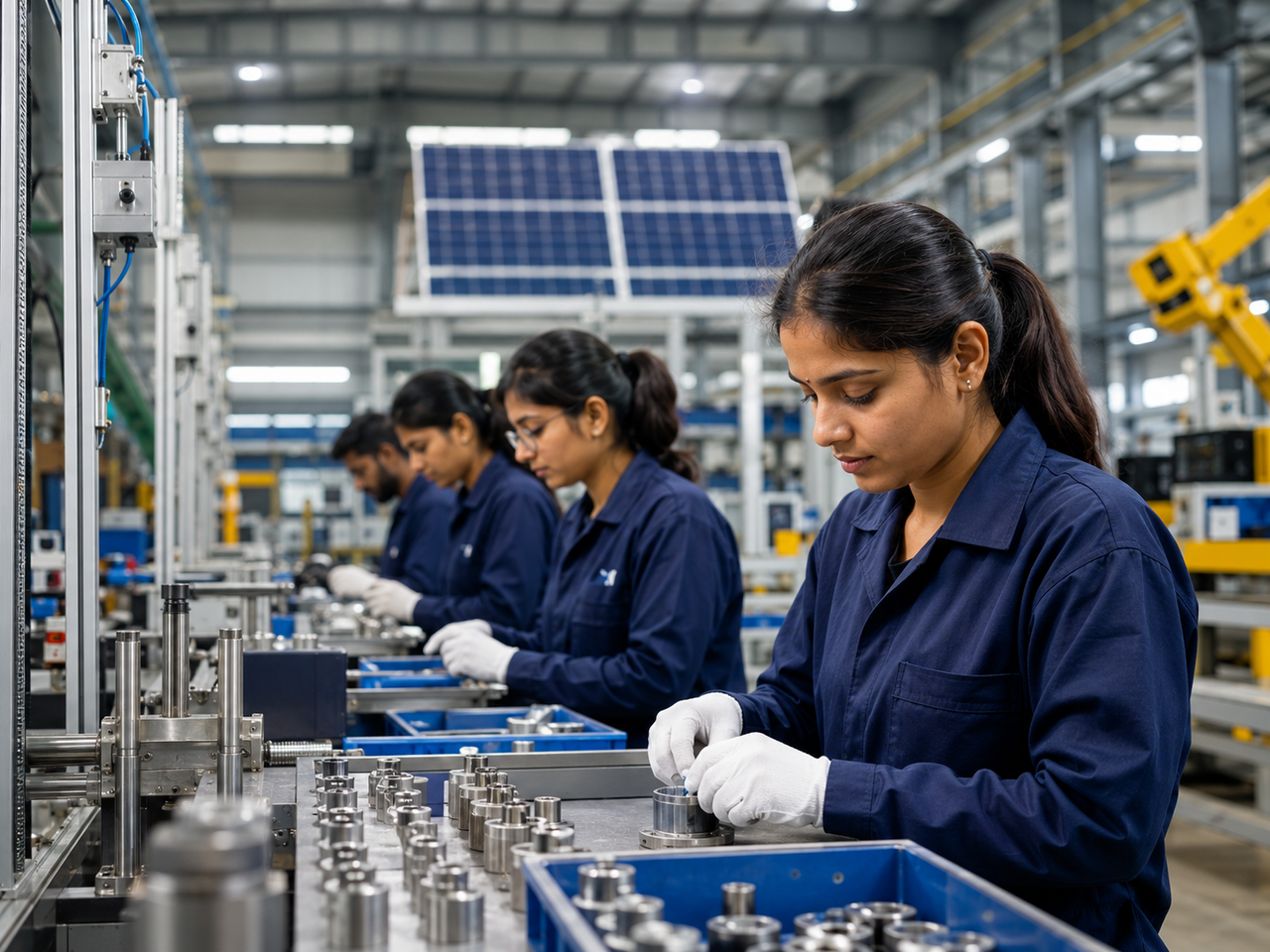

With over 6.7 lakh certified enterprises and a 100% certification subsidy for women-led MSMEs, the government’s Zero Defect Zero Effect initiative is helping small businesses strengthen quality, sustainability and global competitiveness.
India’s ambition to become a global manufacturing powerhouse will not be realised by large industries alone. It will depend equally on millions of Micro, Small and Medium Enterprises (MSMEs) that form the backbone of the country’s industrial economy.
Recognising that challenge, the Ministry of Micro, Small and Medium Enterprises is steadily expanding its MSME Sustainable (Zero Defect, Zero Effect – ZED) Certification Scheme, an initiative designed to help small manufacturers improve product quality, reduce waste, adopt sustainable production practices and become more competitive in domestic and international markets.
The programme has now crossed an important milestone. As of July 2026, more than 6.67 lakh MSMEs have received ZED certification, while nearly 9.5 lakh enterprises have registered under the scheme. To encourage greater participation from women entrepreneurs, the Ministry continues to offer a 100% subsidy on ZED Certification for eligible women-owned MSMEs, effectively removing the cost of certification.
The numbers suggest that India’s manufacturing strategy is evolving. Increasingly, the emphasis is shifting from producing more to producing better.
Global Markets Reward Quality Before Price
For decades, India’s MSMEs built their reputation on competitive pricing.
Today, global buyers are asking different questions.
Can suppliers maintain consistent quality? Do they follow sustainable manufacturing practices? Are production systems reliable? Do they meet international standards for safety and environmental responsibility?
Those expectations are reshaping manufacturing worldwide, and Indian MSMEs are adapting accordingly.
The ZED Certification Scheme encourages enterprises to strengthen production systems, reduce defects, improve resource efficiency and minimise environmental impact. Rather than functioning as a one-time compliance exercise, the programme provides a structured framework that allows businesses to continuously improve through Bronze, Silver and Gold certification levels.
For MSMEs seeking to become suppliers to large manufacturers or expand into export markets, those improvements increasingly influence business opportunities as much as pricing.
Quality Improvements Are Delivering Business Results
The impact of ZED is becoming visible on factory floors.
Finex Industries Pvt. Ltd., a furniture manufacturer based in Nashik, secured ZED Silver Certification in July 2025. After implementing Zero Defect, Zero Effect practices, the company reported an 11% reduction in the Cost of Poor Quality (COPQ), a 10% decline in rework, fewer product defects and measurable gains in workplace safety, energy efficiency and resource utilisation.
A similar transformation was reported by Concept Clothing Pvt. Ltd. in Jalandhar after obtaining ZED Silver Certification. The company recorded an 80% reduction in workplace incidents, a 50% reduction in Mean Time to Repair (MTTR), lower rejection rates and significant improvements in operational efficiency.
While each enterprise has followed its own improvement journey, the underlying message is consistent.
Investments in quality systems are delivering measurable operational and financial benefits.
/fit-in/580x348/filters:format(webp)/tice-news-prod/media/media_files/2026/08/04/quiet-manufacturing-revolution-2026-08-04-12-13-10.png)
Women Entrepreneurs Receive a Stronger Policy Push
One of the scheme’s most significant features is its support for women-led enterprises.
Since November 11, 2023, eligible women-owned MSMEs have been entitled to a 100% subsidy on the cost of ZED Certification, making participation effectively free.
The objective goes beyond reducing costs.
By removing a key financial barrier, the government aims to encourage more women entrepreneurs to adopt globally recognised manufacturing standards, improve operational processes and enhance their credibility with customers, financial institutions and larger industrial buyers.
For many first-generation entrepreneurs, particularly those running manufacturing businesses, certification can become an important business credential when competing for larger contracts or entering new markets.
Certification Is Creating a Larger Business Ecosystem
The value of ZED increasingly extends beyond the certificate itself.
The Ministry has already provided more than ₹913 crore in financial assistance under the programme to support quality improvement, consultancy, testing, cleaner technologies and process upgrades.
Support is also expanding beyond the Central Government.
Today, 22 States and Union Territories have incorporated ZED into their industrial policies, offering additional incentives to certified enterprises. At the same time, 19 financial institutions are extending benefits such as concessions in processing fees and interest rates, improving access to finance for certified MSMEs.
Together, these measures are helping create an ecosystem where better manufacturing practices are increasingly rewarded through easier finance, stronger market acceptance and greater policy support.
India’s Manufacturing Advantage Is Being Redefined
For years, cost competitiveness gave Indian MSMEs an edge.
That advantage remains important.
But as global supply chains become more quality-conscious and sustainability expectations continue to rise, competitive pricing alone is unlikely to secure long-term growth.
Manufacturers that can consistently deliver high-quality products, efficient production systems and responsible environmental practices will increasingly find themselves better positioned to win contracts, attract customers and integrate into global value chains.
The ZED initiative reflects that changing reality.
It is not simply encouraging MSMEs to obtain another government certification.
It is helping Indian manufacturers build the capabilities that modern markets increasingly demand.
If India’s manufacturing story over the past decade has been about expanding capacity, the next chapter may well be defined by something more enduring—the ability of its smallest enterprises to compete on quality, consistency and sustainability alongside the world’s best.