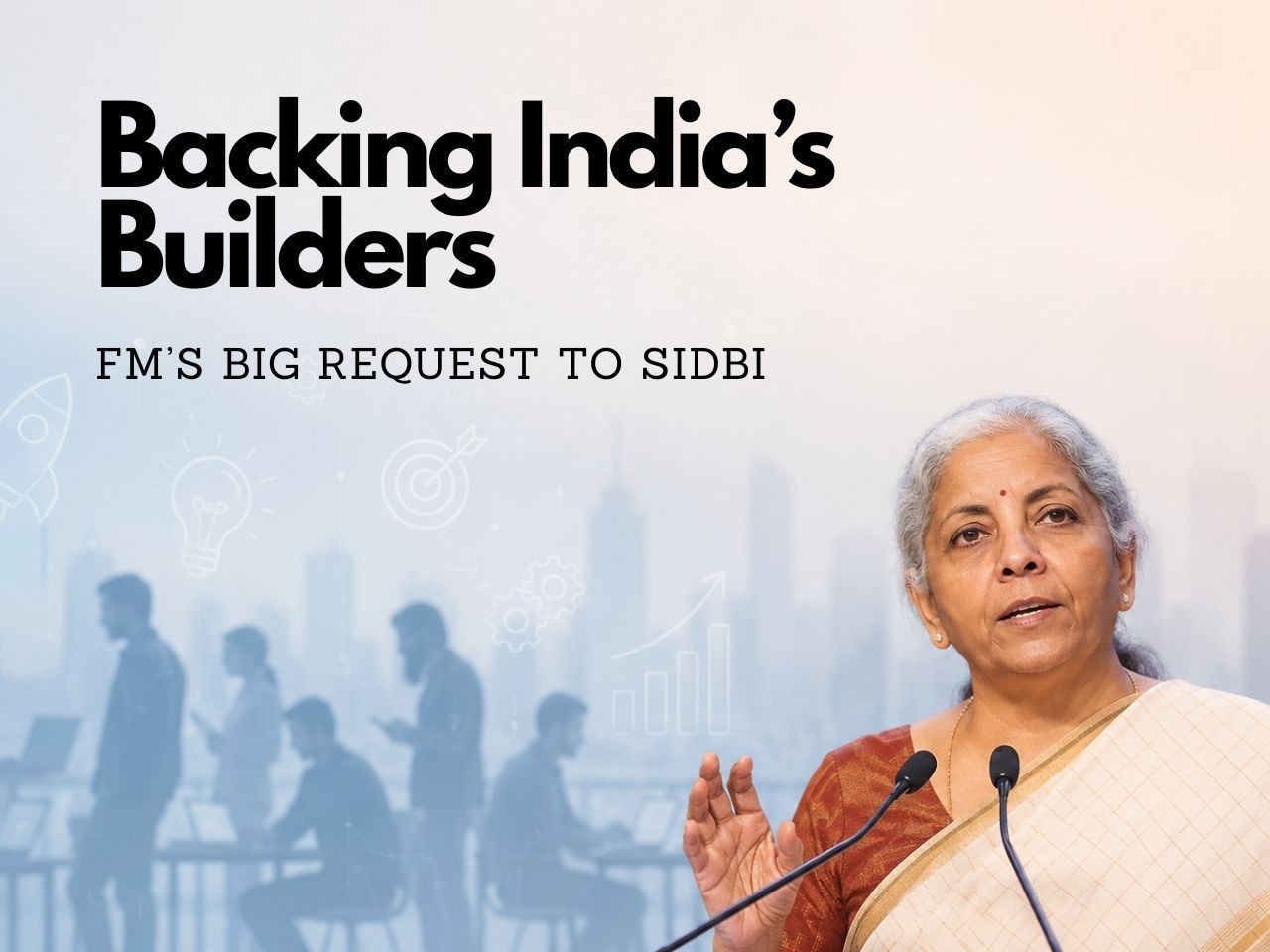

At a time when global uncertainty is testing economies across the world, India’s startup and MSME ecosystem received a strong message of reassurance from Union Finance Minister Nirmala Sitharaman — the country’s financial institutions must evolve, innovate and stand shoulder-to-shoulder with entrepreneurs instead of functioning as mere lenders.
Addressing the 37th Foundation Day celebrations of Small Industries Development Bank of India in Mumbai on Monday, Sitharaman laid out a broader and more ambitious vision for SIDBI’s future role in India’s growth story. Her message was clear: India’s startups and MSMEs need more than traditional financing — they need institutions willing to absorb risk, understand sector-specific realities and actively participate in building resilient businesses.
In a strongly worded address focused on entrepreneurship, economic resilience and financial innovation, the Finance Minister urged SIDBI to transition from being simply a lender to becoming a “market maker and risk-sharing partner” for India’s startup and MSME ecosystem.
A Push Beyond Traditional Lending
India’s startup economy has evolved rapidly over the last decade. From fintech and deeptech to agritech and manufacturing, new-age businesses today operate in vastly different environments with unique funding cycles, risk profiles and growth trajectories. Sitharaman acknowledged this changing reality and said conventional financing structures can no longer adequately support emerging enterprises.
“Standard products cannot serve non-standard businesses,” the Finance Minister said during her address.
The remark captured the larger shift she was advocating for — one where financial institutions move away from rigid, one-size-fits-all lending frameworks and instead create customised funding models based on sectoral needs and operational realities.
According to Sitharaman, repayment structures and financing products should be tailored depending on the nature of businesses, whether they are agricultural enterprises, engineering firms, tourism operators or technology startups. Each sector, she noted, faces different working capital cycles, revenue patterns and market pressures.
For India’s startups especially, this statement carries significance. Founders have long argued that traditional banking systems often struggle to evaluate innovation-led businesses that may not have fixed collateral or predictable cash flows in their early stages. Sitharaman’s remarks indicate growing recognition at the policy level that startup financing requires a more flexible and risk-tolerant approach.
SIDBI’s Expanding Role in India’s Startup Story
Over the years, SIDBI has emerged as one of the most influential institutions supporting India’s small businesses and startup ecosystem. Through initiatives such as Fund of Funds for Startups (FFS), direct lending programmes and venture debt support, the institution has already built a strong presence in entrepreneurial financing.
However, Sitharaman suggested that the next phase of India’s growth requires SIDBI to play an even larger strategic role.
Rather than limiting itself to credit disbursement, the Finance Minister encouraged SIDBI to strengthen venture capital and debt ecosystems by enabling long-term and flexible financing solutions. The emphasis was not merely on lending more capital, but on helping build stronger financial markets for startups and MSMEs.
Her comments come at a crucial time when many startups, particularly growth-stage ventures and manufacturing-focused businesses, are facing tighter funding conditions globally. Venture capital inflows have become more selective over the past two years, while rising global uncertainty has made access to patient capital increasingly important.
By asking SIDBI to emerge as a “risk-sharing partner,” Sitharaman appeared to signal the government’s intent to build more institutional support mechanisms capable of cushioning entrepreneurs during volatile economic periods.
Global Tensions and the Pressure on Indian Businesses
A significant portion of the Finance Minister’s speech focused on the broader global environment and the challenges it poses to Indian businesses.
Referring to ongoing tensions in West Asia and rising geopolitical instability, Sitharaman warned that external disruptions continue to affect economies through volatile commodity prices, disrupted logistics and uncertain trade conditions.
She identified what she described as the “three Fs” currently pressuring the Indian economy — fuel, fertilizer and foreign exchange outflows linked to gold imports.
According to Sitharaman, rising international crude oil prices remain one of the biggest concerns because of their direct impact on logistics costs, transportation expenses and inflationary pressures. She noted that crude prices continue to remain highly dynamic and unpredictable.
“It is because of high international crude prices. And the high crude prices are ever changing. It’s seriously dynamic,” she said.
The Finance Minister explained that geopolitical tensions are no longer distant international developments with limited domestic impact. Instead, they directly affect businesses and consumers through higher fuel costs, delayed cargo movements, expensive shipping routes, input shortages and uncertainty in export orders.
“For businesses and common people, it can mean higher fuel cost, delayed cargo, costlier shipping, shortage of inputs, pressure on working capital, and uncertainty in export orders,” she stated.
For startups and MSMEs operating with thinner margins and tighter cash flows, such disruptions can significantly impact operational stability. Manufacturing startups, logistics firms, exporters and D2C brands are particularly vulnerable to rising shipping and raw material costs.
Government Measures to Protect Businesses
Even as she acknowledged the challenges, Sitharaman stressed that the government’s focus remains firmly on protecting economic stability and supporting businesses through difficult global conditions.
Highlighting steps already taken by the Centre, she pointed to the government’s earlier decision to reduce excise duty on petrol and diesel by Rs 10 per litre — a move aimed at lowering logistics costs and easing inflationary pressure on businesses and consumers.
According to the Finance Minister, the decision involved a revenue sacrifice of over Rs 1 lakh crore by the government.
She also referenced customs duty exemptions introduced on critical industrial raw materials to ensure supply chain continuity and support exporters dealing with global volatility.
The broader message from the government appeared to centre around balancing fiscal management with economic support measures, especially for sectors driving employment and manufacturing growth.
India’s Domestic Economy Remains Strong, Says Sitharaman
Despite the uncertainty surrounding the global economy, Sitharaman repeatedly underlined that India’s internal economic indicators remain robust.
Cautioning against pessimistic narratives around India’s economy, she warned that excessive negativity and fear-mongering could damage business confidence and investor sentiment at a time when resilience is essential.
“India cannot afford fear-mongering,” she said.
To support her argument, the Finance Minister cited several economic indicators that, according to her, demonstrate the underlying strength of domestic demand and economic activity.
She said India’s gross GST collections crossed Rs 22 lakh crore during FY26, marking an 8.3 per cent increase. She also highlighted strong growth in tractor sales and passenger vehicle demand as signs of sustained consumption and rural activity.
Domestic wholesale tractor sales, she noted, grew by 26 per cent, while passenger vehicle sales increased by 25 per cent.
Additionally, Sitharaman pointed to rising life insurance premiums as another indicator reflecting consumer confidence and long-term financial planning among citizens.
For startups and investors, these indicators reinforce a narrative that India continues to remain one of the world’s strongest consumption-driven growth markets despite global headwinds.
ECLGS 5.0 and MSME Support
Sitharaman also used the platform to highlight continued support for MSMEs through the Emergency Credit Liquidity Guarantee Scheme (ECLGS) 5.0.
Under the scheme, the government aims to facilitate an additional Rs 2.55 lakh crore in credit support for MSMEs with 100 per cent government guarantee coverage.
The announcement is particularly important for small businesses still navigating cost pressures, uneven demand recovery and tighter liquidity conditions.
India’s MSME sector remains one of the country’s largest employment generators and contributes significantly to exports and manufacturing output. Ensuring easier access to capital, especially during uncertain global conditions, remains central to sustaining economic momentum.
A Bigger Message for India’s Entrepreneurial Economy
Beyond the policy announcements and economic indicators, Sitharaman’s speech reflected a broader shift in how India’s financial ecosystem is being asked to support entrepreneurship.
The expectation from institutions like SIDBI is no longer limited to disbursing loans. Instead, the government wants development finance institutions to actively participate in de-risking innovation, supporting emerging sectors and strengthening long-term entrepreneurial capacity.
For startups and MSMEs, access to capital often becomes the defining factor between survival and scale. By advocating flexible financing, sector-specific repayment models and institutional risk-sharing, Sitharaman’s address touched upon some of the ecosystem’s most persistent concerns.
At a time when founders are navigating global uncertainty, tighter investment cycles and rising operational costs, the Finance Minister’s remarks signal that India wants its financial architecture to evolve alongside its entrepreneurial ambitions.
And in that evolution, SIDBI may now be expected to play a much larger role than ever before.