Crypto investing used to be simple: you bought a coin, watched the chart every five minutes, panicked during dips, and told yourself you were “in it for the long term.”
Now? Things are a little different.
Between staking rewards, leverage trading, portfolio tracking, taxes, and market cap analysis, crypto has become far more data-heavy. Manually tracking these calculations can become time-consuming and difficult to manage efficiently.
That’s where crypto calculators come in. Some help you estimate profits, while others track portfolio performance or calculate liquidation prices before your trade turns into an expensive lesson. In 2026, crypto calculators are becoming more commonly used by both active traders and long-term investors.
After reviewing multiple platforms, the following three crypto calculators stood out for usability, feature depth, and accessibility in 2026.
What Is a Crypto Calculator and How Does It Work?
A crypto calculator is a tool that helps you estimate the value of a cryptocurrency if it reaches a certain price in the future. But this is only for the basic version. For more advanced ones, depending on the platform, you can calculate:
- Profit and loss;
- Mining rewards;
- Staking earnings;
- Portfolio growth;
- Taxes;
- Risk/reward ratios;
- Market capitalization comparisons.
Some calculators are extremely simple: you enter an amount, select a coin, and get a conversion result. Others go much deeper, and they pull live market data, simulate future returns, compare assets, and help you plan trades more strategically. Honestly? That matters more than ever now.
Crypto in 2026 isn’t the same wild west as it was a few years ago. Retail investors have more tools, institutions are more involved, and traders are becoming increasingly data-driven.
Even casual holders are checking things like token concentration and whale activity before investing. For example, many XRP investors now monitor the XRP rich list to understand wallet distribution and whale dominance across the network.
Wallet concentration can be an important factor to review before entering a position in a cryptocurrency.
3 Crypto Calculators Reviewed in 2026
The following three crypto calculators offer different tools for estimating portfolio value, profit scenarios, and trading metrics in 2026. These tools offer relatively accessible interfaces for users with different levels of crypto experience.
1. MarketCapOf’s Crypto Calculator

Source: MarketCapOf
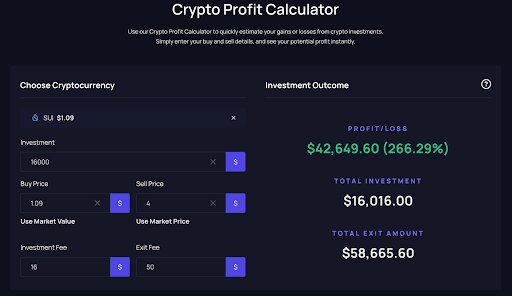
Marketcapof’s crypto calculator is the easiest and most convenient one to use. And the printscreen above speaks for itself. You need to pick a certain cryptocurrency from the list (and if it’s not on the list, just paste the smart contract, it will work).
Then set up the initial investment and at what buy price you got that token. In this example, we’ve used the button for “Use market value” to get the exact price of SUI. And we simulated what would be our profit if SUI would reach $4.
The calculator focuses on straightforward inputs and simplified estimation tools. I’ve also added the investment fee and the exit fee – but that’s only if you want to.
What MarketCapOf Is Used For
The platform lets you compare cryptocurrencies (and stocks) against each other and instantly estimate hypothetical prices.
For example:
- What if DOGE reached Ethereum’s market cap?
- What if SOL flipped BNB?
- What happens if XRP reaches the market valuation of gold?
You enter a coin, pick another asset’s market cap, and the calculator does the rest. The interface makes it easy to compare hypothetical valuation scenarios across different assets.
Key Features of MarketCapOf
- Marketcapof Crypto Calculator
- Real-time market cap data;
- Hypothetical price simulations;
- Easy-to-read UI;
- Supports major cryptocurrencies and stocks;
- Helpful for long-term scenario analysis.
More importantly, MarketCapOf avoids the common problem many crypto tools have: unnecessary clutter, no complicated dashboards, and he platform avoids overly complex dashboards that may overwhelm casual users.
Just straightforward calculations. Even beginners who don’t fully understand market capitalization yet can use the tool immediately without feeling overwhelmed.
That’s rare in crypto.
Who Is MarketCapOf Suitable For
MarketCapOf is ideal for:
- Long-term investors;
- Crypto beginners;
- Research-focused traders;
- Users comparing upside potential between assets.
- The platform may also appeal to casual users experimenting with smaller crypto investments.
The last one’s a joke, but you get the idea – Marketcapof is perfect for anyone new or experienced in crypto and can be used to compare your favorite cryptocurrencies.
2. CoinStats

Source: Conistats
CoinStats is less of a “single calculator” and more of a complete crypto tracking ecosystem. Still, its built-in calculators and analytics tools make it one of the strongest options available in 2026.
Especially if your portfolio is spread across multiple exchanges and wallets, which, let’s be honest, describes most crypto users nowadays.
Why Do People Use CoinStats
Automation. Instead of manually entering trades into spreadsheets like it’s 2017, CoinStats syncs directly with exchanges, wallets, and DeFi protocols.
Then it calculates:
- Portfolio performance;
- Profit/loss;
- Allocation percentages;
- Transaction history;
- Tax estimates;
- Staking rewards.
All in one place, and yes, seeing your portfolio performance in real time can be emotionally dangerous during market volatility. But at least the numbers are accurate.
Key Features of CoinStats
- Portfolio syncing;
- Multi-chain support;
- Tax reporting tools;
- Live price tracking;
- DeFi analytics;
- Mobile-friendly interface.
Another thing CoinStats does well: visualization. The dashboards are clean, readable, and beginner-friendly without feeling overly simplistic. A lot of crypto apps struggle with that balance, and some platforms prioritize advanced analytics, while others focus more heavily on visual simplicity.
CoinStats lands somewhere in the middle.
Who May Find CoinStats Useful
CoinStats is ideal for:
- Active traders;
- Multi-wallet investors;
- DeFi users;
- Long-term portfolio tracking;
- Users managing taxes across exchanges.
Particularly if you’re tired of opening six tabs just to figure out whether your portfolio is actually up or down for the month.
3. TradingFinder

Source: TradingFinder
TradingFinder takes a different approach. Instead of focusing mainly on portfolio tracking or market cap comparisons, it leans heavily into trading calculations.
Risk management, leverage, position sizing, liquidation levels… These tools focus on trading metrics that become especially important in leveraged markets.
Why Do People Use TradingFinder
The platform includes a wide range of calculators specifically built for active trading.
That includes:
- Position size calculators;
- Risk/reward calculators;
- Pip calculators;
- Futures profit calculators;
- Margin calculators;
- Leverage calculators.
And yes, crypto traders absolutely need those because crypto volatility can get ridiculous fast. A 5% move may be considered significant in traditional markets, while similar volatility can occur more frequently in crypto markets.
Key Features of TradingFinder
- Trading-focused tools;
- Beginner-friendly calculators;
- Fast calculations;
- Supports crypto and forex markets;
- Useful educational content.
One thing TradingFinder does particularly well is accessibility. Many advanced trading calculators assume you already know every technical term on the screen. TradingFinder explains concepts clearly enough that newer traders can actually learn while using the tools.
This can improve accessibility for newer traders learning trading terminology.
Who Is TradingFinder Suitable For
TradingFinder is suited for:
- Futures traders;
- Day traders;
- Scalpers;
- Leverage users;
- Beginners learning risk management.
Proper position sizing can help traders manage downside risk more effectively. Many traders focus heavily on identifying high-upside investment opportunities. Very few spend time calculating how much they should actually risk on a trade. That’s usually the more important calculation.
Conclusion
Crypto calculators used to be niche tools for hardcore traders. Not anymore and in 2026, they’ve become part of everyday investing.
Whether you’re comparing market caps, tracking portfolio growth, estimating staking rewards, or managing leveraged trades. These tools can help users organize trading data and evaluate potential risk scenarios more efficiently.
MarketCapOf stands out for valuation comparisons, CoinStats shines for portfolio management, while TradingFinder delivers strong trading-focused calculations.
And beyond calculators themselves, smart investors are increasingly combining pricing tools with on-chain insights to better understand aspects such as whale activity and token distribution before making investment decisions.
Because in crypto, numbers alone rarely tell the full story.
The post Leading Crypto Calculators to Compare Prices, Profits, and Risk in 2026 appeared first on Ventureburn.