
India’s urban mobility ambitions are entering a new phase — and this time, the spotlight is not just on metro trains or new rail corridors, but on the institutions quietly financing the future of Indian cities.
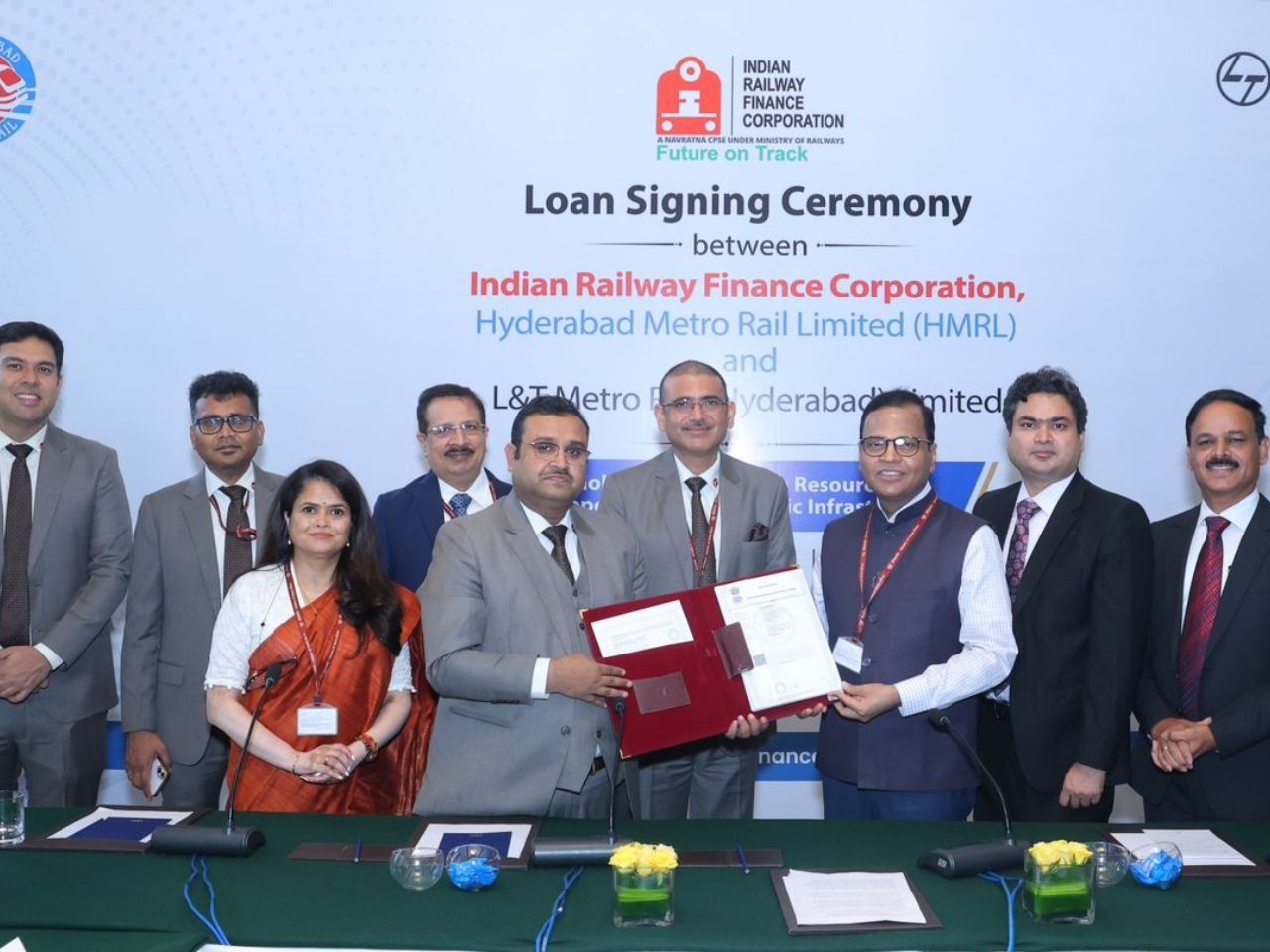
In a major development for the country’s infrastructure and transportation ecosystem, Indian Railway Finance Corporation has signed a massive Rs 13,527 crore refinancing agreement for the L&T Metro Rail (Hyderabad) Limited project, marking one of the largest refinancing transactions in India’s urban transit sector.
The agreement, signed on Monday, is far bigger than a routine financial deal. It reflects a growing transformation within IRFC itself — from being primarily a railway financing arm into a broader infrastructure financing powerhouse that now wants to play a larger role in India’s expanding urban transit ecosystem.
At the centre of this transition is the Hyderabad Metro Rail project, one of India’s most ambitious metro systems and among the largest public-private partnership (PPP)-based metro projects in the world.
A Landmark Financing Move for Urban India
The refinancing agreement was signed in the presence of IRFC CMD and CEO Manoj Kumar Dubey and Telangana Chief Secretary K. Ramakrishna Rao, underlining the strategic significance of the transaction for both the state and the Centre.
The funding facility will refinance existing liabilities tied to the Hyderabad Metro project, including non-convertible debentures (NCDs), commercial papers and term loans. In simpler terms, the transaction is designed to replace older and relatively expensive debt with a more structured, long-term and financially sustainable funding arrangement.
The refinancing has been structured over a 20-year tenure with quarterly repayments, giving the project significantly greater financial flexibility for future expansion and operations.
Importantly, the structure has been designed to be borrower-friendly. Officials said the facility carries no processing fees, commitment charges or prepayment penalties — a move that substantially reduces the financing burden on the metro project over the long run.
The agreement is also backed by multiple layers of financial safeguards, including an unconditional and irrevocable undertaking from the Government of Telangana, a state government guarantee and an RBI-backed direct debit mandate.
Taken together, the structure demonstrates how large-scale infrastructure financing in India is becoming increasingly sophisticated and domestically driven.
Hyderabad Metro’s Journey Enters a New Chapter
The refinancing deal comes at a crucial moment for the Hyderabad Metro network.
Recently, 100 per cent ownership of L&T Metro Rail (Hyderabad) Limited was transferred from Larsen & Toubro Limited to the Government of Telangana through Hyderabad Metro Rail Limited (HMRL).
The transition has effectively repositioned the metro system from a privately controlled PPP asset into a strategic public mobility network under state ownership.
That shift is expected to provide stronger institutional support for the project’s next phase of growth, especially as Hyderabad continues expanding into new residential and commercial corridors.
Spread across 69.2 kilometres and three major corridors with 57 stations, Hyderabad Metro Rail Phase-I today serves more than five lakh passenger journeys every day. Over the years, the network has become one of the city’s most important transportation lifelines, reducing traffic congestion and improving daily commute efficiency for lakhs of residents.
Now, with refinancing support in place, the Telangana government is expected to accelerate metro expansion into emerging urban growth zones while also strengthening last-mile connectivity and carrying capacity across the city.
IRFC Wants a Bigger Role Beyond Railways
For IRFC, however, the transaction represents something even larger — a strategic repositioning of the institution itself.
Traditionally known as the dedicated financing arm of Indian Railways, IRFC has long played a crucial role in funding railway expansion and rolling stock acquisition. But over the past few years, the company has gradually started diversifying beyond conventional railway financing.
The Hyderabad Metro refinancing deal signals that this diversification strategy is now gaining serious momentum.
Speaking on the occasion, IRFC CMD Manoj Kumar Dubey said the agreement reflects the organisation’s growing ability to structure innovative, long-tenor financing solutions for nationally important infrastructure projects.
He added that IRFC is not restricting itself to Hyderabad alone and is open to supporting metro rail projects for any state government seeking financing assistance.
In a particularly notable statement, Dubey also said the company is interested in participating in the financing of India’s future bullet train projects — a signal that IRFC wants to position itself at the centre of India’s next-generation transportation infrastructure push.
The company believes its strengths — including sovereign-backed borrowing capability, strong market credibility, deep access to capital markets and a zero-NPA track record — uniquely position it to finance large-scale infrastructure projects that require stable, long-term capital.
Financing India’s Infrastructure — With Indian Capital
One of the strongest messages emerging from the transaction is India’s increasing ability to fund major infrastructure projects domestically.
Dubey said the refinancing demonstrates that large-scale urban infrastructure can be financed efficiently through long-term funding structures aligned with project cash flows.
More importantly, he emphasised that IRFC aims to become a trusted domestic financing partner capable of channeling “Indian savings into Indian infrastructure on Indian terms.”
That statement reflects a broader shift currently underway in India’s infrastructure financing ecosystem.
As India races toward becoming a developed economy under the government’s Viksit Bharat vision, the country is expected to require enormous investments across railways, metros, logistics, airports, clean mobility and urban infrastructure. Financing those projects sustainably — without excessive dependence on foreign capital — is becoming a major policy priority.
Institutions like IRFC are now emerging as critical players in that journey.
Why This Deal Matters Beyond Hyderabad
The Hyderabad Metro refinancing transaction is already being viewed by many in infrastructure and financial circles as a possible template for future urban transit financing across India.
Metro rail projects are capital-intensive by nature and often require long gestation periods before achieving financial stability. Access to affordable long-term financing therefore becomes one of the most important determinants of a project’s sustainability.
The structure created by IRFC — combining long-tenor funding, state-backed guarantees and borrower-friendly repayment terms — could potentially serve as a replicable model for other metro projects in cities looking to expand sustainable public transportation systems.
This becomes especially important as India continues witnessing rapid urbanisation.
Cities across the country are under growing pressure to build integrated public transport systems that can support economic activity while reducing congestion and pollution. Metro rail networks are increasingly becoming central to that urban planning vision.
By stepping deeper into urban transit financing, IRFC is effectively positioning itself at the intersection of infrastructure, mobility and economic development.
A Strategic Expansion With Long-Term Implications
The Rs 13,527 crore Hyderabad Metro refinancing agreement may appear on the surface like a major corporate debt transaction. But underneath, it tells a much larger story about how India is preparing to finance its future.
It reflects the rise of domestic institutions capable of supporting massive infrastructure ambitions. It highlights the growing importance of sustainable urban mobility. And it signals how financial innovation is becoming just as important as engineering innovation in building modern Indian cities.
For Hyderabad, the refinancing strengthens the metro network’s financial flexibility and opens the door for future expansion.
For IRFC, it marks another decisive step toward becoming one of India’s most influential infrastructure financing institutions beyond the railway sector.
And for India’s broader infrastructure ecosystem, the deal sends a clear message — the country is steadily building the financial architecture needed to fund its next era of growth.