
Nashik is standing at a historic threshold. Every few decades, a city gets an opportunity not only to host an event, but to redefine its future. For Nashik, that opportunity is Simhastha Kumbh 2027 :- a moment where sacred geography, civic ambition, cultural memory, industrial capacity, youth aspirations and Maharashtra’s development vision are converging.
The preparation for Kumbh cannot be seen only through roads, ghats, sanitation, transport and crowd management. Those are essential. Even as monsoon management continues on the ground, Nashik’s elected representatives, administration and civic stakeholders appear to be working simultaneously on a larger future-facing agenda :- one that looks beyond temporary arrangements and towards long-term legacy.
The larger question before Nashik is therefore far more significant: Can Simhastha Kumbh become the foundation for a new Nashik :- spiritually rooted, culturally confident, industrially vibrant, globally visible, youth-centric and inclusive?
That is where the idea of Building Nashik, Elevating Maharashtra becomes more than a slogan. It becomes a development direction.
Nashik Is Not Just Another Kumbh City
Nashik carries a civilisational identity that few cities can claim.
It is part of India’s sacred geography :- connected with the Godavari, Trimbakeshwar, Panchavati, Ramayan, ancient tirthas and living devotional practices. It is also the land associated with Dadasaheb Phalke, the father of Indian cinema and shot first Indian movie in Nashik. His pioneering work gave India its earliest cinematic imagination.
Nashik’s cultural personality also carries the literary force of Kusumagraj, the celebrated Marathi poet, playwright and novelist whose contribution to Maharashtra’s literary, cultural and social life remains deeply respected.
This combination is rare.
Nashik is not only a pilgrimage city. It is a river city, a temple city, a literary city, a cinema legacy city, a culinary and agriculture-driven region, a manufacturing centre and an emerging urban economy.
Its agriculture and food identity are equally powerful. Nashik district is strongly associated with grapes, onions, raisins, pomegranates and other high-value agricultural produce. Its grape exports and GI-linked agri identity have already given the district national and international visibility. Its food traditions, local produce, temple-town food economy and regional culinary entrepreneurship can become an important part of the visitor economy around Kumbh and beyond.
Its industrial base also gives the city a practical growth advantage. Nashik has long been known for engineering, manufacturing, defence-linked production, electrical equipment, automotive components, food processing and MSME strength. The Igatpuri-Nashik-Sinnar investment region is also linked to the larger Delhi-Mumbai Industrial Corridor vision, giving the city a strategic industrial location.
If Mumbai is Maharashtra’s financial, film, entertainment capital, Pune its IT, knowledge and education hub and Nagpur its logistics and governance centre, Nashik has the opportunity to emerge as Maharashtra’s spiritual, creative, agricultural and future industries capital.
A Leadership Moment for Nashik
Large transformations happen when vision, execution and local leadership move in alignment.
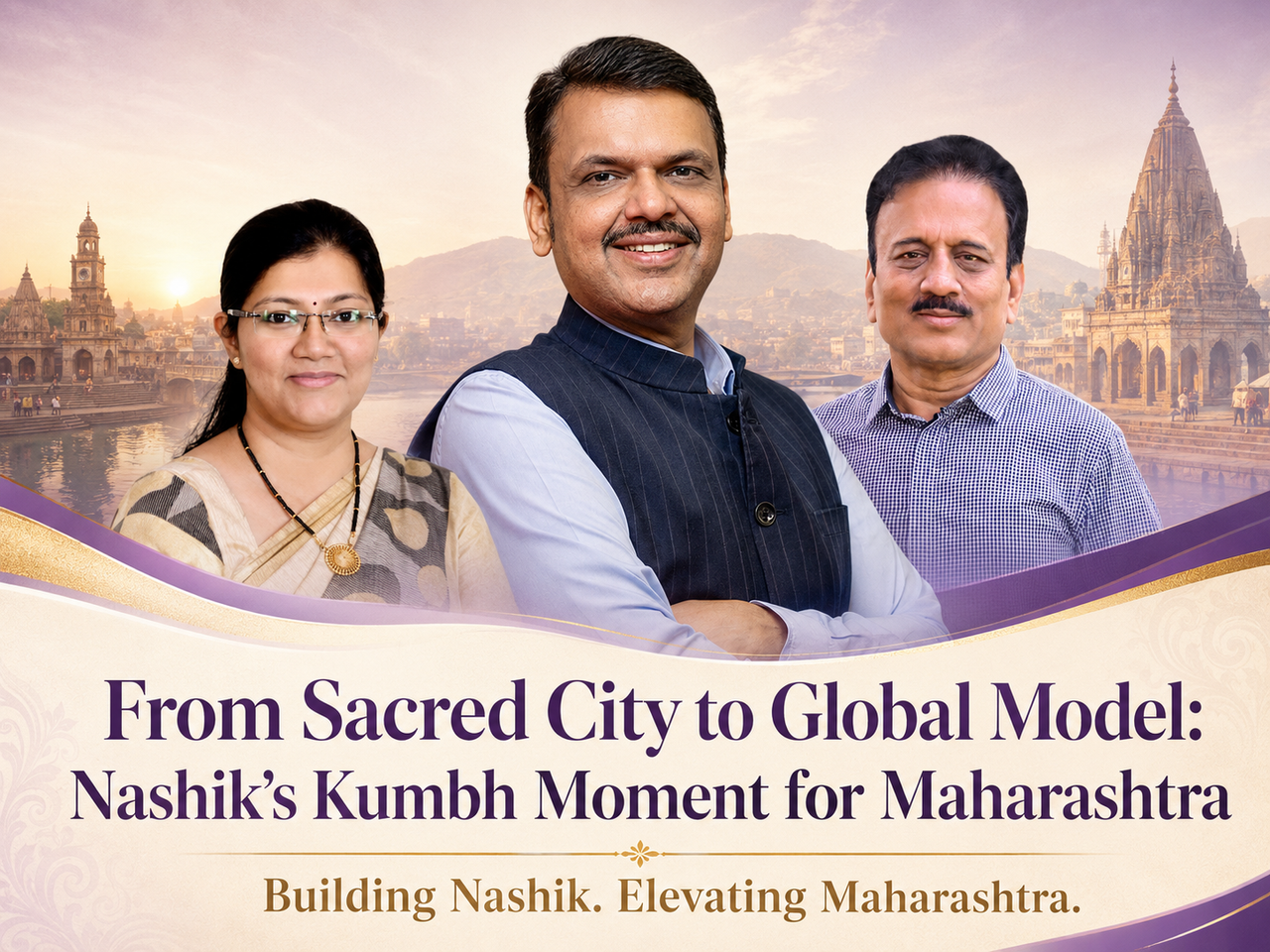
Hon’ble Chief Minister Devendra Fadnavis has previously spoken of Nashik in deeply personal development terms, stating that he was “adopting Nashik” and would personally look after the city’s development priorities. That sentiment now carries renewed significance as the city prepares for Simhastha Kumbh 2027.
The Chief Minister has also described Kumbh as a reflection of India’s inclusive cultural spirit, where people come together beyond caste and ideology. This framing is important because it positions Kumbh not merely as an administrative responsibility, but as a civilisational opportunity for inclusive public participation.
At the implementation level, Hon’ble Minister Girish Mahajan’s role in steering Kumbh preparations gives Nashik a focused administrative anchor. The state’s push for timely completion of Kumbh-related works, including roads, bridges, ghats and sewage treatment upgrades, reflects the scale and seriousness of the preparation underway.
At the civic level, Hon’ble Mayor Himgauri Aher has taken charge at a defining moment for Nashik. Her priorities are not limited to routine civic administration. Public reports have highlighted her focus on reviving long-pending projects such as the IT Park and logistics hub, while also pushing youth employability and skill-based education for emerging industry needs.
This is important because Nashik’s future will not be shaped by pilgrimage infrastructure alone. It will also depend on whether new industries, new-age education, e-learning infrastructure, future skilling ecosystems and youth-focused opportunities can be brought into the city.
Together, this creates a rare leadership alignment: state vision, ministerial execution and city-level civic leadership.
Kumbh as a Transformation Platform, Not Just an Event
The Simhastha Kumbh will bring pilgrims. But if planned with vision, it can also bring something more enduring: livelihoods, enterprises, youth participation, creative industries, tourism circuits, digital visibility, cultural infrastructure and civic pride.
A successful Kumbh should not end when the last pilgrim leaves.
It should leave behind better urban systems, cleaner rivers, stronger roads, improved public spaces, trained youth, empowered local businesses, upgraded tourism capacity and a new confidence in the city’s future.
For Nashik, the Kumbh opportunity can be imagined across multiple long-term dimensions:
-Spiritual tourism and pilgrimage experience.
-Riverfront and heritage-linked civic renewal.
-Youth volunteering, skilling and entrepreneurship.
-Local artisans, guides, performers, food entrepreneurs and service providers.
-Creative economy, storytelling and digital content.
-Culinary tourism and agriculture-linked visitor experiences.
-Manufacturing, logistics and industry-linked opportunities.
-Clean, green and inclusive public systems.
-Investment attraction and destination branding.
-E-education, skill development and future industry training.
This is where Nashik can demonstrate something important for Bharat: that sacred cities do not have to choose between heritage and modernity. They can preserve their soul while building future-ready systems.
From Sacred Geography to Economic Geography
Nashik’s sacred geography is already known to millions of devotees. But the city’s next leap will come when this sacred geography is connected with economic geography.
The Godavari, Trimbakeshwar, Panchavati and Kumbh routes give Nashik a spiritual map. Its agriculture, manufacturing, MSMEs, logistics potential, creative legacy and youth population give it an economic map.
The real opportunity is to connect both.
A pilgrim who comes to Nashik should experience not only temples and ghats, but also the city’s food, local enterprise, crafts, cultural performances, digital storytelling, heritage trails, youth volunteers and improved civic systems.
A student in Nashik should see Kumbh not merely as a religious gathering, but as a live classroom for management, technology, media, hospitality, sustainability, logistics, tourism, entrepreneurship and public service.
A local entrepreneur should see Kumbh not as a temporary market, but as a launchpad for long-term business opportunities.
A manufacturer, investor or institution should see Nashik not as a city preparing for one event, but as a city building future capacity.
That is how Nashik can move from being a sacred destination to becoming a complete development model.
From Sacred City to Global Model for Bharat
Across the world, cities have used major cultural, religious and sporting events to reshape their long-term identity. The best examples are not remembered only for event management. They are remembered for what they built before the event and what they sustained after it.
Nashik can do the same.
The city’s sacred geography gives it authenticity. Its Kumbh identity gives it scale. Its Dadasaheb Phalke legacy gives it creative depth. Its Kusumagraj legacy gives it literary and cultural gravitas. Its agriculture and culinary strength give it local economic character. Its manufacturing base gives it industrial credibility. Its youth and entrepreneurs give it energy. Its leadership alignment gives it momentum.
The real opportunity is to position Nashik as a global model for Bharat’s sacred cities :- a model where pilgrimage, culture, literature, cinema, creativity, agriculture, manufacturing, technology, enterprise, sustainability, innovation and inclusion work together.
This is especially important because the future of Indian urban development cannot be limited to metros alone. Tier-2 cities like Nashik will increasingly define India’s next phase of growth. They carry culture, land, talent, aspiration and community identity in ways that larger metros often struggle to retain.
The Legacy Beyond 2027
The question that matters is not only whether Nashik can host a successful Kumbh.
The larger question is: What will Nashik become because of Kumbh?
-Will the city create new livelihoods for youth?
-Will local enterprises benefit from tourism and service demand?
-Will food entrepreneurs, farmers, artisans and service providers find new markets?
-Will creative professionals, writers, performers and content creators find new platforms?
-Will future industries, skilling institutions and e-education ecosystems find reason to come to Nashik?
-Will the Godavari and pilgrimage infrastructure see long-term improvement?
-Will Nashik’s brand travel beyond Maharashtra and India?
-Will citizens feel that Kumbh created a better city for them too?
That is the true test of legacy.
Recent public conversations around Nashik’s future show a welcome openness to ideas that combine heritage, youth, enterprise, tourism, content, technology, industry and inclusive development. This is the right direction. Kumbh must become a people-led, institution-backed, leadership-driven transformation moment.
Nashik’s Moment, Maharashtra’s Opportunity
Simhastha Kumbh 2027 can become a defining milestone in Nashik’s modern history.
If executed with vision, Nashik can move from being seen primarily as a pilgrimage destination to being recognised as Maharashtra’s spiritual, cultural, creative, agricultural, industrial and economic growth engine.
The city has the sacred geography.
It has the cultural memory.
It has the literary and cinematic legacy.
It has the agricultural and culinary strength.
It has the manufacturing base.
It has the youth energy.
It has the civic urgency.
It has the leadership attention.
It has the Kumbh moment.
What it now needs is an integrated vision that converts faith into infrastructure, heritage into opportunity, youth energy into enterprise, agriculture into value creation, industry into employment and civic preparation into generational pride.
Building Nashik is no longer only a city agenda. It is a Maharashtra opportunity and a Bharat model in the making.