
The parliamentary standing committee on commerce says India must move beyond tariff negotiations and strengthen advanced manufacturing, MSMEs and technology-led exports to secure its place in global supply chains.
India is being urged to fundamentally rethink its export strategy as rising tariffs, geopolitical shifts and changing global supply chains redefine international trade.
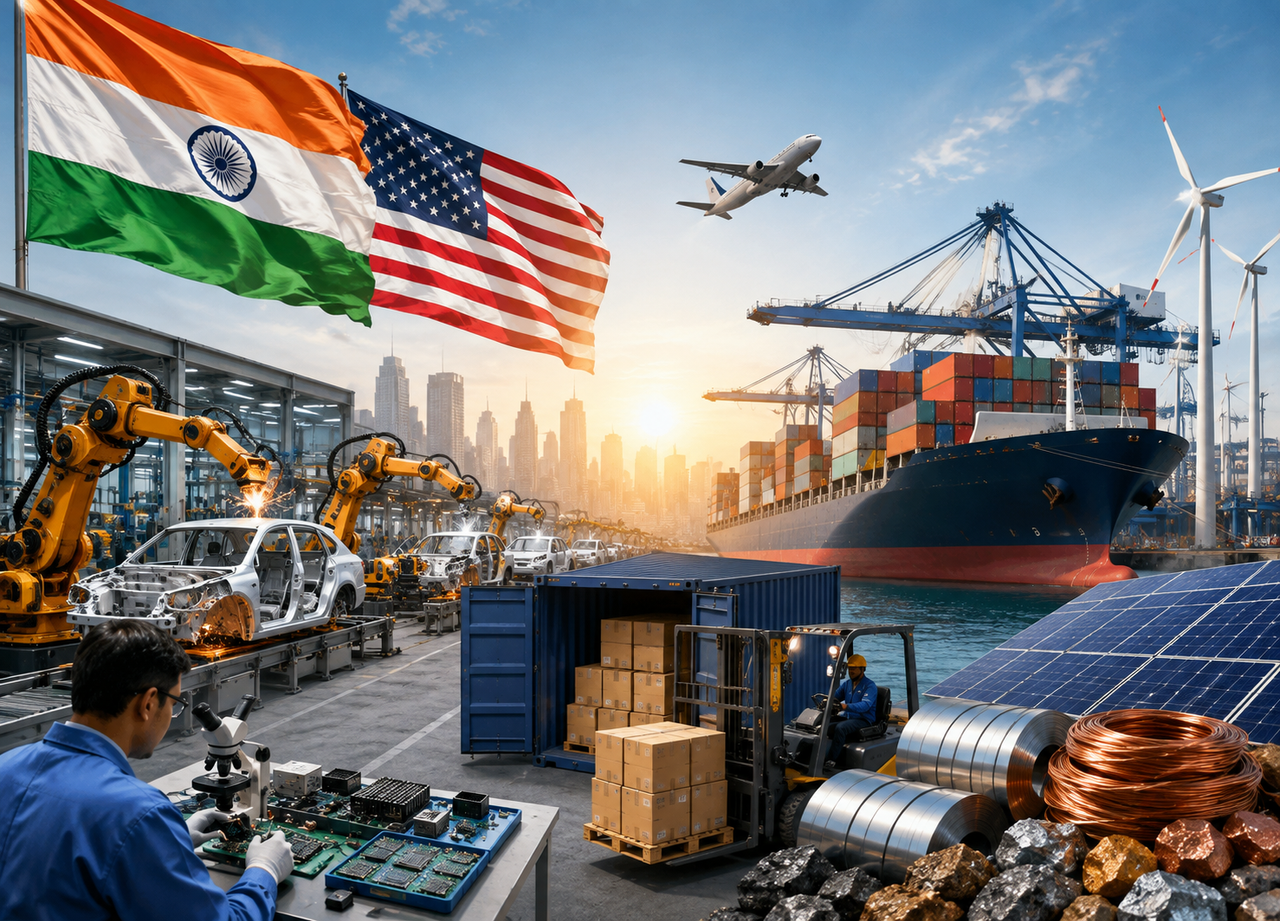
Rather than responding only through tariff negotiations, the Department-related Parliamentary Standing Committee on Commerce has recommended a broader strategy focused on technology-led manufacturing, stronger MSMEs, diversified export markets and faster integration into global value chains. The recommendations, contained in the Committee’s 200th Report on Evaluation of India-US Trade Relations, argue that India’s long-term competitiveness will depend less on lower tariffs and more on building industries that global companies increasingly depend upon.
The report comes at a crucial moment. India and the United States are working towards Mission 500, an ambitious goal of expanding bilateral trade to US$500 billion by 2030, even as businesses navigate tariff uncertainties and an increasingly fragmented global trading landscape.
The Real Opportunity Lies Beyond a Trade Agreement
Trade negotiations dominate headlines, but the Committee’s recommendations suggest the larger opportunity lies elsewhere.
While supporting the early conclusion of the proposed India-US Bilateral Trade Agreement, the report argues that India should simultaneously strengthen its industrial capabilities instead of relying solely on preferential market access. It recommends reducing logistics costs, addressing non-tariff barriers, improving export competitiveness and creating faster institutional mechanisms to resolve trade disputes.
The underlying message is unmistakable.
Trade agreements may open markets, but competitive industries determine who succeeds in them.
That represents an important shift in India’s trade thinking—from negotiating access to building enduring global competitiveness.
MSMEs Are Emerging as India’s Strategic Export Advantage
One of the strongest themes running through the report is the central role assigned to India’s micro, small and medium enterprises.
Across sectors including engineering goods, automotive components, textiles, leather, chemicals, agriculture and marine products, the Committee recommends easier export credit, technology upgradation, compliance support, market diversification and stronger institutional assistance to help MSMEs remain globally competitive.
This is more than a recommendation for small businesses.
It reflects a recognition that India’s export ambitions cannot be achieved by large corporations alone.
Millions of MSMEs already form the backbone of the country’s manufacturing ecosystem. Helping them comply with international standards, adopt modern technologies and access new overseas markets could significantly expand India’s participation in global value chains.
The report also proposes digital export support systems, overseas warehousing, early-warning mechanisms for regulatory changes and faster responses to trade disruptions—tools that increasingly define successful export economies.
Technology Is Becoming India’s New Trade Currency
Perhaps the report’s most significant message is not about tariffs at all.
It is about technology.
The Committee recommends deeper India-US collaboration in semiconductors, artificial intelligence, critical minerals, quantum technologies, advanced communications, clean energy and digital infrastructure. It also highlights the growing importance of Global Capability Centres (GCCs), engineering research, cloud computing and cybersecurity as future drivers of India’s export competitiveness.
That signals a broader transformation.
For decades, India’s export success was largely associated with labour-intensive industries and IT services.
The next phase is expected to be shaped increasingly by intellectual property, engineering capability, advanced manufacturing and knowledge-intensive products.
In other words, India’s future exports may depend as much on innovation as on production.
Resilient Supply Chains Are Becoming the New Competitive Edge
The Committee also encourages Indian businesses to reduce excessive dependence on individual export markets.
Alongside an early bilateral trade agreement with the United States, it recommends expanding commercial engagement across Europe, ASEAN, Africa, the Gulf and Latin America, while encouraging companies to diversify both products and markets.
That recommendation reflects a larger shift in global trade.
Companies worldwide are redesigning supply chains to improve resilience rather than maximise efficiency alone.
For India, this presents an opportunity.
If it can combine manufacturing scale, policy stability, technology capability and a competitive MSME ecosystem, it could emerge as one of the preferred alternatives in a rapidly diversifying global supply chain.
India’s Next Export Story Will Be Written in Its Factories and Innovation Labs
Tariffs may have triggered the debate.
But they are unlikely to define India’s long-term trade success.
The Parliamentary Committee’s recommendations point towards a future where export competitiveness depends on technology, manufacturing capability, resilient supply chains and globally competitive enterprises rather than tariff advantages alone.
Every major export economy has eventually reached a point where competing on cost was no longer enough.
That moment appears to be approaching for India.
The country’s next export breakthrough may not come from selling more products overseas.
It may come from building products, technologies and industrial capabilities that the world increasingly cannot build without.