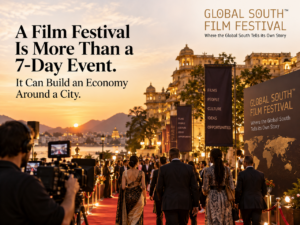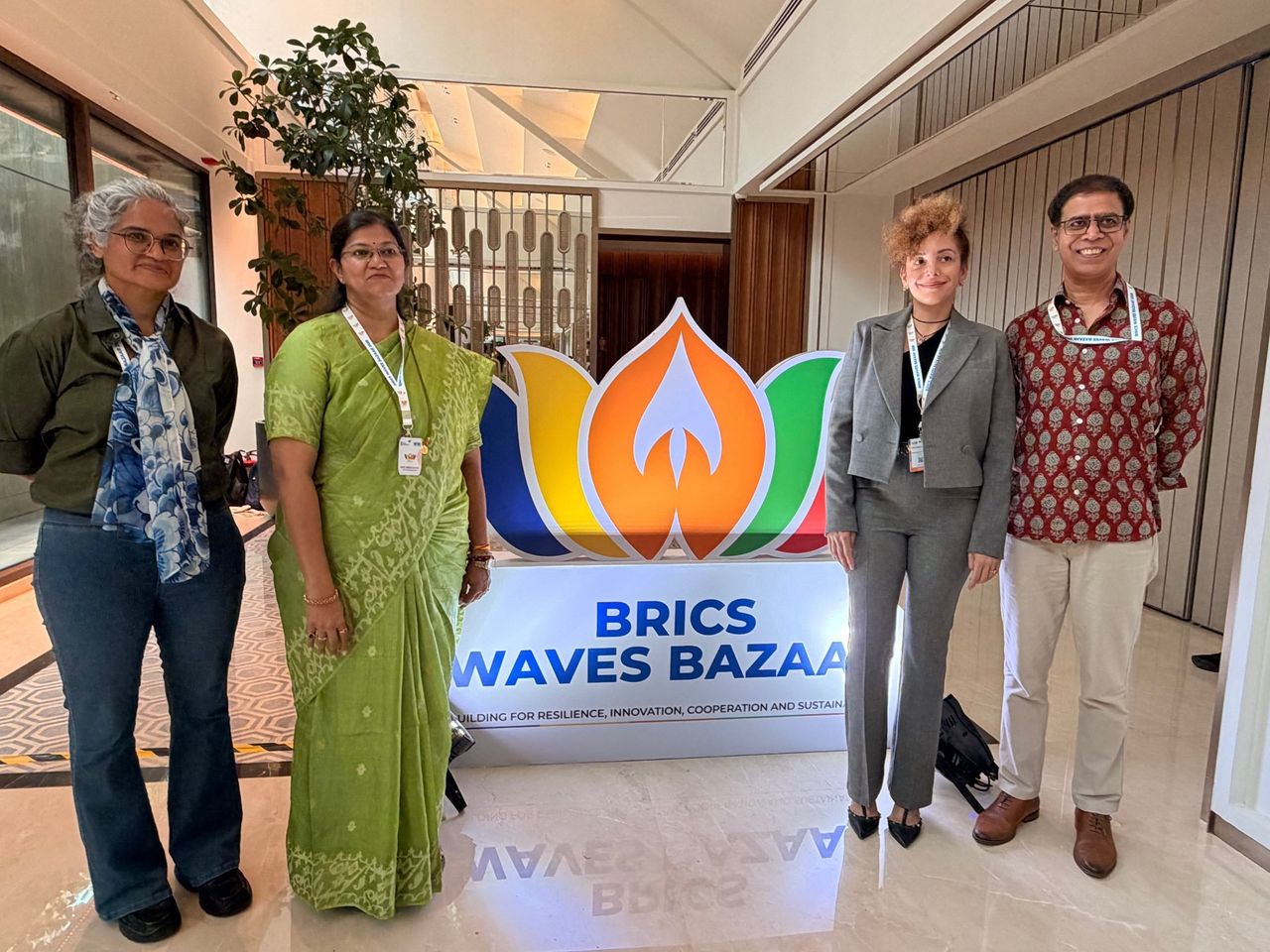

Some creative ideas are born in boardrooms. Others emerge from conversations between people who believe that something new is possible. The Global South Film Festival (GSFF) belongs to the second category.
Its journey has been closely connected with India’s expanding creative economy ecosystem of international film cooperation, creative industries and cultural diplomacy from the International Film Festival of India (IFFI) and Film Bazaar in Goa to the BRICS WAVES Bazaar in Mumbai and the BRICS Summit in New Delhi.
It began with IFFI Goa and Film Bazaar
The first conversations that eventually led to GSFF took place around IFFI Goa and Film Bazaar, where Indian co-creators met colleagues from Brazil, Russia and the UAE. What began as conversations around films, filmmakers and international collaboration soon became a larger question:
Could there be a platform where the Global South could come together not only to screen films, but also to build creative, cultural and business partnerships?
Film Bazaar’s role in bringing filmmakers, producers, sales agents, festival programmers and other industry stakeholders together provided a natural environment for such conversations. NFDC’s film-market ecosystem has increasingly become an important interface between Indian cinema and international creative industries.
MIB and NFDC: Creating the institutional pathway
An idea needs an institutional ecosystem to move from conversation to implementation.
The Ministry of Information & Broadcasting has an established mandate covering IFFI, national and international film festivals, Film Bazaar and financial assistance to film-festival organisers under the Development, Communication & Dissemination of Filmic Content (DCDFC) framework. The Ministry’s current guidelines specifically provide for financial assistance to domestic film festivals through NFDC.
For the Indian co-creators of GSFF, this created a meaningful pathway to explore how an international Global South film platform could be developed within India’s broader film and creative-economy ecosystem.
BRICS WAVES Bazaar: The idea finds a larger network
The next defining moment came at the BRICS WAVES Bazaar 2026 in Mumbai, hosted by the Ministry of Information & Broadcasting through NFDC.
The Bazaar brought together more than 900 industry delegates from 20 BRICS member and partner countries and facilitated more than 275 curated B2B meetings involving producers, studios, broadcasters, film commissions, government representatives, investors, technology companies and creative enterprises.
For GSFF, this was transformative.
/fit-in/580x348/filters:format(webp)/tice-news-prod/media/media_files/2026/09/20/mayor-1-2026-09-20-17-51-05.jpeg)
- During the BRICS Waves Bazaar, Nashik’s Honorable Mayor HImgauri Aher Adke ji,d presented Nashik vision for the Orange Economy, opening a conversation around the city as a potential host.
/fit-in/580x348/filters:format(webp)/tice-news-prod/media/media_files/2026/08/21/gsff-brics-nfdc-2026-08-21-16-21-12.jpeg)
- More importantly, the emerging GSFF consortium expanded dramatically. Eleven new members from across eight countries joined the initiative, bringing new geographies, expertise and relationships into the platform.
/fit-in/580x348/filters:format(webp)/tice-news-prod/media/media_files/2026/08/21/gsff-press-2026-08-21-15-52-36.jpeg)
Global South Film Festival announcement at BRICS WAVES, MUMBAI
NFDC also provided a platform for us to announce GSFF. An idea that had begun with a few conversations was now becoming an international consortium.
From consortium to institution
Since then, the momentum has continued.
Three additional cities have expressed interest in exploring the possibility of hosting GSFF. Brands, creative-industry professionals and other stakeholders have approached the initiative. A Festival Director, Curator and Advisory Board are now being brought into the institutional architecture.
This is perhaps the most important outcome of the journey so far: the platform is beginning to create its own ecosystem.
BRICS Delhi: A larger cultural and creative context
India’s BRICS Chairship in 2026 provided another important dimension.
The BRICS declaration placed Creative Economy and People-to-People Cooperation among its key areas of co-operation, alongside cultural heritage and culture, climate. The New Delhi Declaration reaffirmed cultural and people-to-people cooperation as one of the three pillars of BRICS cooperation, alongside political and security and economic and financial cooperation.
At BRICS Delhi, we launched KAVYA, GSFF’s AI filmmaking initiative, bringing technology, storytelling and cultural heritage into the conversation.
For us, the alignment was clear.
GSFF embodies many of the principles that India’s BRICS Presidency has brought into sharper focus: people-to-people connections, cultural cooperation, creative industries, technology, innovation and South-South collaboration.
Giving the Global South Film Festival its wings
The inaugural Global South Film Festival is planned for March 2027.
We are now working with prospective host states and cities to explore how their films, culture, cuisine, heritage, tourism, creative industries and local talent can be presented to an international Global South audience.
The ambition is to bring together filmmakers, producers, investors, cultural leaders, creative entrepreneurs and industry personalities from across the Global South with an expected participation of more than 250 industry personalities and delegates.
Looking back, the journey has a remarkable institutional chronology:
– IFFI Goa created the first conversations.
– Film Bazaar enabled the first international industry connections.
– MIB and NFDC provided the institutional and policy ecosystem.
– BRICS WAVES Bazaar expanded the network and gave GSFF an industry platform.
– BRICS Delhi provided a larger framework of cultural cooperation, people-to-people exchange and the creative economy.
The idea may have begun with a few people. But it found its wings because India had already been building the platforms, institutions and international bridges that make such an idea possible.
And that is a story worth acknowledging.
-Dr Seema
India Lead, Global South Film Festival
https://globalsouthfilmfestival.org/