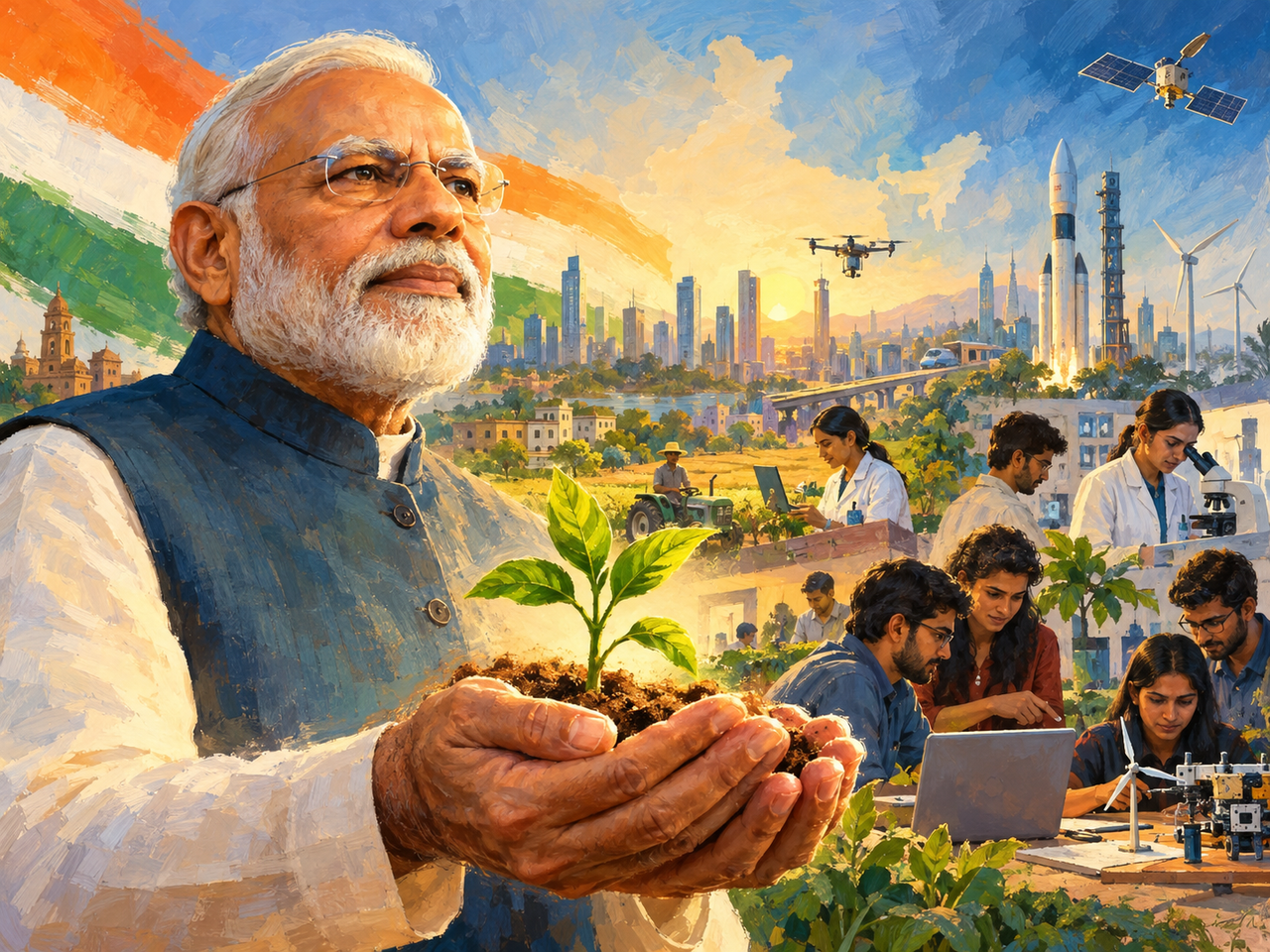

The nation is marking ‘Seva Diwas’ today as Prime Minister Narendra Modi turns 76. At its heart, seva is about contributing to something larger than oneself – serving society, solving problems and creating value for others.
For an entrepreneur or investor, that idea of service means building a business that solves a real problem, generating employment, developing new technology and adding economic value. A decade ago, that broad concept was codified into policy.
On January 16, 2016, Startup India was launched with an ambition to build an ecosystem for entrepreneurs and transform India from a nation of job seekers into one of job creators. At the time, just 502 startups were recognised. Today, that number had crossed 2.50 lakh, with recognised startups reporting more than 23.36 lakh direct jobs.
The scale of that change is now being described not simply as an increase in startup numbers, but as a shift in India’s entrepreneurial culture.
“Under the visionary leadership of Hon’ble Prime Minister Shri Narendra Modi, Startup India has grown from fewer than 500 DPIIT-recognised startups in 2016 to over 2.5 lakh today. This is more than growth in numbers; it is a new culture of entrepreneurship. The next decade is about taking Indian innovation from local ideas to global impact.”
— Ateesh Kumar Singh, Additional Secretary, Department for Promotion of Industry and Internal Trade (DPIIT)
The numbers are striking, but the more interesting story lies beneath them.
What began as a policy push to simplify the process of starting a business has evolved into a broad economic ecosystem – one that now reaches small-town founders, women entrepreneurs, deep-tech pioneers, space ventures and an increasingly sophisticated pool of institutional capital.
As Modi turns 76, Startup India provides a useful lens through which to look back at that journey: what was planted in 2016, how far it has grown, and what the next decade will demand from India’s founders, investors and policymakers.
Because the fundamental question has changed.
A decade ago, India was asking how to create more startups. Today, with over two lakh recognised ventures, the harder question is: what can India build with them?
/fit-in/580x348/filters:format(webp)/tice-news-prod/media/media_files/ibICScIjDqbyZtXqjJTz.jpg)
The Seed Was Small. The Ecosystem Isn’t.
Startup India began with a 19-point Action Plan built around three broad ideas: simplification and handholding, funding support and incentives, and industry-academia partnerships and incubation. It included self-certification, streamlined intellectual property processes, public procurement reforms, faster exits and a ₹10,000 crore Fund of Funds.
But the policy challenge went beyond incentives. Starting a company is rarely just about having a good idea. Founders need capital, customers, mentors, talent, intellectual property support and a regulatory environment that allows experimentation without making it unnecessarily difficult.
Over the years, that supporting architecture has grown considerably.
Startup recognition has been accompanied by incubator networks, seed funding, credit guarantees, investor connections and digital platforms. Government data shows that FY2025-26 alone saw more than 55,200 startups recognised – the highest annual addition since Startup India began.
The environment for an Indian founder today is therefore markedly different from what it was in 2016.
And that has changed the policy question too.
/fit-in/580x348/filters:format(webp)/tice-news-prod/media/media_files/2025/01/19/fNQcTLcszdR1TZ0Zx6I0.png)
The Capital Question Has Changed Too
Capital was always going to be central to the experiment.
The initial Fund of Funds for Startups (FFS 1.0) was designed not to pick individual winners, but to channel government-backed capital through Alternative Investment Funds and catalyse India’s private venture market.
Under FFS 1.0, the entire ₹10,000 crore corpus has been committed to 145 AIFs, which have invested more than ₹25,500 crore in over 1,370 startups across sectors ranging from AI and robotics to clean technology, healthcare, space technology and biotechnology.
That model has now entered its next phase.
In February 2026, the government approved Startup India Fund of Funds 2.0, with another ₹10,000 crore corpus. Its focus is revealing: deep tech, technology-driven innovative manufacturing and early-growth companies. The objective is to mobilise patient domestic institutional capital rather than simply create another public funding pool.
Early-stage support has expanded alongside it.
The Startup India Seed Fund Scheme operates with a ₹945 crore corpus. By the end of FY2025-26, 219 incubators had been selected, with more than ₹605 crore approved for over 3,400 startups. Meanwhile, the Credit Guarantee Scheme for Startups had guaranteed more than 410 loans worth over ₹1,250 crore.
The maximum guarantee cover per borrower has also been raised from ₹10 crore to ₹20 crore.
Taken together, these interventions point to a maturing capital architecture.
India is no longer asking only how to fund entrepreneurs. The more difficult question is how to finance companies through different stages of risk — from an idea and prototype to commercialisation and scale.
That distinction becomes crucial when startups move into technologies that may require years, rather than months, to reach the market.
/fit-in/580x348/filters:format(webp)/tice-news-prod/media/media_files/WFfFs0mN53NQ3zIHQ8ML.jpg)
The Startup Map Is No Longer Just the Metros
For much of the first decade of India’s startup story, the narrative was dominated by Bengaluru, Mumbai, Delhi-NCR and a handful of other technology centres.
That geography is changing.
Government data shows that more than half of India’s recognised startups now emerge from Tier-II and Tier-III cities. Nearly 48% of recognised ventures have at least one woman director or partner.
This matters because geography influences the kind of problems entrepreneurs see – and the markets they build for.
As startups spread beyond the traditional technology hubs, entrepreneurship increasingly intersects with agriculture, manufacturing, healthcare, logistics, education, financial services and regional supply chains.
The employment footprint has expanded alongside it. Recognised startups had reported more than 23.36 lakh direct jobs by March 2026, with startups now present across every State and Union Territory.
Recognition alone, of course, does not guarantee commercial success. Nor does a larger startup count automatically translate into productive businesses.
But the geographical shift is significant.
Entrepreneurship is becoming less dependent on proximity to India’s traditional startup hubs. The map has widened. The next challenge is to deepen the economic impact of that expansion.
/fit-in/580x348/filters:format(webp)/tice-news-prod/media/media_files/2026/09/17/ateesh-kumar-singh-additional-secretary-dpiit-2026-09-17-15-02-53.png)
From Valuation to Intellectual Property and Deep Tech
For much of the past decade, India’s startup success was measured through a familiar vocabulary: funding rounds, valuations and unicorn counts.
That vocabulary is now expanding.
India’s emerging startup ambitions increasingly span artificial intelligence, space technology, robotics, semiconductors, climate technology and advanced manufacturing. Policy is moving in the same direction, with FoF 2.0 explicitly prioritising deep tech and innovative manufacturing.
Intellectual property offers another way to see the shift.
Startups have filed more than 19,400 patent applications, including over 4,480 applications in FY2025-26, according to government data.
The economics of these businesses are fundamentally different from those of consumer internet companies.
A software venture can often test and iterate a product relatively quickly. A space company may spend years on research, hardware testing and regulatory approvals. Biotech businesses face long research and validation cycles before commercialisation, while advanced manufacturing requires specialised facilities, engineering talent and industrial customers willing to adopt new technologies.
The capital requirement is different. So is the patience required.
That means the next chapter of Startup India will demand more than an entrepreneurial mindset. It will require the infrastructure around difficult businesses — laboratories, testing facilities, intellectual-property support, specialist talent, patient investors and early customers.
Creating a startup is one milestone. Turning difficult technology into a commercially viable company is another altogether.
/fit-in/580x348/filters:format(webp)/tice-news-prod/media/media_files/2026/05/06/startup-india-growth-2026-05-06-22-42-11.jpg)
Redefining Success for the Next Decade
Startup India began with the vision of creating job creators. Ten years after its launch, India has a far larger pool of founders and a significantly more developed institutional support system around them.
The next measure of progress cannot rely solely on registering more startups.
It will increasingly be reflected in sustainable revenues, exports, patents, productivity, manufacturing capability, technology ownership and companies that remain competitive long after their first venture round.
Maturity will also depend on how effectively capital and expertise recycle through the system.
A successful founder becomes an angel investor. An early employee becomes a founder. University research turns into a commercial product. A startup’s technology finds its way into an established industry. Domestic institutions begin backing the next generation of risk.
That is how a collection of startups becomes an economic ecosystem.
And it brings the conversation back to seva.
For a founder, service can mean building a solution that addresses a problem faced by millions. For an innovator, it can mean taking knowledge from the laboratory into the real world. For an investor, it can mean committing capital to an uncertain idea that may eventually create businesses, jobs and new capabilities.
Ten years ago, Startup India was about planting a seed. Today, an expansive ecosystem has taken root. The defining test for the decade ahead is whether enough of these enterprises can grow into enduring institutions – companies that create not just jobs, but technology, productivity, wealth and solutions that can travel beyond India’s borders.
The seed has grown. Now comes the harder part: seeing how many of its branches become trees.