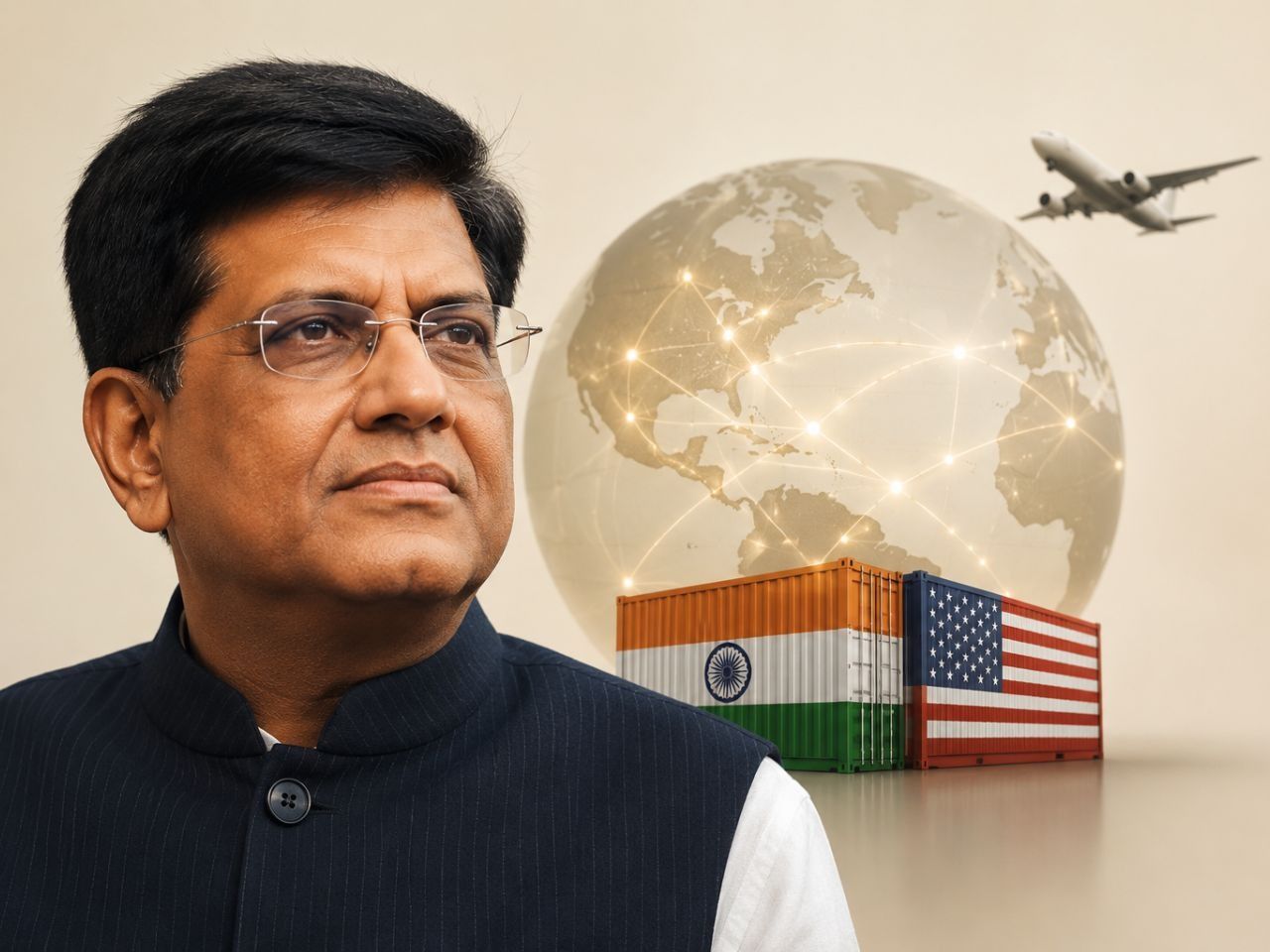

As geopolitical tensions continue to disrupt global trade routes, energy markets, and supply chains, India is positioning itself as one of the world’s most trusted economic partners — and according to Union Commerce and Industry Minister Piyush Goyal, this moment could become a turning point for India-US trade relations.
Speaking at the Annual Leadership Summit of the American Chamber of Commerce, Goyal said the ongoing Ukraine war and the escalating crisis in West Asia are forcing countries and businesses worldwide to rethink their supply chain strategies. In this shifting global environment, he said India’s economic resilience, manufacturing capabilities, and growing international credibility are creating a historic opportunity for deeper India-America economic cooperation.
The remarks come at a time when global companies are actively seeking alternatives to concentrated supply chains and looking for reliable manufacturing and investment destinations amid rising uncertainty.
According to Goyal, India’s steady economic performance despite global instability is strengthening international confidence in the country’s long-term growth story.
India Emerging Stronger Despite Global Uncertainty
Describing the current global environment as a period of “tremendous times,” Goyal said the world is witnessing multiple geopolitical disruptions simultaneously, from the prolonged Ukraine conflict to growing instability in West Asia. Yet, despite these challenges, India has continued to emerge stronger economically and strategically.
He pointed to India’s recent economic growth upgrade from 6.4 percent to 6.5 percent as evidence of the country’s resilience and the growing confidence in India’s economy.
According to the minister, the achievement reflects not only policy stability and leadership but also the capability and confidence of India’s 1.4 billion citizens.
Goyal also highlighted Prime Minister Narendra Modi’s recent five-nation diplomatic visit, saying the tour further strengthened India’s global standing. He noted that several world leaders expressed admiration for India’s leadership, economic direction, and rising geopolitical importance.
India-US Partnership Could Define the Next Era of Global Trade
One of the strongest themes in Goyal’s address was the growing strategic importance of India-US trade relations.
Calling the current moment a “perfect opportunity,” the minister said both countries can work together to build resilient and trusted global supply chains that are less vulnerable to geopolitical disruptions and economic uncertainty.
He described the potential India-US collaboration as a “defining partnership of the 21st century,” where American innovation, technology, and investments could combine with India’s manufacturing strength, talent pool, and skilled workforce.
The statement reflects a broader shift taking place globally, where multinational corporations are increasingly prioritising supply chain diversification after years of disruptions caused by the pandemic, wars, shipping bottlenecks, and rising economic nationalism in several regions.
According to Goyal, India is uniquely positioned to benefit from this transition because of its stable policy environment, expanding infrastructure, and growing industrial ecosystem.
Industry experts believe sectors such as electronics, semiconductors, clean energy, advanced manufacturing, pharmaceuticals, and defence production could become major pillars of future India-US cooperation.
MSMEs Could Become the Backbone of India’s Supply Chain Ambitions
Goyal also stressed that India’s Micro, Small and Medium Enterprises (MSMEs) will play a crucial role in integrating the country into global supply chains.
He said Indian MSMEs need stronger support in achieving international certifications and quality standards so they can evolve into first-tier suppliers for multinational corporations and global businesses.
For India, this is a critical area because MSMEs contribute significantly to employment generation, manufacturing output, and exports.
The minister also highlighted the importance of logistics modernization, lower transportation costs, and world-class infrastructure in making India globally competitive.
According to him, infrastructure development, digital connectivity, and efficient logistics systems are becoming central pillars of India’s long-term trade and economic strategy.
The focus aligns with the government’s broader efforts to improve ease of doing business, expand industrial corridors, modernize ports, and strengthen manufacturing under initiatives such as Make in India and PM Gati Shakti.
India’s 2047 Vision: Becoming a Developed Economy
Reaffirming the government’s long-term economic ambition, Goyal said India is targeting developed nation status by 2047, with a long-term per capita income goal of 20,000 US dollars.
According to him, achieving that milestone will require:
- Stronger industrial growth
- Expansion of exports
- Deeper global economic partnerships
- Greater participation in international value chains
- Increased global competitiveness of Indian businesses
The minister said India’s rising global reputation is not only boosting investor confidence but also inspiring confidence among Indian citizens and entrepreneurs.
As India continues positioning itself as a manufacturing and innovation hub, policymakers increasingly see strategic trade partnerships as essential to achieving the country’s long-term economic transformation goals.
Trade Talks Between India and the US Expected to Accelerate
On the sidelines of the event, Goyal also revealed that the chief negotiator from the United States is expected to visit India next month, signalling fresh momentum in bilateral trade discussions between the two countries.
The development is particularly significant as India and the US continue deepening cooperation across several strategic sectors, including:
- Manufacturing
- Technology
- Semiconductors
- Clean energy
- Strategic trade
- Supply chain resilience
Analysts believe that stronger trade coordination between the two economies could reshape regional manufacturing dynamics and create long-term opportunities for Indian exporters and startups alike.
Government Closely Monitoring Rupee Volatility
Addressing concerns around the recent decline in the Indian rupee amid global financial volatility, Goyal said the government is closely monitoring the situation.
He stated that multiple arms of the government are working together to maintain macroeconomic stability and address external pressures caused by rising geopolitical uncertainty.
While acknowledging global financial risks, the minister clarified that the government currently has no plans to impose restrictions on non-essential imports.
Instead, he appealed to citizens to voluntarily reduce consumption of import-dependent products as part of efforts to strengthen India’s domestic economic resilience.
Agriculture Remains a Pillar of Stability
Goyal also highlighted the strength of India’s agricultural sector during his address.
Referring to the recent recognition received by Prime Minister Modi from the Food and Agriculture Organization, the minister said the honour reflects the contribution of Indian farmers towards food security and agricultural development.
He added that agriculture has continued to remain a stabilising force for India even during periods of global uncertainty and supply chain disruptions.
India Positioning Itself for a New Global Order
As geopolitical tensions reshape trade routes and economic alliances worldwide, India is increasingly presenting itself as a stable, scalable, and trusted economic partner.
For global businesses searching for reliable alternatives in an unpredictable world, India’s combination of market size, manufacturing ambition, digital infrastructure, and geopolitical positioning is becoming increasingly attractive.
And according to Goyal, the evolving India-US partnership could become one of the defining economic relationships shaping the future of global supply chains in the decades ahead.