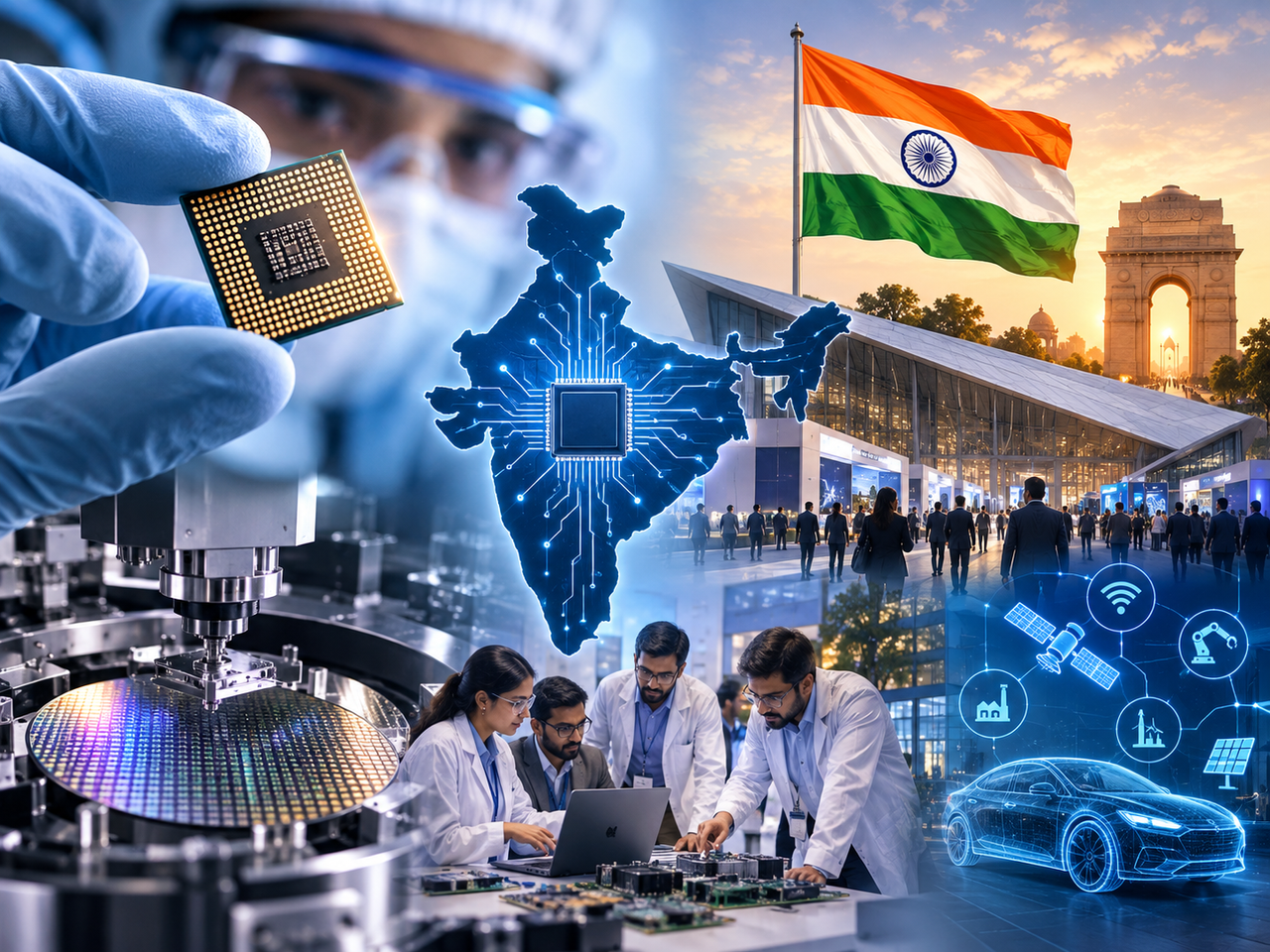

At Yashobhoomi, the most interesting thing about SEMICON India 2026 was not any single chip.
It was everything around it.
Over three days, more than 600 exhibitors, including around 300 international companies, brought chip design, manufacturing, advanced packaging, materials, equipment, AI, research, startups and talent under one roof. The event, held from September 17 to 19, was built around a telling theme: “Silicon to Systems: Building the Ecosystem.”
That theme captures where India’s semiconductor ambition is moving.
The first phase was about proving that India could attract fabs, design companies and investment. The next phase is considerably harder: building the companies, intellectual property, suppliers, engineers and products that make those factories economically meaningful.
India is beginning to assemble those pieces.
/fit-in/580x348/filters:format(webp)/tice-news-prod/media/media_files/2026/09/22/semicon-india-2026-2026-09-22-13-35-19.jpg)
Key Semiconductor Metrics
| Indicator | Latest figure |
|---|---|
| SEMICON India 2026 exhibitors | 600+ |
| International exhibitors | ~300 |
| Countries represented | 52 |
| SEMICON India registrations | 51,656 |
| Semicon 2.0 outlay | ₹1.275 lakh crore |
| Semicon 1.0 projects | 12 across 6 states |
| Operational commercial semiconductor units | 5 |
| Chip designs developed through supported ecosystem | 300+ |
| Chip-design tool usage | 4 crore+ hours |
The Chip Is Only the Beginning
For years, India’s semiconductor conversation was dominated by one question: When will India manufacture chips?
That question is now giving way to a broader one.
Can India build a semiconductor industry around those chips?
The distinction is important.
A modern semiconductor value chain includes intellectual property and chip design, fabrication, equipment, specialty chemicals and materials, packaging and testing, research, logistics, system design and the engineers required to connect all of it.
SEMICON India 2026 brought that chain into the same conversation.
C-DAC showcased high-performance computing and AI capabilities, including the AUM HPC-AI Processor and RUDRA-AUM compute node. Indian companies and startups displayed technologies for automotive systems, energy management, connectivity, surveillance, industrial applications and electric mobility.
That is a sign of a semiconductor industry beginning to move from components towards products and systems.
The shift is also visible in processor design.
C-DAC’s 64-bit RISC-V work and InCore Semiconductors’ processor IP and SoC design tools point to a domestic design layer that can feed into multiple applications. InCore’s IP has been silicon-proven across customer chips and technology nodes ranging from 180 nm to 16 nm, according to the government release.
For India, indigenous intellectual property could ultimately matter as much as manufacturing capacity.
/fit-in/580x348/filters:format(webp)/tice-news-prod/media/media_files/2026/09/22/semicon-2026-2026-09-22-13-35-54.jpg)
AI Is Changing What the Chip Has to Do
The semiconductor story is also being rewritten by AI.
At SEMICON India, Netrasemi showcased an AI-capable SoC designed for applications including surveillance, robotics, drones, smart sensors and mobility. Its indigenous AI SoC for CCTV surveillance integrates AI/ML accelerators, vision processing and video engines.
That matters because AI is pushing computing closer to the device.
Instead of sending every piece of data to a distant cloud, more processing is moving to cameras, vehicles, industrial machines, drones and other edge devices.
That creates a market for specialised chips.
And specialised chips create opportunities beyond the handful of companies capable of building a large fabrication plant.
This is where startups become important.
India does not need every semiconductor company to become a fab company. It needs companies that can own the intellectual property, design the architecture, develop application-specific chips and turn those chips into products that customers will actually buy.
Semicon 2.0 Changes the Scale of the Bet
The policy architecture is expanding alongside the industry.
The Union Cabinet approved Semicon 2.0 with an outlay of ₹1,27,500 crore in July 2026. Its six pillars cover design, machines and materials, new fabs, advanced packaging, R&D and talent development.
That is a significant change from treating semiconductors primarily as a manufacturing incentive programme.
The ecosystem now includes the suppliers that fabs need, the packaging technologies that chips require, the research institutions that develop new intellectual property and the workforce that keeps the entire chain moving.
The latest government account says five of the 12 semiconductor projects approved under Semicon 1.0 have commenced commercial production.
That is the point at which the story starts becoming tangible.
A semiconductor strategy becomes an industry only when plants produce, suppliers localise, engineers gain experience and products reach customers.
India’s Biggest Semiconductor Asset May Be Its Talent
There is another number buried inside the semiconductor push that deserves more attention.
More than one lakh engineers from over 500 organisations, including academic institutions and startups, have been onboarded through the ChipIN Centre under the Chips to Startup programme and Design Linked Incentive ecosystem, according to the government release.
They have collectively developed more than 300 chip designs and clocked over four crore hours of chip-design tool usage.
That is not yet a commercial outcome.
But it is ecosystem infrastructure.
India’s semiconductor opportunity has always been constrained by the depth of its manufacturing capabilities. It could now face a different constraint: whether enough engineers, researchers, product companies and suppliers can emerge quickly enough to support the capital being deployed.
The answer will not come from policy alone.
/fit-in/580x348/filters:format(webp)/tice-news-prod/media/media_files/2026/09/22/semicon-india-2026-09-22-13-36-33.jpg)
From Semiconductor Policy to Semiconductor Products
This is ultimately where India’s next semiconductor test lies.
SEMICON India 2026 showed that India is no longer building the story around a single fab. The ecosystem now stretches from RISC-V processors and AI SoCs to advanced computing, packaging, materials, equipment and electronics systems. The event also generated 56 MoUs, announcements and strategic initiatives across design, manufacturing, packaging, materials, equipment, R&D, startups and talent.
But ecosystems do not become competitive simply because all the pieces are present.
They become competitive when the pieces work together.
India will need fabs that buy from Indian suppliers, designers whose IP finds global customers, startups that turn research into products, packaging companies that can compete internationally and a workforce that can move from training to real manufacturing and product environments.
That is why “Silicon to Systems” is more than an event theme.
It describes the real transition underway.
India’s semiconductor journey began with the ambition to make chips.
The larger opportunity now is to own more of what happens before the chip is made, what happens after it is packaged and, most importantly, what the chip enables once it reaches a real product.
That is where a semiconductor programme becomes a semiconductor economy.