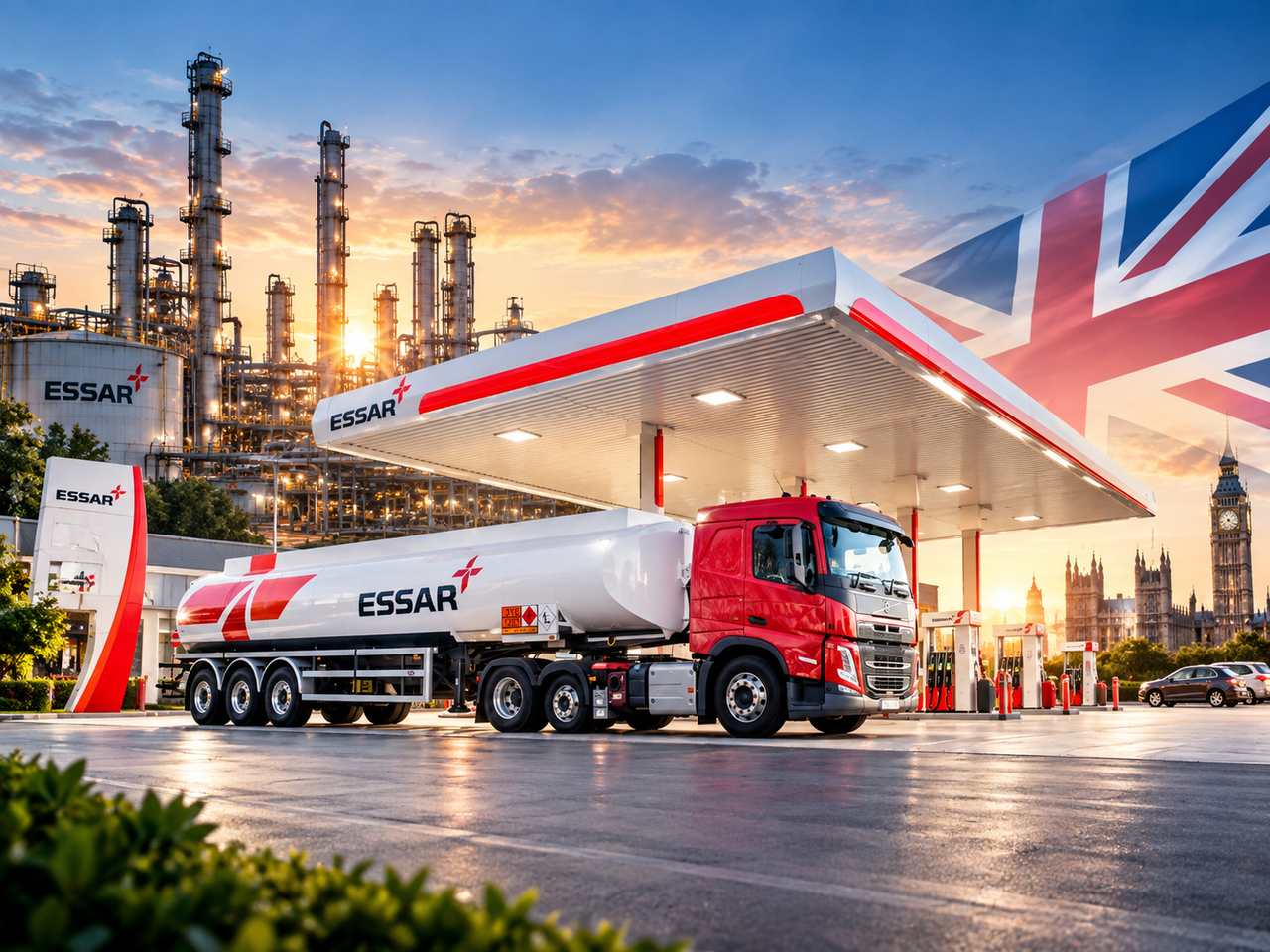

Essar Energy Transition is sharply expanding its presence in the UK fuel retail market, agreeing to acquire 118 forecourts from independent operator SGN Retail in a deal that will take its network to 235 sites and annual fuel throughput above 650 million litres.
The acquisition gives Essar Energy Transition Retail (EET Retail) one of the UK’s largest backward-integrated forecourt networks, linking its retail operations directly with the Stanlow refinery in Cheshire. The company is targeting 800 forecourts by 2031, or roughly 9% of the UK market, as it seeks to rebuild a direct refinery-to-pump model.
For Essar, the deal is about more than adding petrol stations. It is an attempt to reconnect two parts of a UK fuel market that have become increasingly separated over the past two decades: refining and retail.
From Refinery to Forecourt
The acquisition of SGN Retail, founded in 2016 by Graham Peacock and Susan Tobbell, immediately adds scale to Essar’s retail business.
EET Retail currently operates 117 sites. Adding SGN’s 118 locations creates a 235-site network spread across the UK, with the combined estate handling more than 650 million litres of fuel annually.
The strategic attraction lies in what sits behind those forecourts.
Essar says the UK fuel market has become fragmented as oil majors reduced domestic refinery investment, creating increasingly complex supply chains and greater dependence on imports. Its answer is vertical integration—producing fuel at Stanlow and moving it directly into its own retail network.
That could give the company greater control over supply, distribution and the customer relationship at the pump.
/fit-in/580x348/filters:format(webp)/tice-news-prod/media/media_files/2026/09/14/essar-2026-09-14-17-45-40.jpeg)
Why Essar Wants Scale Now
EET Retail believes the UK forecourt market offers room for consolidation, pointing to demographic growth, more multi-car households and a declining number of forecourts.
The SGN transaction substantially accelerates its expansion plan. Instead of building the network site by site, Essar is adding 118 locations in one move and moving closer to the scale required for its 2031 target.
Arvan Ruia, CEO of EET Retail, described SGN as a high-quality forecourt network and said the acquisition accelerates the company’s plan to build a nationwide platform backed by direct refinery supply.
The strategy also gives Essar a larger platform for services beyond fuel. The company plans to expand its forecourt proposition around hot food, convenience, valeting and EV charging.
That is increasingly important as traditional fuel retail evolves into a broader mobility and convenience business.
The Energy Security Argument
Essar is also positioning the transaction as an energy-security play.
The company says routing fuel refined at Stanlow directly to its own UK forecourts can make domestic distribution more efficient and reduce exposure to global supply disruptions and regional refinery closures.
The logic is straightforward: the closer the connection between domestic production and domestic retail, the fewer layers stand between refinery output and the motorist.
But the success of that model will ultimately depend on whether the efficiencies from integration can translate into competitive prices and reliable supply. Essar says removing inefficiencies from the supply chain can benefit motorists at the pump.
A £250 Million Debt Facility Funds the Expansion
The acquisition will be financed through a combination of cash and a new £250 million senior debt facility.
The financing has been arranged by a group of eight banks and financial institutions, including First Abu Dhabi Bank, Macquarie Bank, Mizrahi Tefahot Bank, Natixis, OakNorth Bank, Royal Bank of Canada, SMBC Bank International and Sound Point Capital Management.
Viral Gathani, Head of Strategic Transactions at Essar Energy Transition, said the transaction advances a core part of the group’s M&A strategy and highlighted the breadth of financial backing for the deal.
For Essar, the financing also signals confidence in the economics of the UK forecourt and convenience market as it attempts to build a much larger integrated platform.
The Bigger Bet Is 800 Sites
The SGN deal is sizeable, but it is still only a step towards Essar’s larger ambition.
EET Retail wants to reach 800 forecourts by 2031, supplied by Stanlow. That would turn its retail arm into a national network rather than a refinery-linked regional operation.
At the same time, Essar Energy Transition is pursuing a broader £4.3 billion investment pipeline through 2035 focused on low-carbon energy-transition projects in the North-West of England.
That makes the forecourt strategy particularly interesting. Essar is not simply defending a legacy fuel business; it is trying to use an established refinery and an expanding retail network as platforms for a changing energy market.
The real test will be whether that vertical integration can deliver what Essar promises: more control over supply, stronger energy security and a better-value proposition for customers—while the forecourt itself evolves beyond petrol and diesel.