
India’s startup ecosystem has spent the last decade learning how to build businesses at speed. But as the conversation around climate change, resource efficiency and sustainable growth becomes more urgent, a new question is gaining ground: can startups build businesses that are not only commercially viable, but also solve some of the country’s biggest environmental and social challenges?
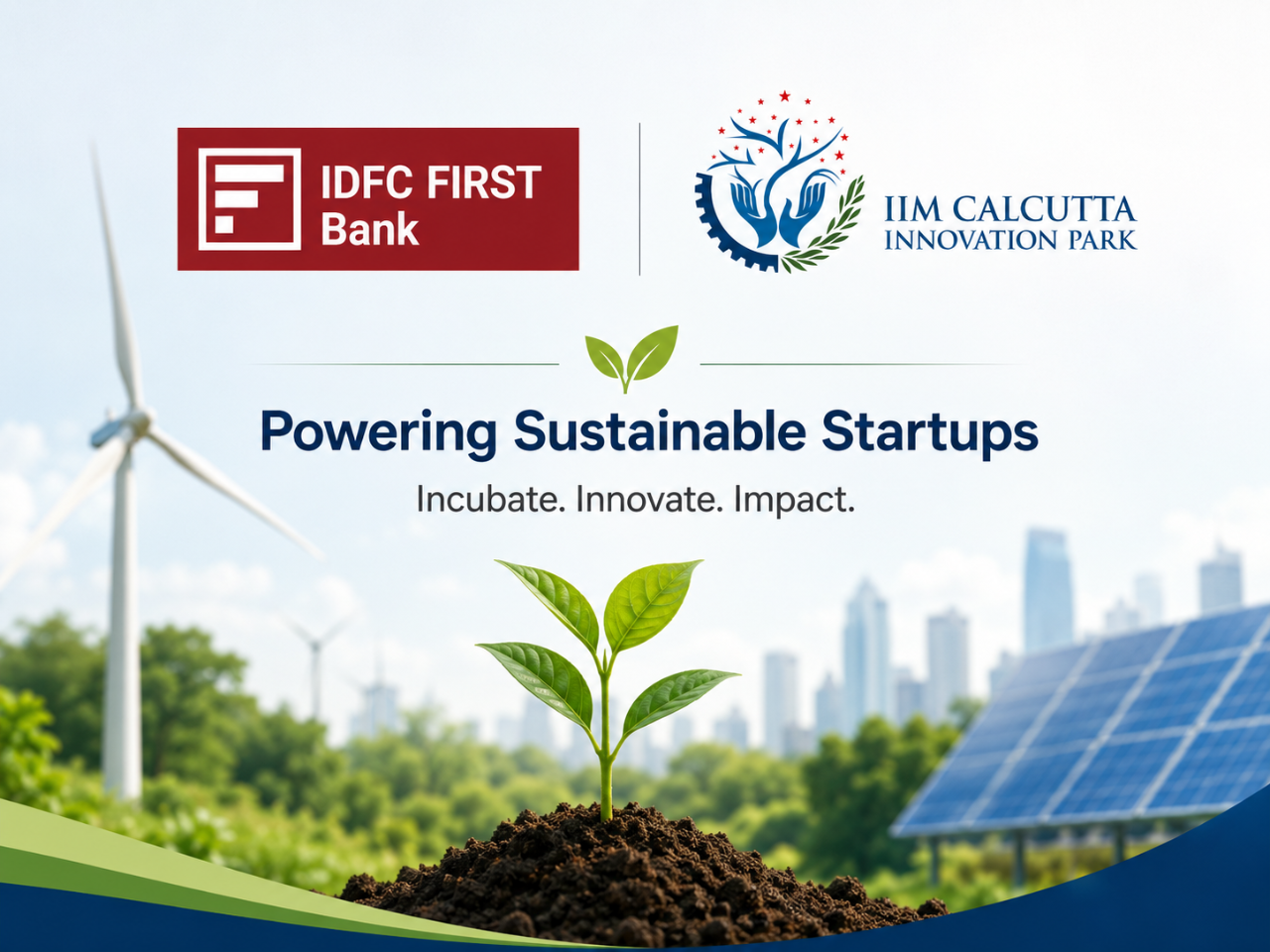
A new initiative from IDFC FIRST Bank and the IIM Calcutta Innovation Park (IIMCIP) is looking to answer that question by putting capital, mentorship and industry access behind early-stage enterprises working on sustainable solutions.
The two organisations have launched IGNITE, a pan-India startup incubation programme that will provide a total of Rs 2 crore in financial and operational support to selected ventures.
Of this, Rs 1.36 crore will form a direct startup grant corpus, giving participating companies access to capital as they work towards strengthening their business models and taking their solutions to a larger market.
The programme, according to an official statement, is designed to support enterprises that are working at the intersection of business and sustainability — startups that are not simply developing green ideas, but are attempting to turn those ideas into scalable businesses with measurable environmental and social outcomes.
16 startups to be selected from across India
At the heart of IGNITE will be a cohort of 16 startups, which will be selected through a competitive evaluation process.
The programme is aimed at early-stage ventures that have developed sustainable business solutions and are now looking to move beyond the initial stages of experimentation and build stronger, more commercially viable businesses.
The areas covered under the initiative are broad, reflecting the range of sustainability challenges facing businesses and communities in India.
These include green manufacturing, waste recycling and upcycling, cleantech, renewable energy, water management, environmental technologies and the sustainable use of indigenous resources.
For startups operating in these sectors, the challenge is often not a lack of ideas. It is the ability to build a business around those ideas, access the right networks, understand markets, improve operations and secure the resources needed to scale.
IGNITE is positioned around precisely this gap.
Rather than treating incubation as simply a funding exercise, the programme will combine financial assistance with a structured support system intended to help participating startups become more operationally and commercially ready.
More than just a grant
The Rs 2-crore programme will bring together financial and non-financial support.
Selected startups will go through a structured incubation journey that will include business diagnostics, expert mentoring, intensive bootcamps, networking opportunities and access to the wider industry ecosystem.
This is significant for early-stage sustainable businesses because developing a technology or product is only one part of the journey.
A startup may have a solution for recycling industrial waste, a technology that improves water efficiency or a renewable energy product with potential applications across multiple sectors. But moving from a promising solution to a scalable enterprise requires a stronger business model, customers, operational capabilities and access to the right ecosystem.
The IGNITE programme seeks to work on these aspects alongside funding.
The business diagnostics component is expected to help startups identify gaps in their existing models, while mentoring and bootcamps will provide founders with structured guidance as they work towards improving their businesses.
Networking and industry ecosystem access will add another layer by potentially connecting startups with stakeholders, experts and opportunities that can help them move closer to commercial scale.
Performance-linked support for startups that deliver
The programme is also designed to link a part of the support to performance.
According to the announcement, top-performing enterprises will receive performance-linked grant support to scale their operations.
This introduces a scale-up element to the programme, with support tied to the progress made by participating ventures.
For startups, that could mean that the incubation journey is not limited to helping them refine an idea or prepare a business plan. The focus is also on identifying ventures that demonstrate the ability to translate their solutions into measurable business and impact outcomes.
The broader objective is to accelerate the commercial scale-up of 16 sustainable solutions while strengthening the companies behind them.
Turning sustainability into a business opportunity
One of the more interesting aspects of the initiative is its focus on the commercialisation of sustainability.
For years, sustainability-focused startups have operated in a space where the environmental value of a solution and its commercial viability have had to develop together. A product can have a strong environmental proposition, but without a sustainable business model, market demand and the ability to scale, its impact can remain limited.
IGNITE’s approach appears to recognise this challenge.
The programme aims to help participating enterprises strengthen their business models, expand market reach and deliver measurable environmental and social outcomes.
That means the objective is not simply to support startups because they work in the sustainability sector. The larger ambition is to help them build enterprises capable of generating sustained commercial activity while creating measurable impact.
For India’s startup ecosystem, this is increasingly important as capital and entrepreneurial attention move into areas such as climate technology, circular economy, clean energy and resource efficiency.
From waste diversion to local jobs
The programme’s expected outcomes also extend beyond the individual startups.
According to the organisations, IGNITE seeks to promote landfill waste diversion through circular economy models, improve the operational capabilities of participating businesses and drive revenue growth.
The circular economy component is particularly relevant in the context of waste management, recycling and upcycling.
Instead of following a traditional linear model in which resources are extracted, products are manufactured, consumed and eventually discarded, circular economy businesses attempt to keep materials and resources in use for longer. Startups working in recycling, reuse and upcycling can play an important role in creating such systems, particularly when they can build commercially viable models around them.
The initiative also aims to create local employment opportunities as participating enterprises expand.
This gives the programme a broader impact lens: supporting startups could simultaneously help build businesses, scale sustainable technologies, divert waste, improve resource efficiency and generate employment.
Why incubation matters for India’s sustainability startups
The startup ecosystem has no shortage of incubators and accelerators. What makes programmes like IGNITE relevant is the specific combination of capital, institutional support and sector-focused mentoring.
Sustainability startups often face a different set of challenges compared with software or consumer internet companies.
Some require significant investment in technology, manufacturing or physical infrastructure. Others need to navigate long enterprise sales cycles, regulatory requirements or complex supply chains. For businesses working in waste management, renewable energy or water, proving the technology is only the first step; building the infrastructure and partnerships required for adoption can take considerably longer.
This makes access to experienced mentors, industry networks and commercial expertise particularly valuable.
The involvement of IIM Calcutta Innovation Park brings an incubation and entrepreneurship ecosystem into the initiative, while IDFC FIRST Bank brings the financial support component.
Together, the partnership is aimed at helping early-stage enterprises move through some of the difficult stages between having a sustainable solution and building a scalable business around it.
A focused bet on 16 ventures
IGNITE will ultimately select just 16 startups from across India.
While the number is relatively small compared with the size of India’s startup ecosystem, the programme’s structure suggests a focus on intensive engagement rather than simply distributing capital across a large number of companies.
The selected ventures will be taken through diagnostics, mentoring, bootcamps and networking before the top performers become eligible for performance-linked grant support.
The idea is to create a pipeline in which startups first receive structured support, demonstrate progress and then get additional assistance to scale.
For founders working on sustainability-focused businesses, that could provide something that is often difficult to secure at the earliest stages: not just money, but a combination of capital, business guidance, market access and ecosystem connections.
The larger opportunity for sustainable entrepreneurship
India’s sustainability challenges are enormous — from waste management and water security to energy transition, resource efficiency and cleaner manufacturing. At the same time, these challenges represent significant opportunities for entrepreneurs capable of developing solutions that work at scale.
The success of such businesses, however, will ultimately depend on whether they can move from promising technology to viable enterprise.
That is the gap IGNITE is attempting to address.
With a Rs 2-crore support programme, Rs 1.36 crore in direct startup grants, a cohort of 16 ventures and a structured incubation programme, IDFC FIRST Bank and IIMCIP are placing a targeted bet on startups that seek to combine commercial growth with measurable environmental and social impact.
For the selected founders, the programme could become an opportunity to strengthen the foundations of their businesses and take their solutions to a larger market.
And for India’s wider startup ecosystem, it offers another signal that sustainability is increasingly moving from being a peripheral theme in entrepreneurship to becoming a space where innovation, capital, business growth and impact are beginning to converge.