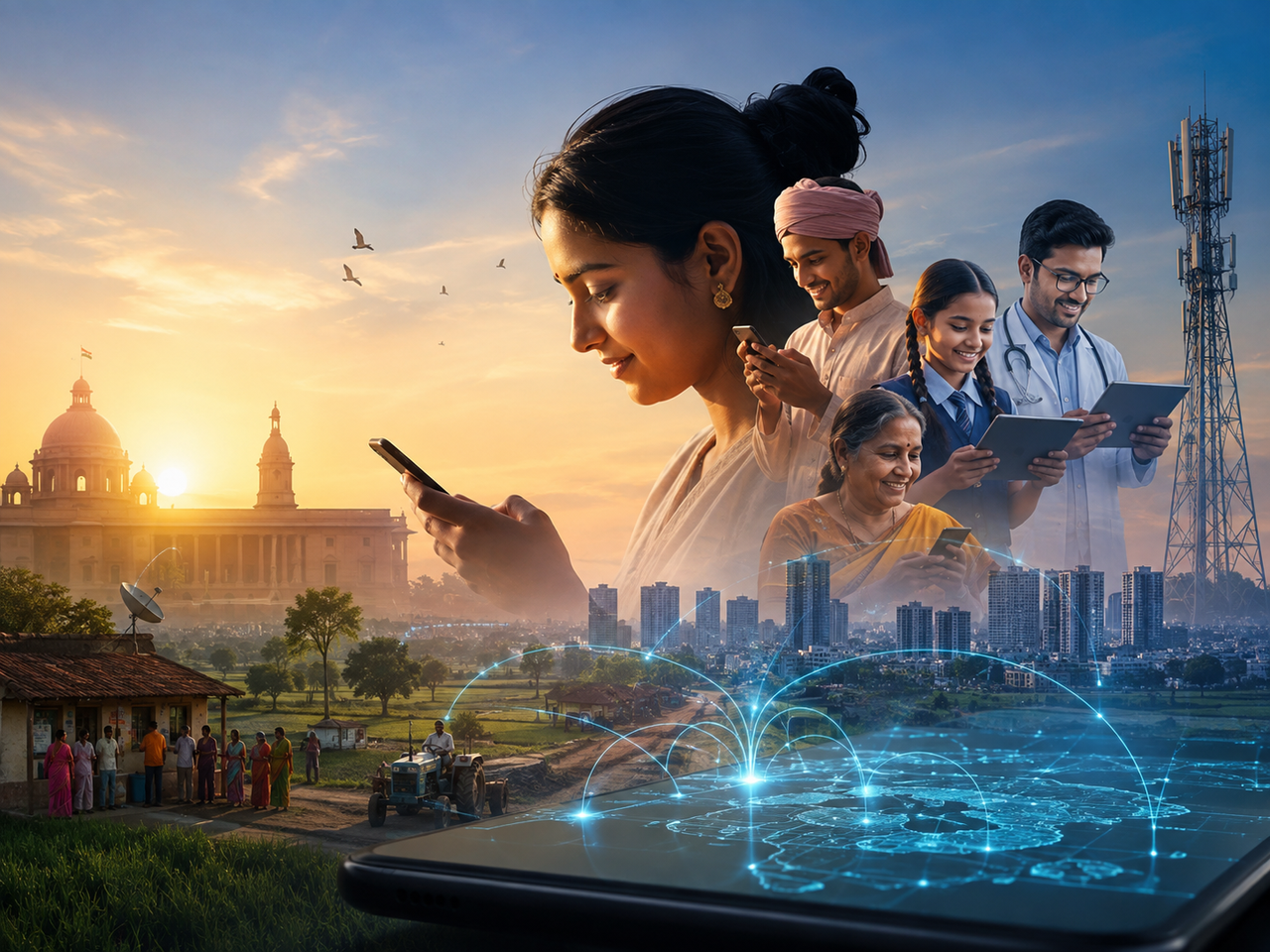

As India prepares to celebrate its 80th Independence Day, one of the country’s most consequential transformations has unfolded not on highways, factory floors, or stock exchanges, but inside government offices, village service centres, and millions of smartphones.
In just over a decade, a nation once synonymous with paperwork, queues, and fragmented public services has built one of the world’s largest digital public infrastructure ecosystems. Today, digital technologies are helping deliver welfare benefits, expand financial inclusion, strengthen manufacturing, connect villages, support education, and reshape the relationship between citizens and the state.
India’s digital economy now contributes between 12% and 14% of GDP and is projected to account for nearly one-fifth of the national economy over the next decade. According to the State of India’s Digital Economy Report 2026, the country now ranks as the world’s fifth-largest digitalised economy and the fourth-highest among G20 nations.
At the heart of this transformation lies a simple but profound shift: governance is no longer defined by physical offices. It is increasingly being delivered through digital platforms.
From Paper Files to Digital Rails
For decades, access to the Indian state depended almost entirely on geography. Getting a document verified meant travelling to a district office, standing in line, and navigating administrative layers. Information remained locked inside departmental silos, and welfare distribution was vulnerable to leakages at every handoff.
The breakthrough wasn’t simply the spread of affordable smartphones. It was the decision to connect identity, payments, and service delivery into a unified digital stack. Once those layers started speaking to each other, governance stopped depending on physical presence.
Instead of building isolated, single-purpose IT projects, India laid open digital rails on which both public agencies and private enterprises could build. Today, patients consult doctors through telemedicine platforms, students in remote towns stream classroom materials, farmers access credit directly from their phones, and welfare transfers hit bank accounts without administrative friction.
Governance, for the first time in independent India’s history, has become truly portable.
/fit-in/580x348/filters:format(webp)/tice-news-prod/media/media_files/2026/08/13/india-digital-revolution-2026-08-13-20-05-37.png)
The Factory Becomes Part of the Digital Story
The transformation isn’t confined to software or government benefits—it is visible on factory floors as well. Electronics production has expanded nearly sevenfold over the past decade, rising from ₹1.9 lakh crore in 2014–15 to ₹13.11 lakh crore in 2025–26. Exports have crossed ₹4.24 lakh crore ($47.96 billion), turning electronic goods into India’s third-largest export category and generating nearly 25 lakh jobs, with women accounting for almost 30% of the workforce.
This shift has fundamentally altered India’s standing in global supply chains. For years, India consumed technology designed and manufactured elsewhere. Today’s policy push suggests the country wants to participate in building it. A combination of targeted initiatives—including the Production Linked Incentive (PLI) scheme, the Electronics Components Manufacturing Scheme, and dedicated manufacturing clusters—is attempting to turn India into an export hub.
Why India Is Betting on Chips
Every country aspiring to technological resilience eventually confronts the same bottleneck: semiconductors. Control over chip design and fabrication influences everything from smartphones and electric vehicles to artificial intelligence, defence systems, and data infrastructure.
India has now moved past policy announcements into physical execution. Under the India Semiconductor Mission, 12 semiconductor units representing an investment of ₹1.64 lakh crore have been approved. Three facilities have already entered commercial production, with another set to come online this year. To build long-term depth across the supply chain, the Union Cabinet recently approved Semicon 2.0 with an additional outlay of ₹1.27 lakh crore.
While competing with established semiconductor giants remains a long-term challenge, India is making its most ambitious industrial bet since economic liberalisation—moving away from pure assembly toward front-end design and fabrication.
The Next Divide Is No Longer Internet Access
The first chapter of India’s digital story was about connectivity—getting towers built, fiber laid, and data costs down. The current chapter is about capability.
Digital tools now reach into classrooms, primary healthcare centres, and village service outlets. Yet the biggest lesson of the past decade is that internet penetration alone does not equal inclusion. Owning a smartphone does not automatically create mobility. Real economic participation happens only when citizens can leverage digital tools to learn new skills, secure affordable credit, run small businesses, and deal transparently with the state.
Closing that capability gap—rather than just adding mobile subscribers—will determine the true reach of India’s digital model.
Independence in the Age of Digital Citizenship
India’s first three decades after 1947 were defined by building foundational state institutions. The next three were defined by market liberalisation and economic integration. The current era is building something equally significant: digital state capacity.
The transition is far from complete. Digital literacy is uneven across regions, cyber vulnerabilities are expanding, and local language accessibility still lags behind. The digital divide has narrowed, but it has far from disappeared.
Yet, eighty years after Independence, India’s most important institutional experiment is no longer taking place inside administrative corridors or corporate boardrooms. It is unfolding every time a pension reaches a beneficiary without delay, a farmer secures institutional credit on a mobile phone, or a student in a tier-3 town accesses top-tier educational resources.
India has already proved that it can build digital infrastructure at scale.
The next test is harder.
Can that infrastructure create better jobs, stronger businesses, more productive farms, improved public services and genuine economic mobility?
That question may define India’s next decade just as profoundly as digitalisation defined the last one.