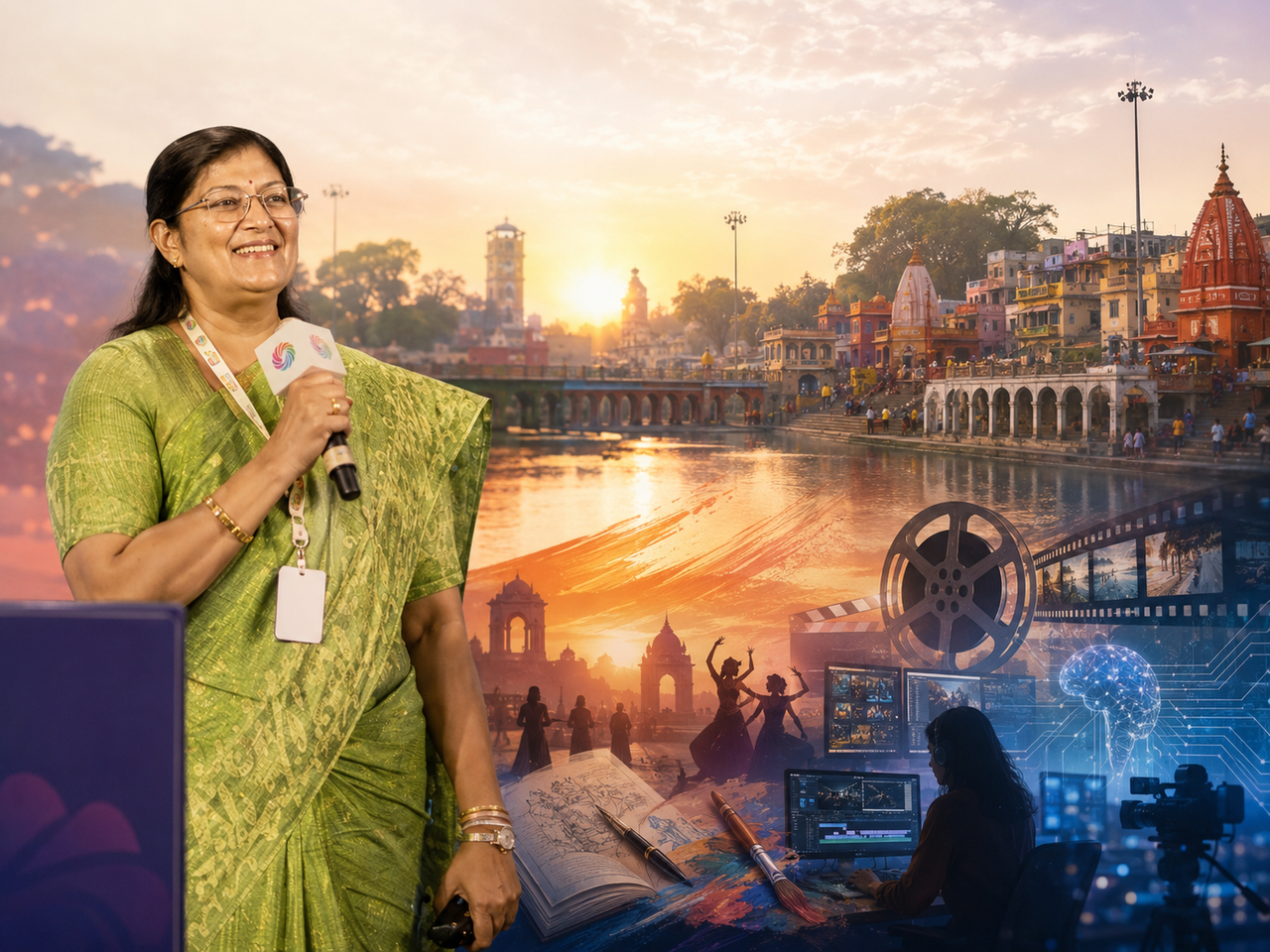

At BRICS WAVES, Nashik Mayor Himgauri Aher-Adke presented a vision that connects the city’s spiritual heritage, creative industries, technology and Simhastha Kumbh 2027 into a new urban growth strategy.
Nashik is pitching Simhastha Kumbh 2027–28 as more than a mega religious gathering. The city wants to use the event as a catalyst for a broader creative economy—one that brings together culture, technology, tourism, entrepreneurship and new forms of digital storytelling.
That proposition was at the centre of Nashik Mayor Himgauri Aher-Adke’s presentation at BRICS WAVES in Mumbai, before an audience of more than 500 delegates and representatives from over 20 countries.
Titled “Orange Economy & Creative Industry in Nashik – The Nashik Creative Economy Mission · Simhastha Kumbh 2027,” the presentation offered a different way of looking at the city’s future.
The question was not simply how Nashik can attract more visitors.
It was whether the city can turn the cultural capital it already possesses into a new economic engine—without losing the identity that made it valuable in the first place.
Nashik Is Trying to Become Three Cities at Once
The presentation framed Nashik through three identities: Sacred Nashik, Creative Nashik and Future-Ready Nashik.
The first is deeply rooted in the city’s civilisational geography. The Godavari, Trimbakeshwar, Panchavati and Ramkund form a landscape closely associated with India’s spiritual traditions and the Ramayana.
But the second identity changes the conversation.
Creative Nashik draws on the city’s literary and artistic traditions, its place in Marathi cultural life and its connection with the history of Indian cinema.
That history has a particularly powerful name: Dadasaheb Phalke, born in the Nashik region and widely recognised as the Father of Indian Cinema.
The presentation’s approach was not to preserve that legacy as a museum piece.
It was to ask what Nashik could build from it.
That is where the third identity—Future-Ready Nashik—enters the picture.
The city is looking to connect its industrial and educational base with emerging opportunities in AI, aerospace and creative technologies.
The underlying proposition is simple but important: Nashik does not need to become another Bengaluru to participate in India’s technology economy.
It can build a technology-enabled creative economy around its own strengths.
From “Land of Mantra” to “Land of Tantra”
One of the most memorable phrases in the presentation described Nashik’s transformation as a journey “from land of mantra to land of tantra.”
It captured the central tension in the city’s proposition.
Technology is coming to Nashik, but the city does not want technological development to erase its cultural character.
That distinction matters because cities across India are increasingly competing for investment, talent and visitors. The temptation is often to adopt the same formula—new infrastructure, technology parks, commercial districts and events.
Nashik’s proposition is different.
Its competitive advantage could lie precisely in what cannot easily be replicated elsewhere: its religious geography, cultural memory, literary traditions, cinematic history and relationship with the Godavari.
The challenge is converting that identity into economic activity without reducing it to a marketing slogan.
That is where the idea of the orange economy becomes more than a branding exercise.
Film, design, literature, digital content, music, performing arts, gaming, cultural experiences and creative technology can create livelihoods and businesses around cultural assets.
For Nashik, the opportunity is to build that ecosystem locally.
/fit-in/580x348/filters:format(webp)/tice-news-prod/media/media_files/2026/08/09/himgauri-2026-08-09-19-25-45.jpeg)
Simhastha Kumbh Could Become the City’s Biggest Test
The most immediate opportunity is Simhastha Kumbh 2027–28.
The presentation deliberately moved beyond treating the Kumbh simply as a religious gathering or tourism event.
Instead, it positioned the once-in-12-years gathering as an opportunity to build systems and capabilities that remain useful long after the event ends.
One phrase captured the idea particularly well:
“A mega-event as a movement, not a moment.”
That means thinking about the Kumbh through the lens of river-first planning, sustainability, crowd science, AI-enabled monitoring, public participation and digital documentation.
It also means thinking about how a younger generation experiences culture.
The presentation proposed the idea of a “first Gen-Z Kumbh”—an event experienced not only on the ground but through reels, podcasts, short films, livestreams, immersive experiences and other forms of digital storytelling.
That opens a different economic possibility.
The Kumbh could become a platform for filmmakers, creators, designers, researchers, students, technology companies and cultural institutions to produce content and experiences that travel far beyond Nashik.
The event, in other words, becomes a creative-industry opportunity.
Can the Orange Economy Become a Real Business Ecosystem?
This is where the vision will ultimately be tested.
A creative economy cannot be built through branding alone.
It needs people who can earn from it, companies that can grow around it, infrastructure that supports them and institutions willing to invest in skills and ideas.
The proposed Nashik Creative Economy Mission attempts to create that foundation through four pillars: livelihoods, skills, infrastructure and partnerships.
Its proposed initiatives include Nashik Ramayan, Brand Nashik, Voice of the Mela, Kumbh content documentation, literature and design programmes, devotional arts, youth creative-tech initiatives and an IICT-linked regional lab.
Taken together, they suggest an ecosystem rather than a collection of cultural events.
The opportunity could extend well beyond filmmaking.
Designers, writers, musicians, digital creators, researchers, educators, event companies, tourism businesses, technology startups and cultural institutions could all participate in a broader local creative economy.
For young people, that could create career pathways that do not require leaving the city for Mumbai, Bengaluru or Hyderabad.
But the economics will depend on execution.
The city will need sustained investment in skills, infrastructure, digital connectivity, partnerships and markets for creative work. It will also need to demonstrate that cultural entrepreneurship can generate durable livelihoods rather than short-lived event activity.
Nashik’s Bigger Bet Is on Identity as Economic Capital
The significance of the Mayor’s BRICS WAVES presentation goes beyond the proposals themselves.
It offers a different model of city-building.
Nashik is effectively arguing that heritage and technology do not have to compete for space. A city can be deeply rooted in its past while building industries around new technologies and changing consumer behaviour.
That could be an important lesson for India’s next generation of cities.
Not every city can become a Bengaluru. Not every city needs to.
Some cities may have a more powerful advantage: a distinctive identity that cannot be copied.
The real test for Nashik will be whether it can convert that identity into skills, startups, creative businesses, jobs and global visibility without diluting the very character that gives the city its appeal.
Simhastha Kumbh 2027 could provide the first major test.
If the city succeeds, the legacy of the Kumbh may extend beyond the millions who gather on its banks.
It could leave behind something less visible but potentially more valuable: a creative economy rooted in place, powered by technology and capable of giving Nashik’s next generation a reason to build its future at home.