
At a time when global geopolitical tensions are once again reshaping economic priorities across nations, India is facing a new challenge that could directly impact households, farmers, businesses, and inflation alike.
The Confederation of Indian Industry (CII) has now issued a strong warning that rising fuel and fertilizer costs triggered by escalating tensions in West Asia could create fresh economic pressure on India, eventually pushing up food prices and increasing fiscal stress across sectors.
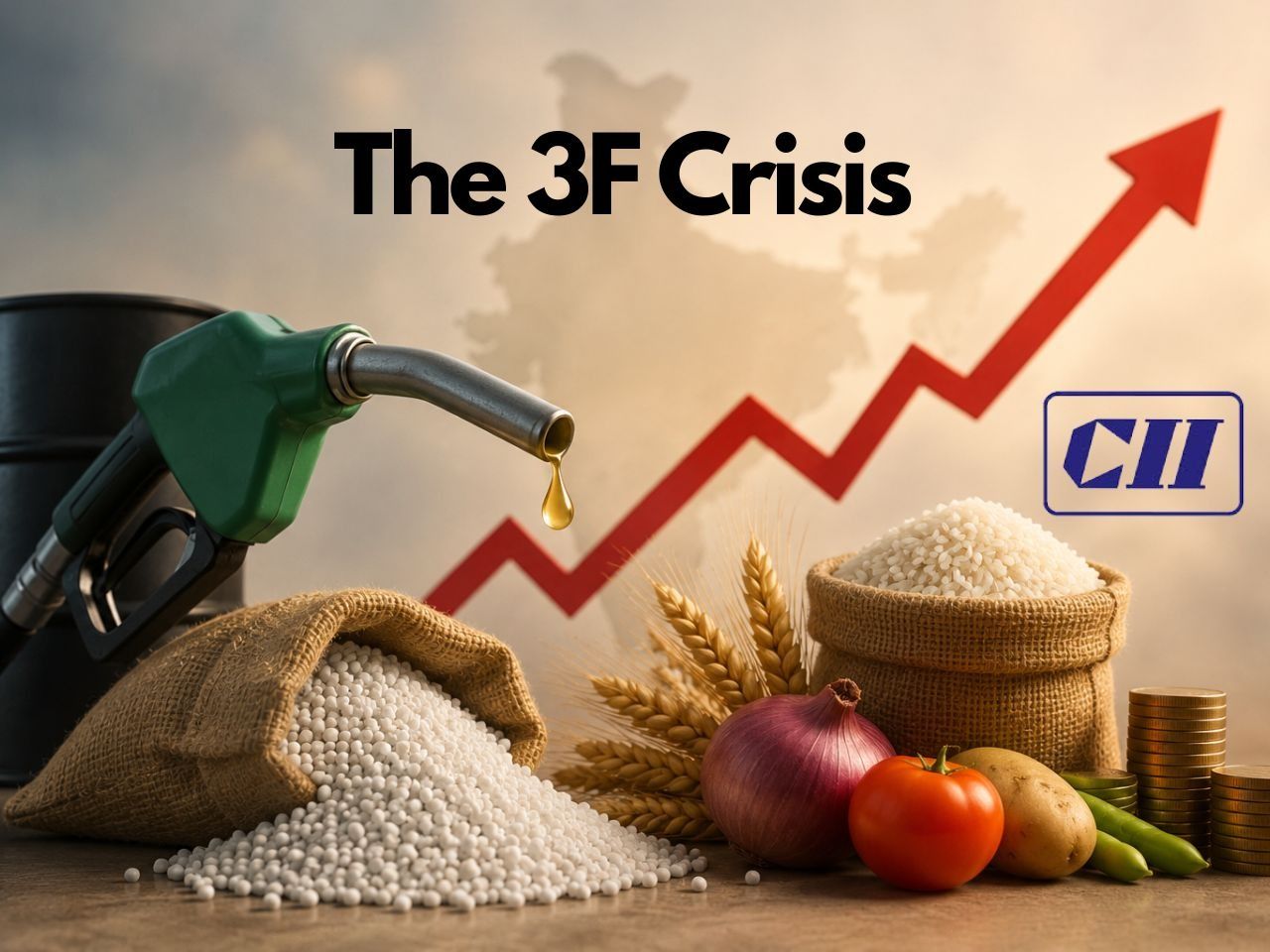
In a detailed assessment, the industry body has urged policymakers to view Fuel, Fertilizer, and Food — the “3Fs” — not as separate issues, but as one interconnected economic challenge that requires a coordinated national response.
The warning comes at a crucial moment for India’s economy. While inflation has remained relatively manageable in recent months and foodgrain production has stayed strong, global disruptions linked to energy markets and supply chains are once again threatening to disturb that balance.
According to CII, the current crisis in West Asia could have a cascading impact on India’s economy through higher crude oil prices, rising fertilizer import costs, elevated logistics expenses, and ultimately food inflation that directly affects consumers.
Why the “3Fs” Matter More Than Ever
Explaining the concern, Chandrajit Banerjee, Director General of Confederation of Indian Industry, said the three sectors are deeply interconnected and collectively influence inflation, household welfare, and overall economic stability.
“Fuel feeds into fertilizer, fertilizer feeds into food, and all three feed into inflation, fiscal stress, and household welfare,” Banerjee stated while emphasizing the need for an integrated policy strategy.
The statement reflects growing concern among industry experts that India’s heavy import dependence in critical sectors leaves the country vulnerable whenever geopolitical conflicts disrupt global commodity markets.
Energy prices influence transportation and manufacturing costs. Fertilizer prices directly affect agriculture. And agriculture ultimately determines food prices for consumers. Any shock in one segment eventually ripples through the entire economic chain.
India’s Heavy Import Dependence Remains a Major Risk
One of the biggest concerns highlighted by CII is India’s reliance on imports for both fuel and fertilizers.
According to government data cited by the industry body, India imports nearly 88 percent of its crude oil requirements, close to 90 percent of phosphates, and roughly 25 percent of urea demand.
Adding to the vulnerability is India’s dependence on the Strait of Hormuz, through which a significant share of the country’s crude oil and LNG imports pass. Any escalation in regional tensions could affect shipping routes, transportation costs, and energy prices almost immediately.
CII warned that rising fuel and logistics costs would not remain limited to the energy sector alone. Instead, they could spill over into agriculture, manufacturing, transportation, and food supply chains, eventually increasing inflationary pressure on Indian households.
At the same time, the organisation acknowledged the government’s initial efforts to cushion consumers from sudden fuel price shocks and prioritise gas supplies for critical sectors.
CII Pushes for Major Energy Reforms
To reduce long-term dependence on imported fuels, CII has proposed a series of structural reforms aimed at strengthening India’s domestic energy resilience.
One of the key recommendations is accelerating ethanol blending targets from E22 to E30 and promoting flex-fuel vehicles in states that already have strong ethanol production capacity.
The industry body has also proposed the creation of a national framework for LNG-based long-haul trucking. This would include dedicated refuelling corridors, transparent pricing systems, and incentives designed to reduce logistics costs and dependence on diesel-based transportation.
In another significant recommendation, CII suggested gradually shifting LPG demand toward more sustainable domestic alternatives such as electric cooking systems, ethanol-based fuels, and green hydrogen.
For long-term energy security, the organisation further called for:
- Faster domestic oil and gas exploration
- Expansion of Strategic Petroleum Reserves
- Diversification of crude oil import sources
- Investments in alternative fuels and energy technologies
These include bio-CNG, methanol blending, coal gasification, and Small Modular Reactors (SMRs), which are increasingly being explored globally as future energy solutions.
Fertilizer Costs Could Put Pressure on Farmers and Government Finances
The fertilizer sector is another major concern area highlighted in the report.
CII warned that rising global fertilizer prices could sharply increase India’s subsidy burden this fiscal year due to the country’s dependence on imported DAP, phosphoric acid, LNG, and urea feedstock.
If prices continue rising globally, the government may face increasing pressure to either expand subsidies or allow higher costs to reach farmers — both of which carry economic consequences.
To improve efficiency and reduce leakage, CII has proposed a phased rollout of Direct Benefit Transfer (DBT) mechanisms for fertilizer subsidies using digital land records, crop information, soil health data, and rural banking networks.
The organisation also recommended bringing urea under the Nutrient Based Subsidy (NBS) framework, arguing that excessive nitrogen usage is contributing to declining soil quality and agricultural imbalance.
According to Banerjee, these reforms are intended not only to improve subsidy efficiency but also to protect small and marginal farmers from excessive exposure to global price volatility.
Food Inflation Could Return as a Major Concern
Perhaps the biggest concern for ordinary consumers is the risk of rising food inflation.
Even though India recorded a strong foodgrain harvest last year, CII warned that higher fuel prices, fertilizer costs, rupee depreciation, and uncertainty around the monsoon could still trigger fresh food inflation in the coming months.
The organisation identified Tomato, Onion, and Potato — commonly known as TOP crops — as major drivers of food price volatility in India.
To prevent sudden price spikes, CII recommended early release of buffer stocks through the Price Stabilisation Fund before the lean season between August and November.
The industry body also called for stricter action against hoarding and speculative trading while recommending stronger cold-chain infrastructure, better transport systems, and wider farmer-to-consumer market access through Farmer Producer Organisations (FPOs).
Experts believe these interventions could become increasingly important as climate-related uncertainties and global commodity disruptions continue affecting agricultural markets worldwide.
Climate Risks Add Another Layer of Pressure
Beyond immediate geopolitical concerns, CII also highlighted the growing impact of climate uncertainty on India’s agricultural ecosystem.
The organisation proposed a long-term Mission for Climate Adaptation in Agriculture that would combine weather intelligence systems, agronomy support, crop pricing mechanisms, and improved farm planning tools.
According to Banerjee, food inflation disproportionately affects vulnerable households and lower-income groups, making supply-chain resilience and agricultural stability critical for India’s broader economic security.
He emphasized that stronger storage systems, better logistics networks, and efficient farm-to-market connectivity will play a major role in ensuring long-term food security.
A Defining Moment for Structural Reforms
While the current global uncertainty poses serious risks, CII believes it also presents an opportunity.
The organisation stated that if India uses the present crisis to implement structural reforms across fuel, fertilizer, and food systems, the country could emerge significantly stronger and more resilient against future global shocks.
For policymakers, the message from industry is clear: the next phase of India’s economic resilience may depend not just on managing inflation temporarily, but on fundamentally strengthening the systems that power the country’s energy, agriculture, and food security ecosystem.