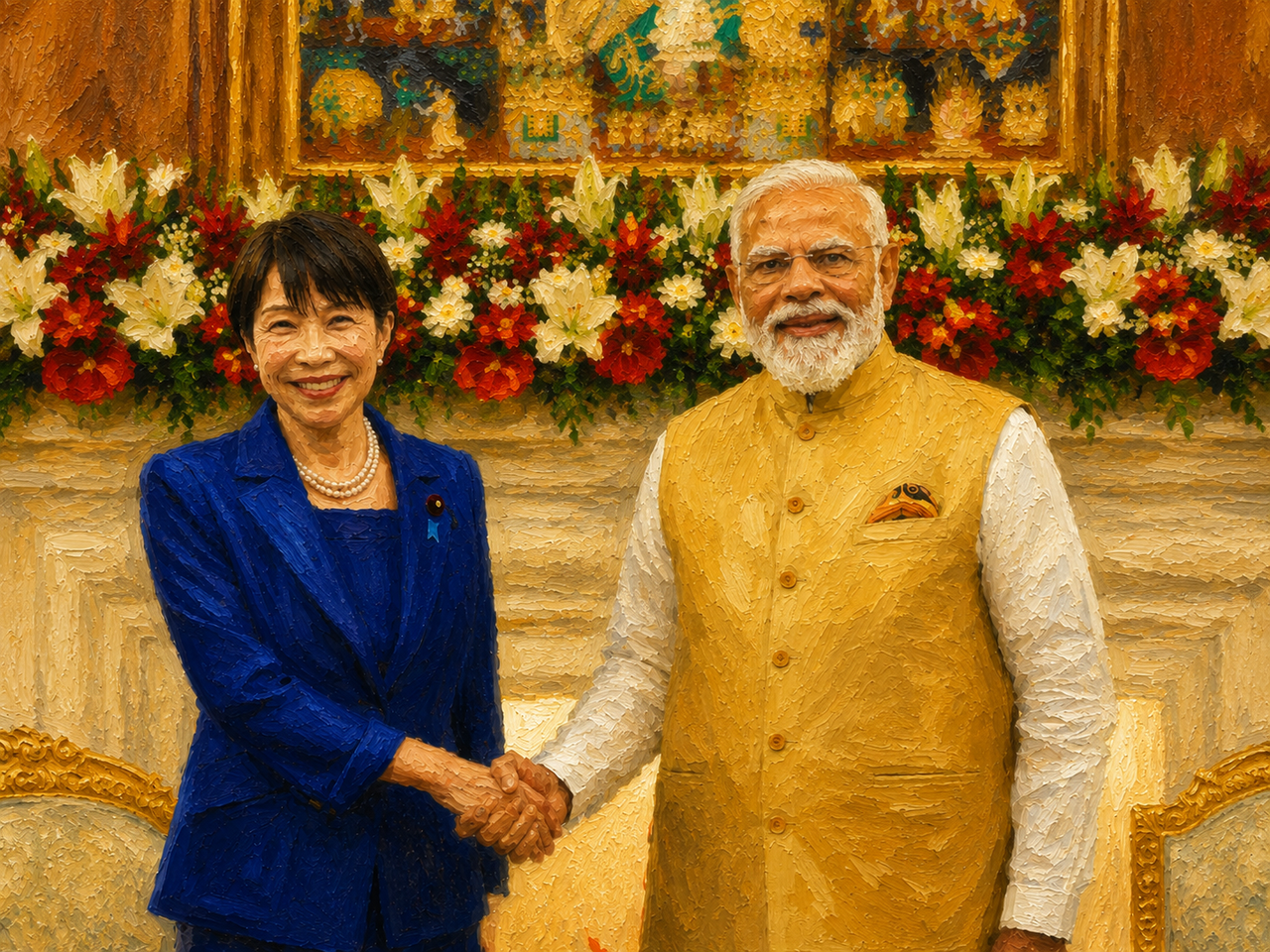

From artificial intelligence and semiconductors to defence innovation and clean energy, India and Japan are giving their strategic partnership a technology-first direction. The shift could unlock fresh opportunities for startups, innovators and investors in both countries.
For decades, the India-Japan partnership was largely defined by automobiles, manufacturing and infrastructure. Japanese companies helped shape India’s industrial journey, while bilateral cooperation revolved around trade, investment and development projects.
That relationship is now entering a new phase.
Artificial Intelligence (AI), semiconductors, deep technology, defence innovation, clean energy and startup collaboration are steadily moving to the centre of bilateral engagement, reflecting a broader shift in how the two countries see their economic future.
/fit-in/580x348/filters:format(webp)/tice-news-prod/media/media_files/2026/07/02/india-japan-summit-2026-07-02-16-13-32.jpg)
At the India-Japan Annual Summit in New Delhi, Prime Minister Narendra Modi and Japanese Prime Minister Sanae Takaichi announced a series of strategic initiatives that expand cooperation well beyond traditional sectors. While the agreements are rooted in economic security and strategic cooperation, they also have significant implications for India’s innovation ecosystem and technology entrepreneurs.
The summit also builds on growing economic momentum between the two countries. Bilateral trade reached US$27.5 billion in FY2025-26, while Japan has pledged to mobilise more than US$61 billion in investments in India by 2035. Nearly 1,400 Japanese companies already operate in India, making Japan one of India’s most significant long-term economic partners.
The announcements come at a time when India’s innovation ecosystem is expanding rapidly. The country has crossed 2.40 lakh DPIIT-recognised startups, with AI, deep technology, semiconductors, defence and climate-tech emerging among the fastest-growing sectors. Against that backdrop, closer collaboration with Japan could strengthen India’s ambition to become a global innovation and technology hub.
AI Takes Centre Stage
Technology emerged as one of the defining themes of the summit.
Prime Minister Modi said he believes “technology partnership will become the strongest pillar of our cooperation.”
Backing that vision, India and Japan issued a Joint Statement on Artificial Intelligence, while leading Indian AI institutions signed collaboration agreements with their Japanese counterparts.
Highlighting the complementary strengths of both countries, Modi said, “Japan’s precision technology and India’s software capability together will give new momentum and strength to global AI development.”
The message goes beyond research cooperation. It points towards a more collaborative innovation ecosystem where startups, universities and technology companies from both countries could work together on next-generation AI solutions for global markets.
/fit-in/580x348/filters:format(webp)/tice-news-prod/media/media_files/2026/07/02/india-japan-summit-2026-2026-07-02-16-14-09.jpg)
DeepTech Moves Higher on the Agenda
Beyond AI, the summit expanded cooperation into technologies expected to shape the global economy over the coming decades.
India and Japan agreed to deepen collaboration in:
- Artificial Intelligence
- Semiconductors
- Quantum technologies
- Advanced materials
These sectors form part of a new Joint Roadmap on Economic Security, which Prime Minister Modi said would strengthen supply-chain resilience in strategic technologies.
The focus is timely. Around the world, countries are investing heavily in semiconductor manufacturing, AI infrastructure and critical technologies as global supply chains undergo structural realignment. For India’s growing deep-tech ecosystem, closer engagement with Japan could complement the country’s efforts to build capabilities in advanced manufacturing, chip design and frontier research.
Defence Partnership Enters a New Chapter
One of the summit’s most significant announcements was the signing of the first India-Japan defence co-development project.
The agreement covers the joint development of a Naval Radio Antenna, marking a new chapter in defence technology cooperation between the two countries.
Calling it “a new chapter in our defence technology partnership,” Prime Minister Modi said India and Japan would jointly develop defence technologies that strengthen regional peace, maritime security and a rules-based order.
While the project is government-led, it also reflects India’s broader push towards indigenous defence innovation. As India’s defence startup ecosystem continues to evolve, stronger collaboration with technologically advanced partners like Japan could gradually create opportunities across defence electronics, communications systems and advanced engineering.
Healthcare and Biotechnology Join the Innovation Agenda
Technology cooperation also extended to healthcare.
India and Japan announced agreements covering pharmaceuticals, medical devices and biotechnology with the shared objective of strengthening global health security.
Prime Minister Modi said “India’s scale and Japan’s quality” could together help deliver affordable, reliable and advanced healthcare solutions to the world.
The collaboration is expected to encourage greater innovation across life sciences, medical technology and healthcare manufacturing.
/fit-in/580x348/filters:format(webp)/tice-news-prod/media/media_files/2026/07/02/india-japan-summit-2026-07-02-16-14-51.jpg)
Investment Partnership Gets Bigger
Investment remains one of the strongest pillars of India-Japan relations.
Prime Minister Modi said more than 100 business agreements had been concluded between Indian and Japanese companies over the past year, expected to bring over US$10 billion in Japanese investment into India.
Both countries have also set an ambitious long-term goal of attracting 10 trillion yen in Japanese investment over the next decade while doubling the number of Japanese companies operating in India.
An agreement between the financial services agencies of both countries is expected to facilitate smoother capital and investment flows.
For Indian startups, the expanding Japanese business presence offers opportunities beyond funding. It could lead to stronger corporate partnerships, technology collaborations, research alliances and access to global supply chains.
Clean Energy Creates New Opportunities
Energy transition featured prominently during the summit.
Prime Minister Modi announced the India-Japan Bio-Gas Initiative, which will support the establishment of 1,000 bio-gas and organic fertiliser plants across India, strengthening the country’s GOBARdhan initiative.
He also highlighted deeper cooperation in green hydrogen, battery technologies and nuclear energy, saying these initiatives would contribute to the world’s clean energy future.
For entrepreneurs working in climate technology, waste management and clean energy, the announcements indicate sustained policy support for sectors expected to play a larger role in India’s transition to a low-carbon economy.
Beyond Automobiles
India and Japan have shared one of the world’s strongest automotive partnerships for more than four decades.
Now, both countries want to extend that success into new industries.
Through the India-Japan Next Generation Mobility Partnership Framework, future cooperation will expand to:
- Shipbuilding
- Aviation
- Logistics
The framework reflects a broader effort to build future-ready mobility ecosystems by combining advanced manufacturing, technology and integrated logistics.
/fit-in/580x348/filters:format(webp)/tice-news-prod/media/media_files/2026/07/02/india-japan-summit-2026-07-02-16-16-23.jpg)
Startups Find a Bigger Place in Bilateral Cooperation
Innovation and entrepreneurship also featured in the leaders’ discussions.
Prime Minister Modi said India and Japan would “strengthen cooperation in research, education and startups,” while expanding opportunities for talent mobility, skilling and technical internship programmes.
No dedicated startup initiative was announced, but the inclusion of startups alongside technology, research and investment reflects how innovation is increasingly becoming part of economic diplomacy.
For Indian founders looking to expand internationally, stronger engagement between research institutions, corporations and innovation ecosystems in both countries could open new pathways for collaboration, technology transfer and market access.
Innovation Shapes the Next Phase of India-Japan Ties
India and Japan will celebrate 75 years of diplomatic relations next year.
The announcements made in New Delhi suggest the relationship is evolving beyond its traditional foundations of manufacturing and infrastructure. Artificial intelligence, semiconductors, quantum technologies, biotechnology, defence innovation, clean energy and startups are steadily becoming central to the bilateral agenda.
For India’s entrepreneurs, the significance lies less in any single agreement and more in the direction of travel.
As India positions itself as a global innovation economy and Japan deepens technology partnerships with trusted partners, founders, researchers and technology companies are likely to play a larger role in shaping the relationship.
The next phase of India-Japan ties may therefore be driven not only by governments and large corporations, but also by startups building AI platforms, semiconductor technologies, climate solutions, advanced manufacturing systems and other frontier innovations for global markets.