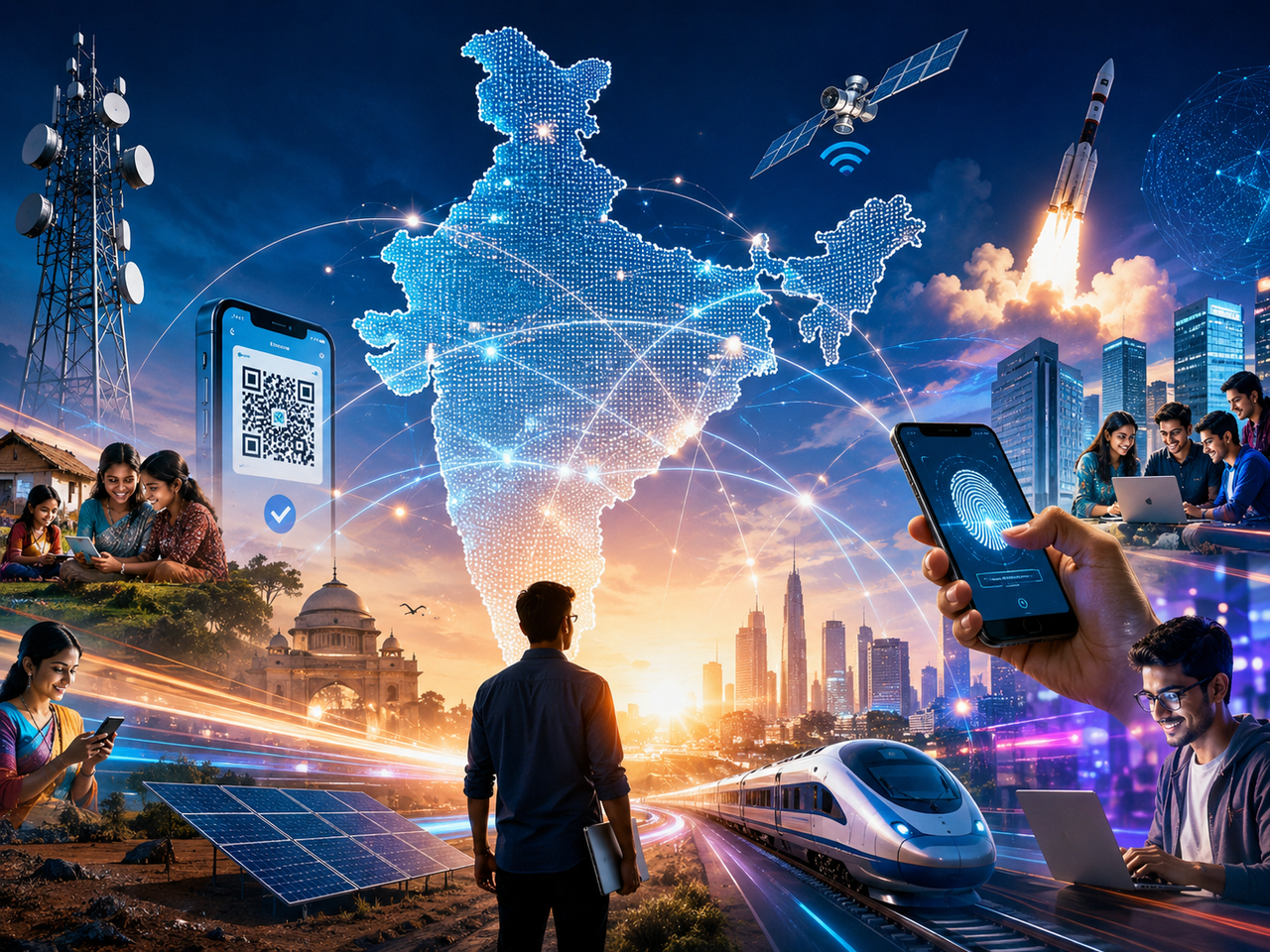

Eleven years after its launch, Digital India has become much more than a governance programme. It has quietly created the digital foundation on which India’s startup ecosystem, now home to over 2.40 lakh recognised startups and nearly 24 lakh jobs, continues to grow.
When a street vendor in Varanasi accepts payment through a QR code, a fintech startup onboards a customer in seconds using Aadhaar, or a SaaS founder in Indore sells software to clients across India, they are all using something most entrepreneurs rarely stop to think about.
They’re building businesses on infrastructure they didn’t have to build.
That may well be Digital India’s biggest contribution to India’s entrepreneurial journey.
When the Government launched Digital India on July 1, 2015, the objective was straightforward-bring governance online, improve public service delivery and make technology accessible to every citizen. Few imagined that eleven years later, the same initiative would become one of the strongest enablers of India’s startup economy.
As Prime Minister Narendra Modi marked the programme’s 11th anniversary, he described Digital India as an initiative that has made governance more transparent, efficient and citizen-centric while empowering over a billion Indians through technology. He also highlighted how innovation is now reaching villages and smaller towns, with startups and young entrepreneurs building solutions to some of the world’s biggest challenges.
For India’s startup ecosystem, however, Digital India represents something even more fundamental.
It built the digital rails on which entrepreneurs now innovate.
Before India Built Unicorns, It Built Digital Infrastructure
Every successful startup ecosystem is built on infrastructure.
The United States had the internet.
China leveraged manufacturing at scale.
India chose a different route.
Over the past decade, it created one of the world’s most sophisticated Digital Public Infrastructure (DPI) ecosystems—combining Aadhaar, UPI, Direct Benefit Transfers (DBT), DigiLocker, BharatNet and a growing stack of interoperable public digital platforms.
Unlike conventional infrastructure, these platforms were designed to be shared.
That meant entrepreneurs didn’t have to spend years building basic digital utilities before launching their products.
A fintech company could verify customers digitally.
A healthtech startup could authenticate users.
An agritech platform could receive payments instantly.
Government infrastructure quietly reduced the cost of entrepreneurship.
One Billion Internet Users Changed Everything
Infrastructure alone doesn’t create businesses.
People do.
When Digital India began, India had around 250 million internet users.
Today, that number has crossed 1.03 billion, making India one of the world’s largest connected digital markets.
Affordable smartphones and some of the world’s lowest mobile data tariffs dramatically changed who could participate in the digital economy.
For entrepreneurs, the market expanded almost overnight.
Products that were once built primarily for metropolitan consumers suddenly found customers in small towns, semi-urban centres and villages.
The next wave of startup growth no longer depended only on Bengaluru, Delhi or Mumbai.
It depended on Bharat coming online.
The Startup Numbers Tell Their Own Story
The scale of India’s entrepreneurial transformation is now visible in the numbers.
The country has crossed 2.40 lakh DPIIT-recognised startups, making it the world’s third-largest startup ecosystem.
These startups have already created more than 23.36 lakh direct jobs, with employment now approaching 24 lakh.
FY26 alone witnessed the highest annual addition since Startup India was launched, with more than 55,200 startups receiving DPIIT recognition.
The ecosystem has also become significantly more inclusive.
Nearly 1.10 lakh recognised startups have at least one woman director or partner, representing almost 48% of all recognised startups.
More importantly, entrepreneurship is no longer concentrated in a handful of cities.
Startups are now operating across every State and Union Territory, with Tier-II and Tier-III cities steadily emerging as India’s next innovation hubs.
That shift would have been difficult without the digital foundation created over the past decade.
/fit-in/580x348/filters:format(webp)/tice-news-prod/media/media_files/2026/07/01/digital-india-2026-07-01-18-54-48.png)
UPI Didn’t Just Make Payments Easier. It Made Startups Faster.
Ask entrepreneurs who built businesses before 2016 about collecting online payments.
Payment gateways were expensive.
Merchant onboarding often took weeks.
Small businesses continued to rely heavily on cash.
That landscape has changed dramatically.
Today, UPI serves more than 500 million users and processed an extraordinary 23.2 billion transactions in May 2026, making it the world’s largest real-time payment system.
Its impact goes far beyond convenience.
For startups, UPI removed friction.
It reduced transaction costs, simplified customer payments and enabled digital commerce at an unprecedented scale.
Entire sectors-including fintech, quick commerce, direct-to-consumer brands, creator economy platforms and digital lending—have flourished because entrepreneurs no longer had to solve the payments problem themselves.
Aadhaar Turned Identity Into Opportunity
Identity verification has traditionally been one of the biggest barriers to financial inclusion.
With Aadhaar now covering nearly 1.4 billion people, India created a trusted digital identity system that startups could integrate into their products.
The platform has also enabled Direct Benefit Transfers exceeding ₹51 lakh crore, significantly improving transparency while reducing leakages in welfare delivery.
For startups in fintech, insurance, healthcare and GovTech, Aadhaar has reduced onboarding costs while helping millions of first-time users enter the formal digital economy.
BharatNet Is Changing Where India’s Next Founder Comes From
One of Digital India’s least celebrated achievements may prove to be one of its most consequential.
Through BharatNet, fibre connectivity has reached more than 2.15 lakh Gram Panchayats, bringing high-speed internet closer to rural India than ever before.
The impact extends beyond connectivity.
It is changing the geography of entrepreneurship.
Founders are increasingly emerging from cities that rarely featured in startup conversations a decade ago.
From agritech ventures in Uttar Pradesh to manufacturing startups in Gujarat and AI companies in Coimbatore, innovation is becoming more geographically diverse.
Digital infrastructure has narrowed the distance between an idea and a market.
The Next Chapter Belongs to Deep Tech
Prime Minister Modi also used the occasion to underline India’s growing capabilities in Artificial Intelligence, semiconductors and quantum computing, describing them as the next engines of growth.
That observation aligns closely with where India’s startup ecosystem is headed.
The next generation of startups is expected to focus less on replicating global consumer internet models and more on building original technologies in AI, climate tech, defence, semiconductors, space technology and enterprise software.
Government investment in digital infrastructure, semiconductor manufacturing and AI capabilities could further strengthen India’s position as a global innovation hub.
Progress Is Real, but the Work Isn’t Finished
Digital India has transformed access to technology, but challenges remain.
Digital literacy still varies across regions.
Cyber frauds and financial scams continue to evolve.
Ensuring secure digital adoption, strengthening cyber resilience and improving digital skills will be essential if the next phase of growth is to be both inclusive and sustainable.
These challenges require as much attention as infrastructure itself.
The Real Legacy of Digital India
History may remember Digital India for UPI, Aadhaar or digital governance.
Entrepreneurs may remember it differently.
It lowered the cost of building a business.
A founder today doesn’t have to create an identity platform, invent a payment network or build digital public infrastructure from scratch.
Those foundations already exist.
That has allowed India’s entrepreneurs to spend less time solving infrastructure problems and more time solving customer problems.
Eleven years after it began, Digital India is no longer simply a government programme.
It has become the operating system of India’s entrepreneurial economy—connecting over one billion people, supporting more than 2.40 lakh recognised startups, enabling nearly 24 lakh jobs, and creating the digital foundation for India’s next generation of innovators.
And if the first decade was about connecting India, the next may well be about building technologies that connect India to the world.