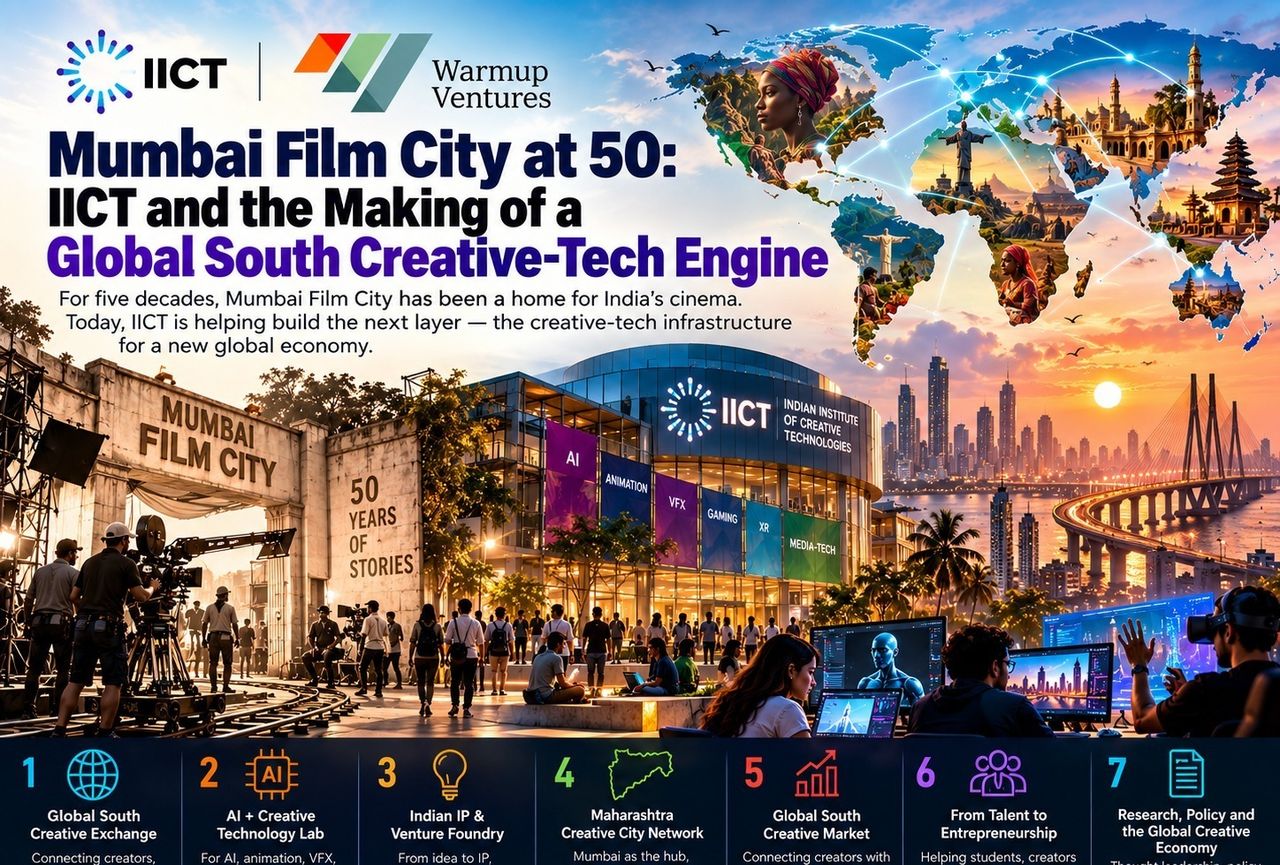

Mumbai Film City is turning 50. For five decades, it has been one of the physical homes of India’s film and television industry, providing the production infrastructure through which generations of creators have brought stories to life.
But the next 50 years of the creative economy will require something more.
It will require AI, IT, culture, technology, entrepreneurship, intellectual property, investment and global connectivity to work together.
And at the centre of this emerging ecosystem is the Indian Institute of Creative Technologies (IICT).
A vision articulated at the highest level
/fit-in/580x348/filters:format(webp)/tice-news-prod/media/media_library/vi/iikEh15yjhQ/hqdefault-724470.jpg)
At WAVES 2025 in Mumbai, Prime Minister Narendra Modi described the emerging Orange Economy through three pillars: Content, Creativity and Culture. He called it the “dawn of Orange Economy in India” and urged creators to “Create in India, Create for the World.” He also described India as emerging as a global hub for film production, digital content, gaming, fashion and music. That was more than a message to the media and entertainment industry.
It was a direction towards treating creativity as an economic opportunity.
From vision to institution
Union Minister Shri Ashwini Vaishnaw, whose recent remarks at the 72nd National Film Awards provide another important piece of this journey.
/fit-in/580x348/filters:format(webp)/tice-news-prod/media/media_files/2025/01/28/t9Lct19xjvxEhmCQ5xwl.jpg)
Speaking about IICT, he described it as a “new talent pool” and highlighted the importance of identifying, nurturing and promoting talent from smaller towns. His larger message is equally significant: government and the creative fraternity working together can unlock India’s creative potential and take Indian talent to audiences around the world.
That is an important transition from simply producing content to building the talent and technology infrastructure behind the content economy.
Maharashtra has a unique opportunity
Maharashtra is already India’s most established media and entertainment ecosystem.
Chief Minister Shri Devendra Fadnavis has spoken about strengthening this foundation, including developing a modern Film City with contemporary technology, production facilities and varied sets, while also supporting greater opportunities for Marathi cinema. Let us amplify Marathi’s voice across the globe by spreading the Marathi language, literature, art, and culture even further through OTT platforms, social media, and various digital mediums.
This is particularly relevant as Mumbai Film City completes 50 years. The opportunity now is not to replace the existing ecosystem, but to add the next layer to it.
/fit-in/580x348/filters:format(webp)/tice-news-prod/media/media_files/2026/10/04/devendra-fadnavis-honorable-cm-maharashtra-2026-10-04-14-44-56.jpeg)
At the Republic TV summit CM Sir mentioned about Mumbai being the Startup capital of India and and that layer is increasingly: AI + IT + Culture + IP and make Mumbai with connected cities network the Creators & Creative Economy ventures capital of Global South
The Shelar vision: technology meeting culture
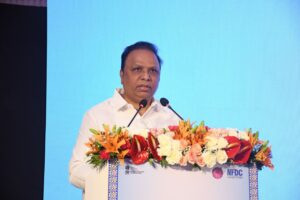
Also its pivotal to acknowledge vision of Maharashtra Cabinet Minister Shri Ashish Shelar, whose portfolio brings together cultural affairs, information technology and emerging technology.
/fit-in/580x348/filters:format(webp)/tice-news-prod/media/media_files/2026/10/01/shelar-sir-ficci-frames-mou-2026-10-01-21-10-03.jpeg)
At FICCI FRAMES 2026, Shelar Sir articulated the opportunity clearly: “India is uniquely positioned to lead the next transformation in media and entertainment.” He spoke about building an ecosystem of professional talent, creators, broadcasters, developers, technologists, innovators and entrepreneurs.
That combination is important. Culture gives technology meaning. Technology gives creativity scale. IP connects both to economic value.
The opportunity for Maharashtra is to build an ecosystem where technology, culture and enterprise reinforce each other.
Where Warmup Ventures enters the picture
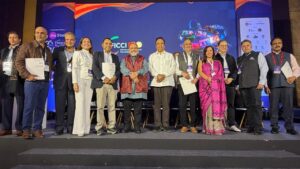
This is also why the IICT–Warmup Ventures MoU, signed at FICCI FRAMES 2026, is meaningful to me personally.
/fit-in/580x348/filters:format(webp)/tice-news-prod/media/media_files/2026/10/01/warmup-ventures-vision-at-iict-warmup-mou-2026-10-01-22-00-39.jpeg)
The partnership brings together IICT’s creative-technology and institutional ecosystem with Warmup Ventures’ focus on venture building, investment readiness, market access and entrepreneurship. The MoU provides a framework for startup and founder support, mentorship, industry partnerships, investment-readiness pathways and international and Global South ecosystem engagement.
For me, the underlying idea is simple:
Talent should not end with a certificate. It should have a pathway towards:India has enormous creative talent.
The next challenge is helping more of that talent become IP owners and creative entrepreneurs.
Seven building blocks
Our, Warmup Ventures MoU with IICT, together with the wider ecosystem it is building, points towards seven areas that can help shape this emerging creative economy:
1. AI + Creative Technology + Culture
2. Indian IP & Venture Building
3. Talent to Entrepreneurship
4. Maharashtra Creative Cities Network
5. Global South Creative Market
6. Global South Creative Exchange
7. Research & Policy for the Global South Creative Economy
These are not simply 7 programs.
Together, they represent an architecture for a creative-economy ecosystem for the Global South, with India taking a leading role.
One such avenue to explore and initiate these programs is Global South Film Festival in India. Our joint endeavour as IICT & Warmup Ventures is to request the GSFF consortium and choose one of the cities in Maharashtra to host Global South Film Festival.
The role of IICT leadership
This is where I want to specifically acknowledge Dr. Vishhwas Deosskar, CEO, IICT and their ecosystem building model.
What stands out in the emerging IICT model is its emphasis on connecting education, industry and technology. Following the MoUs signed at FICCI FRAMES 2026 and earlier at BRICS WAVES BAZAAR, Dr. Deosskar spoke about creating meaningful connections between these three domains and giving students and emerging creators exposure to industry-led learning, international practices and real-world opportunities.
That approach matters. Building an institution is one thing.
Building connections around an institution is how an ecosystem begins to form.
/fit-in/580x348/filters:format(webp)/tice-news-prod/media/media_files/2026/10/01/ficci-frames-2026-10-01-12-49-56.jpeg)
The breadth of IICT’s partnerships, across media, technology, gaming, academia, entrepreneurship and international collaboration shows the beginnings of that connected approach. We at Warmup Ventures are extremely proud and excited on our partnership with IICT
Mumbai as the hub, Maharashtra as the network
Mumbai has the history, industry, talent, institutions and global recognition. But the opportunity is Maharashtra-wide.
Imagine Mumbai as the global-facing hub, connected through technology and enterprise to specialised creative ecosystems across Nashik, Nagpur, Chhatrapati Sambhajinagar, Kolhapur, Solapur and Gadchiroli.
-Nashik can connect cinema with culture, heritage, pilgrimage, tourism, cuisine and creative enterprise.
-Nagpur can develop around technology, animation, gaming, AI and its central geographic position.
-Chhatrapati Sambhajinagar has Ajanta-Ellora, heritage, tourism, architecture and cultural storytelling.
-Gadchiroli offers something very different tribal culture, indigenous knowledge, forests, biodiversity and stories that have rarely received a global creative platform.
–Solapur for its textiles, handloom, crafts and creative enterprise
-Kolhapur brings a deep legacy of Marathi cinema, music, theatre, crafts and cultural heritage.
The objective is not to create smaller Mumbais.
It is to create distinctive creative economies rooted in local talent, culture, technology and enterprise connected to Mumbai and to one another.
/fit-in/580x348/filters:format(webp)/tice-news-prod/media/media_files/2026/10/04/maharashtra-creative-cities-network-2026-10-04-23-20-47.png)
And then imagine those networks extending outward: Maharashtra → India → Global South.
That is where the opportunity becomes much larger than cinema.
From Indian stories to Indian IP, The next 50 years
Mumbai Film City gave India an extraordinary physical foundation for filmmaking. WAVES has created a global platform for creative exchange. The next phase of India’s creative economy should not only be about how many films, shows or digital pieces we produce.
It should also be about how much IP we own, how many creative companies we build, how much capital we attract and how many Indian-origin platforms the world wants to experience.
IICT is building a new institutional layer around creative technology, talent and innovation.
-Film City gave Mumbai the infrastructure to make films.
-IICT is helping build the infrastructure for what comes next.
And Maharashtra has the opportunity to connect its cities into a wider creative economy.
My appreciation to Dr. Vishhwas Deosskar and the entire IICT team for translating this larger direction into partnerships, programs and an increasingly connected ecosystem.
Warmup Ventures brings another piece into that architecture, talent pathways, funding & investment, venture building and a Global South network.
The foundation is being built. Now comes the opportunity to build the future.
– Rajesh Joshi
Venture Partner,
Warmup Ventures