
India’s celebrity-startup story is usually told through names: who invested, which startup they backed and how many funding rounds they joined. But the more revealing story lies underneath the celebrity names.
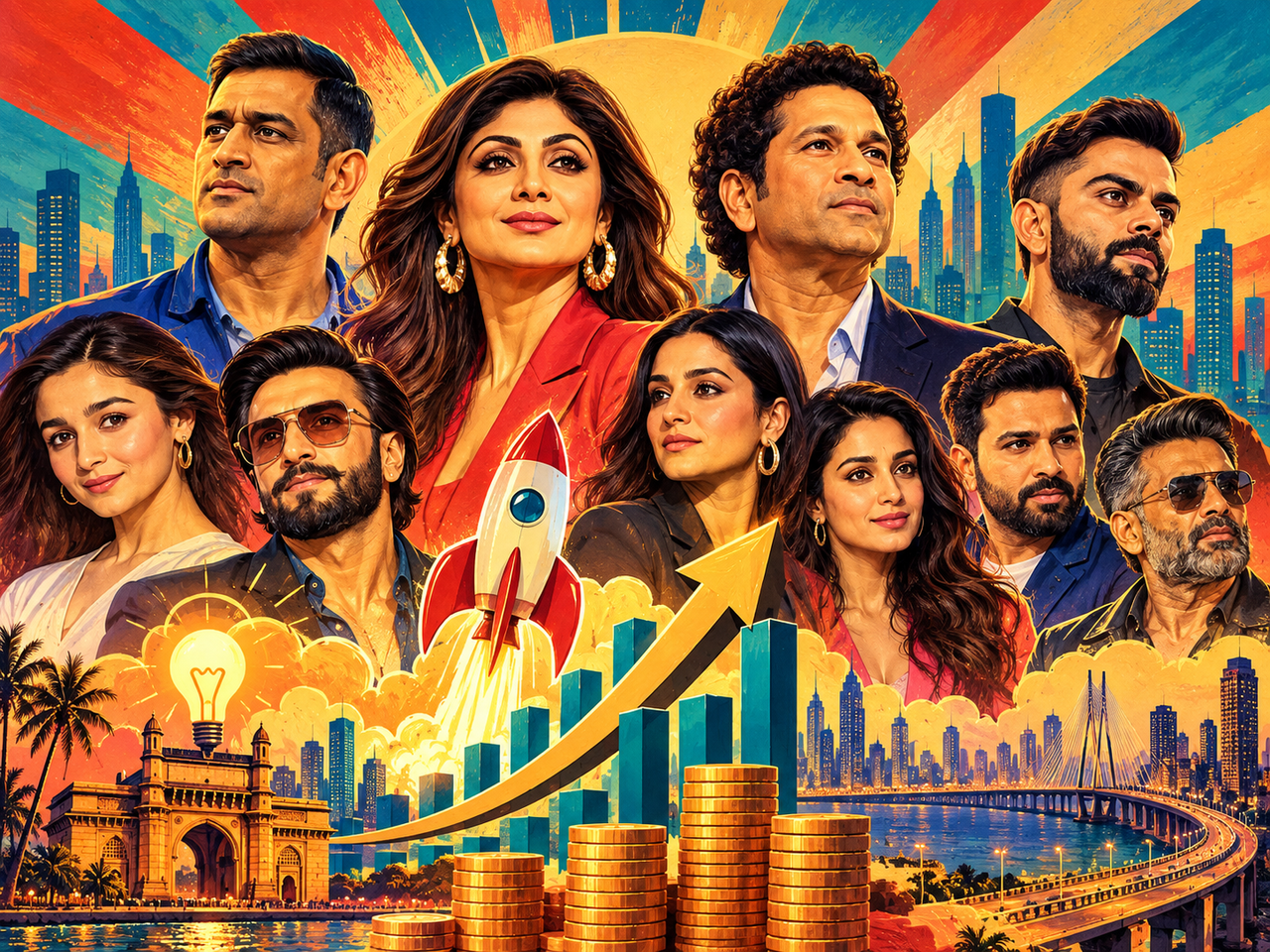
A Tracxn analysis of celebrity participation in Indian startup funding between 2021 and September, 2026 shows that 10 prominent film and sports personalities participated in 49 disclosed funding rounds across 34 India-headquartered startups. The combined value of those rounds was about $458 million.
That figure needs an important qualification: it is the total value of the funding rounds in which the celebrities participated, not the amount invested by the celebrities themselves. Tracxn’s ranking is based on disclosed round count, not capital deployed.
The more interesting finding is where this capital has gone.
Of the 34 startups, 15 are based in Maharashtra, including 12 in Mumbai. Haryana accounts for six, Karnataka five and Delhi three. In other words, 29 of the 34 startups—more than 85%—are concentrated across four established startup markets.
That concentration says something about celebrity capital that a simple top-10 list does not.
Celebrity Capital Follows the Startup Map
The geography is striking because celebrity investing could, in theory, have been one of the channels through which capital and visibility reached India’s emerging startup centres.
Instead, the data largely mirrors the country’s existing startup geography.
Mumbai dominates the cohort, followed by other established ecosystems in Maharashtra, Haryana, Karnataka and Delhi. This is not entirely surprising. These cities already have dense networks of founders, venture capital firms, consumer businesses, media companies and professional advisers.
It also creates a useful distinction between celebrity capital and conventional venture capital.
A VC fund may deliberately search across geographies for a particular technology or business model. Celebrity investors, by contrast, often enter businesses where they can understand the consumer proposition and where their public profile has some relevance.
That helps explain the nature of the portfolio.
The Celebrity Portfolio Looks More Like the Consumer Economy
The 34 startups span food and beverage, beauty and personal care, fashion, mobility, education, logistics, drones, solar energy and other categories.
The pattern becomes clearer when individual portfolios are examined.
Shilpa Shetty Kundra’s disclosed investments include WickedGud, KisanKonnect, Alpino, Sustainiam, Limelight and Mamaearth. She participated in 10 disclosed rounds, the highest number in the Tracxn dataset.
MS Dhoni’s portfolio is more diversified, stretching from SolarSquare and Garuda Aerospace to EMotorad, Tagda Raho, Shaka Harry and Rigi. Sachin Tendulkar’s disclosed activity, meanwhile, is heavily concentrated in Spinny, with five separate disclosed rounds in the used-car platform, alongside an investment in XYXX.
That distinction matters.
Celebrity investing is not one uniform strategy. Some stars appear across several consumer categories; others have made repeated bets on the same company; others have spread their participation across technology, mobility and newer industrial businesses.
The common thread is that these are businesses where brand, consumer trust, visibility or a recognisable public proposition can potentially matter alongside capital.
/fit-in/580x348/filters:format(webp)/tice-news-prod/media/media_files/2026/09/23/celebrity-investors-in-indian-startups-2026-09-23-14-26-34.png)
The More Revealing Number Is 22
There is another number buried in the Tracxn data: 22 of the 49 disclosed rounds came from just nine celebrity-company pairs.
That changes the way the celebrity-investor phenomenon should be viewed.
It is easy to assume that celebrities are simply making a series of one-off bets across India’s startup ecosystem. The data suggests a more complicated picture. Some celebrity investors return when companies raise more capital.
Tendulkar’s repeated participation in Spinny is one example. Shetty’s investments across multiple rounds in WickedGud and KisanKonnect are another. The underlying behaviour is closer to relationship-based investing than a sequence of isolated endorsement deals.
That is significant for founders.
An investor who remains involved through multiple funding rounds potentially brings continuity to a company’s relationship with a public audience. But the Tracxn data itself does not establish how much commercial value each celebrity generated for these businesses. Any claims about customer acquisition, revenue impact or brand lift need to be assessed company by company.
Celebrity Capital Is Entering Earlier Than Many Might Expect
The other structural signal is the stage at which celebrities are participating.
Of the 49 disclosed rounds, 27, or 55%, were Angel or Seed rounds, while another 13 were Series A.
That places a substantial share of celebrity capital close to the beginning of a startup’s institutional journey.
This is important because celebrity participation at the early stage is fundamentally different from simply attaching a famous face to an established company.
At that point, the startup is still building its market, product and identity. The celebrity is becoming part of the company’s ownership story rather than merely its advertising strategy.
There are already signs that some of these bets have matured. Tracxn identifies Spinny as the sole unicorn in the cohort, while Sugar Cosmetics and XYXX are classified as soonicorns. Five companies in the dataset have reached an acquisition or public-listing event, including Ed-a-Mamma, Shunya, Mamaearth/Honasa Consumer, Klassroom and Purple Style Labs.
But these outcomes should not be interpreted as evidence of investment performance. The dataset is a record of disclosed participation, not a return analysis.
Can Celebrity Capital Move Beyond the Metro Bubble?
This is where the data leaves the more interesting question for India’s startup ecosystem.
Celebrity capital has clearly moved beyond the old endorsement model. It is entering startups early, sometimes returning for subsequent rounds and participating across a range of consumer and technology categories.
But it remains geographically concentrated.
The next evolution could be whether this form of capital begins reaching businesses outside India’s established startup corridors—particularly startups building for smaller cities, rural consumers, agriculture, climate resilience, industrial technology and other markets where celebrity visibility could potentially help bridge the gap between innovation and mass adoption.
That does not mean celebrities should become substitutes for venture capital or institutional investors. Their investment decisions will always be shaped by personal interests, business relationships and the relevance of their public profile.
But the Tracxn data points to something bigger than a list of famous investors.
Celebrity capital is becoming a distinct layer of India’s startup financing ecosystem—one that combines ownership with visibility, credibility and, in some cases, long-term association.
For now, that layer is concentrated around the country’s established startup and consumer hubs. The next question is whether it can travel further.