
As India hosts the BRICS Summit in New Delhi and the BRICS Film Festival returns alongside IFFI in Goa, I believe we have an opportunity to think bigger about how the Global South connects through cinema.
This weekend, as India hosts the 18th BRICS Summit in New Delhi, much of the world’s attention will understandably be focused on geopolitics, trade, technology, finance and the changing global order.
But as someone who has spent considerable time working at the intersection of media, culture, entrepreneurship and creative ecosystems, I find another part of the BRICS conversation particularly interesting.
Cinema.
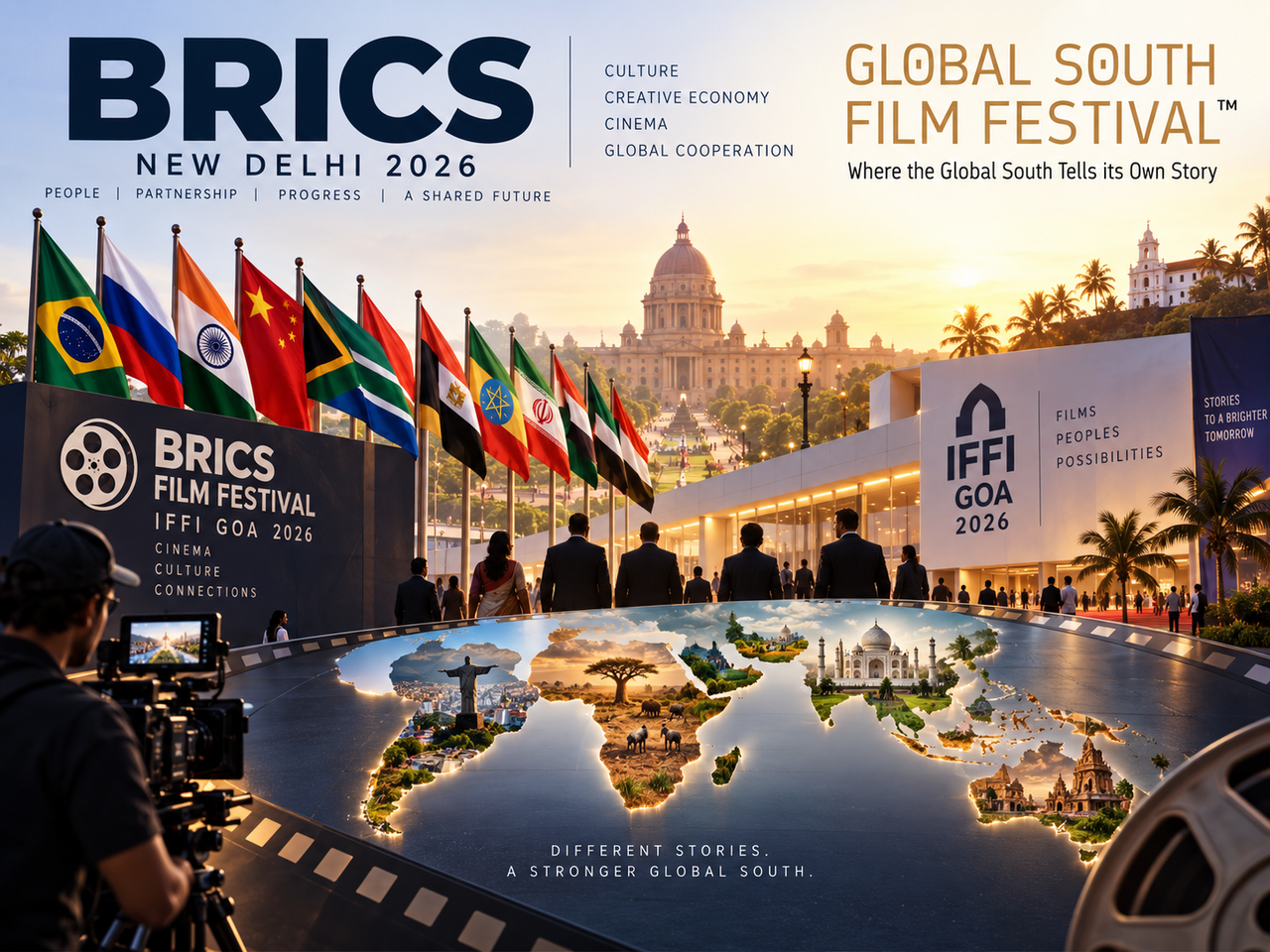
And the timing could not be more appropriate. This year, the BRICS Film Festival is being held alongside the International Film Festival of India (IFFI) in Goa, bringing films and filmmakers from the BRICS ecosystem into one of India’s most important international cinematic platforms.
I see this as more than a festival programme. I see it as a signal of what cinema can contribute to international cooperation. And it makes me ask a larger question:
If BRICS can bring its film industries together, can we take that conversation further across the wider Global South?
Cinema is more than entertainment
I have always believed that cinema is one of the most powerful forms of cultural diplomacy.
Governments can negotiate agreements. Businesses can build partnerships. But a film can make an audience feel another country.
It can introduce people to another society’s history, humour, aspirations, conflicts, music, food and landscapes. And then something interesting happens.
-A film can create a business relationship.
-A producer finds a co-producer.
-A filmmaker discovers a new location.
-A distributor discovers a new market.
-An investor discovers intellectual property.
-A city discovers the potential of film tourism.
Cinema therefore sits at the intersection of culture, commerce, technology, intellectual property, tourism and soft power.
That is why I believe the creative economy deserves to be treated as a serious component of international cooperation.
India is already a creative powerhouse
India enters this conversation from a position of considerable strength. Our film industry produced films at extraordinary scale in 2025, while India’s domestic theatrical box office reached an all-time high of approximately ₹13,395 crore. More broadly, India’s media and entertainment industry reached approximately ₹2.78 lakh crore in 2025. But numbers alone do not tell the entire story.
India’s real advantage is the diversity of its storytelling.
Hindi cinema is only one part of the picture. Tamil, Telugu, Malayalam, Kannada, Marathi, Bengali, Gujarati and many other Indian-language industries have developed their own audiences, creative identities and production ecosystems.
“I believe that diversity gives India a particularly strong foundation from which to engage with the wider Global South.”
The BRICS Film Festival is an important beginning
The BRICS Film Festival alongside IFFI gives filmmakers an opportunity to encounter cinema from countries that they may otherwise experience only through headlines, streaming platforms or occasional international festivals. But there is a natural limitation to any grouping defined by membership.
The Global South is much larger than BRICS.
There are extraordinary creative communities across Africa, Latin America, Southeast Asia, Central Asia, the Middle East and other emerging regions.
Brazil. Russia. India. China. South Africa. Egypt. Indonesia. Thailand. Kazakhstan. Saudi Arabia. UAE. Nigeria. And many more.
Each has its own cinematic language, audience, production ecosystem and cultural identity.
“What interests me is what could happen if these ecosystems began interacting with each other more systematically.”
Why should South-South cinema need a Northern gateway?
This is perhaps the question I keep coming back to. For decades, filmmakers from Asia, Africa and Latin America have travelled to Europe and North America to find international buyers, financing, sales agents, distributors and co-production partners. The great international festivals and markets remain enormously important. I do not believe the answer is to turn away from them.
But why should two filmmakers from the Global South necessarily need a Northern gateway to discover each other?
-Why shouldn’t an Indian producer meet a Brazilian producer in Mumbai?
-Why shouldn’t an African filmmaker meet an Indian distributor in Delhi?
-Why shouldn’t a Kazakh production company explore Indian locations and post-production capabilities
-Why shouldn’t filmmakers from Southeast Asia and India develop stories together for audiences across both regions?
These are not merely cultural exchanges. They are creative-economy opportunities.
Perhaps the festival itself needs to evolve
This also makes me think about the future of film festivals. For many filmmakers, the traditional journey can still be straightforward:
-Submit a film.
-Wait for selection.
-Attend the festival.
-Screen the film.
-Collect the award or certificate.
-Return home.
But filmmakers today need much more.
Perhaps, therefore, the future festival should not be measured only by how many films it screens, but by how many meaningful relationships it creates.
This is the thinking behind GSFF
It is this belief that has shaped my involvement as India Lead of the Global South Film Festival (GSFF).
GSFF is not intended to replace the BRICS Film Festival, IFFI or the established international festival ecosystem.
“I see it as an opportunity to extend the conversation.”
To take the idea of South-South cinematic exchange and make it broader, more connected and more commercially meaningful. Our three pillars – Women, Stories and Capital – reflect that philosophy.
Who gets to tell the stories?
Which stories deserve to travel?
And how do those stories find the capital, partnerships, markets and audiences needed to reach the world?
The ambition is to create a travelling platform that connects filmmakers, producers, investors, distributors, film commissions, technology companies and audiences across the Global South.
/fit-in/580x348/filters:format(webp)/tice-news-prod/media/media_files/2026/08/21/gsff-brics-nfdc-2026-08-21-16-21-12.jpeg)
The Global South Film Festival was formally launched at the BRICS WAVES Bazaar in Mumbai in August 2026, bringing together the GSFF international consortium alongside senior representatives of India’s film and media institutions, including the Managing Director of NFDC and Joint Secretary, Ministry of Information & Broadcasting. The meeting marked an important first step in building a platform for greater South-South collaboration in cinema. It was also a reflection of the growing recognition that the creative economies of the Global South can build stronger connections through stories, talent, markets and partnerships.
India’s opportunity
I believe India can play a special role in this emerging ecosystem.
We have the scale.
We have the talent.
We have the production infrastructure.
We have extraordinary regional cinemas.
And we have an increasingly sophisticated media and entertainment economy.
But perhaps our greatest opportunity is not simply to export more Indian films.
It is to connect more film industries with each other.
That could mean an Indian-Brazilian co-production.
An African filmmaker working with Indian post-production talent.
A Central Asian story finding an Indian distributor.
A Southeast Asian producer exploring Indian locations.
Or an investor discovering a new piece of screen IP from a country they had never previously considered.
That is when a film festival becomes something larger than an event. It becomes infrastructure.
From BRICS to the Global South
As the BRICS leaders meet in New Delhi and filmmakers gather in Goa, I believe we should look at the opportunity in stages.
BRICS has created an important platform for cooperation.
The BRICS Film Festival has created a cinematic bridge. The wider Global South gives us the opportunity to build a much larger network. The objective is not to create another closed circuit. It is to create more bridges. More stories travelling directly between countries. More producers meeting producers. More capital finding stories. More audiences discovering cultures.
And more filmmakers discovering possibilities beyond the traditional centres of global cinema.
“For me, that is the larger promise of the Global South Film Festival. Not to replace the bridges that already exist. But to build more of them.”
Dr. Seema Narera
India Lead, Global South Film Festival
https://globalsouthfilmfestival.org/