
The new manufacturing and testing facilities at IIT Delhi’s mPragati platform aim to bridge one of the biggest gaps in India’s MedTech ecosystem-helping innovators convert research into commercially viable medical devices.
India has produced no shortage of healthcare innovations inside its laboratories.
The bigger challenge has often begun after the research is complete.
Turning a prototype into a medical device that can be manufactured, sterilised, tested, validated and eventually used in hospitals requires specialised infrastructure-something many startups and researchers struggle to access.
The Indian Institute of Technology (IIT) Delhi is attempting to close that gap.
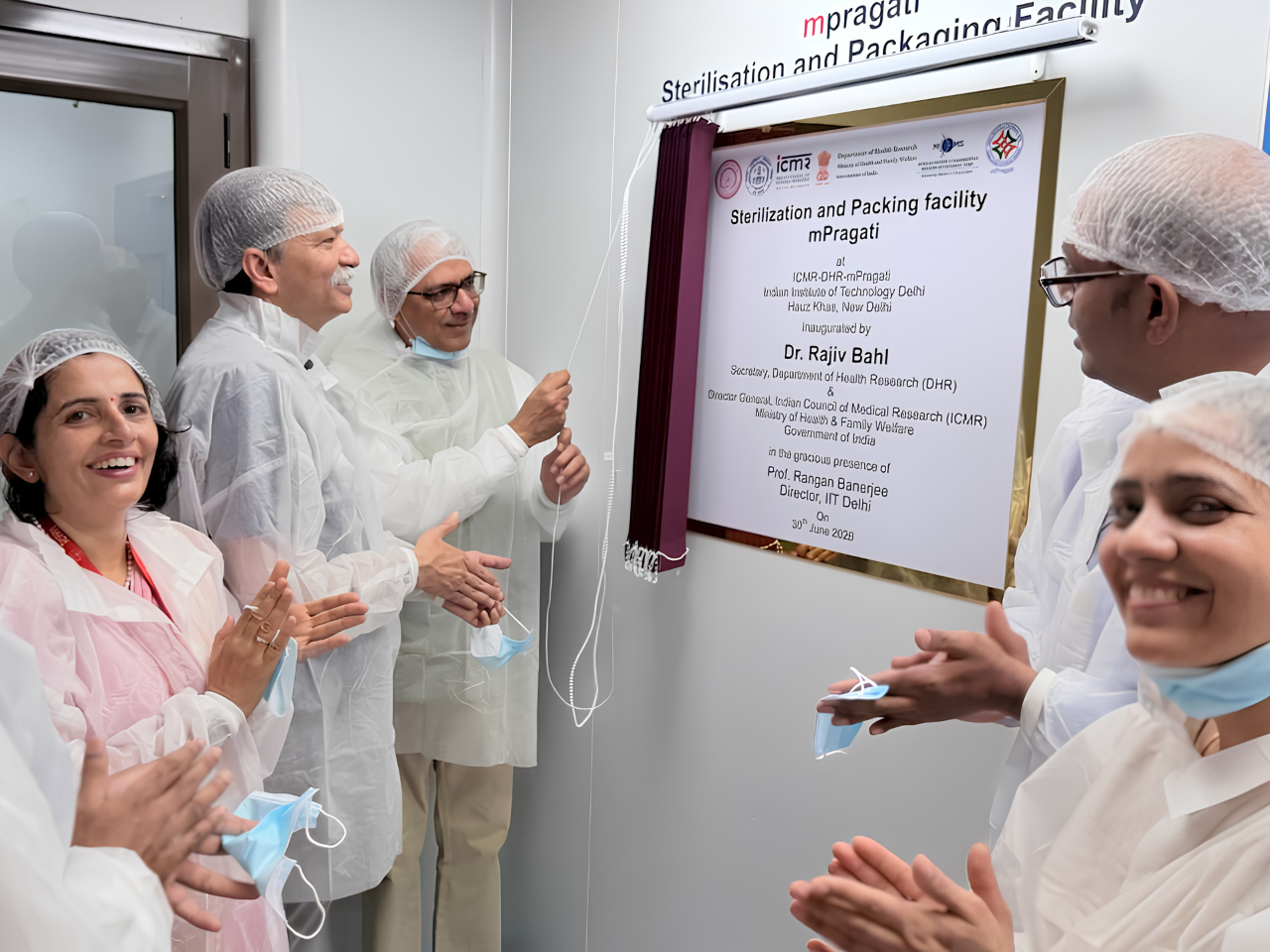
The institute has inaugurated a state-of-the-art CNC Laboratory and Sterilization & Packaging Laboratory under mPragati, its national translational platform for medical devices and diagnostics. Together, the facilities are expected to support every stage of medical device development-from precision manufacturing and biological validation to regulatory testing and commercial production.
The laboratories were inaugurated by Dr. Rajiv Bahl, Secretary, Department of Health Research, Government of India, and Director General of the Indian Council of Medical Research (ICMR), in the presence of Prof. Rangan Banerjee, Director, IIT Delhi, along with Suchita Markan, Ashwini Agrawal, Manidipa Banerjee and Dinesh Kalyanasundaram.
Closing the Gap Between Research and the Market
India’s MedTech ecosystem has expanded rapidly over the past decade, supported by startups developing innovations in diagnostics, medical devices, digital health and biotechnology.
Yet many promising ideas fail to move beyond the prototype stage because the infrastructure required for manufacturing, validation and regulatory compliance is both expensive and difficult to access.
IIT Delhi’s latest investment is designed to address that bottleneck.
Rather than functioning as standalone research laboratories, the new facilities provide an integrated environment where innovators can develop products, test them against quality standards and prepare them for commercial deployment.
For startups, that could shorten product development cycles and reduce the cost of bringing new healthcare technologies to market.
/fit-in/580x348/filters:format(webp)/tice-news-prod/media/media_files/2026/07/03/iit-delhi-3-2026-07-03-14-18-15.png)
Precision Manufacturing for High-End Medical Devices
The newly established CNC Laboratory is equipped to manufacture medical implants, surgical instruments, dental devices and diagnostic components using certified biocompatible materials.
Its advanced manufacturing systems include multi-axis machining, Swiss-type turning and high-speed milling technologies capable of producing both customised patient-specific devices and standardised medical products.
Such capabilities are particularly important as India seeks to reduce its dependence on imported precision medical equipment while strengthening domestic manufacturing.
The facility is expected to help researchers and startups move beyond laboratory prototypes to clinically deployable products.
Building Products That Meet Global Standards
Manufacturing is only one part of the journey for a medical device.
Before reaching hospitals or patients, products must undergo sterilisation, packaging, quality validation and regulatory compliance.
The new Sterilization & Packaging Laboratory brings those capabilities together under one roof.
It houses Ethylene Oxide (EtO) sterilisation systems, steam autoclaves, precision assembly workstations, automated reagent dispensing systems, stability chambers for shelf-life validation, laser welding and marking systems, and vacuum packaging with batch coding and product traceability.
For early-stage MedTech companies, access to such infrastructure can significantly reduce the time and investment required before a product is ready for regulatory approval or commercial manufacturing.
Strengthening India’s Diagnostics Capabilities
The facility also includes an extensive biological and molecular testing infrastructure.
Researchers and startups will have access to thermal cyclers, real-time PCR systems, HPLC systems, fluorescence microscopy, biosafety cabinets, CO₂ incubators, ultracentrifuges, gel electrophoresis systems and ultra-low temperature storage facilities.
These capabilities support molecular diagnostics, biological validation, analytical testing, sterility assurance, quality control and regulatory compliance—critical requirements for medical technologies entering the healthcare system.
By bringing these capabilities together, IIT Delhi aims to create a seamless pathway from laboratory research to clinical application.
A Stronger Foundation for MedTech Entrepreneurship
India’s startup ecosystem has crossed 2.40 lakh DPIIT-recognised startups, with healthcare and medical technology emerging as one of its fastest-growing sectors.
The government’s Atmanirbhar Bharat initiative has also placed greater emphasis on building domestic capabilities in medical devices and diagnostics.
In that context, infrastructure matters as much as funding.
While incubators help founders build companies and investors provide growth capital, specialised facilities determine whether innovative products can meet the quality, safety and regulatory standards required for hospitals and global markets.
According to IIT Delhi, the new laboratories are expected to strengthen India’s ability to design, validate and manufacture high-quality medical devices while accelerating the transition of research into commercial products.
The initiative also supports ICMR’s broader objective of advancing translational biomedical research that addresses national healthcare priorities.
/fit-in/580x348/filters:format(webp)/tice-news-prod/media/media_files/2026/07/03/iit-delhi-2-2026-07-03-14-18-34.png)
More Than a Laboratory
For India’s MedTech entrepreneurs, the inauguration represents more than the addition of two laboratories on a university campus.
It reflects a broader shift in the country’s innovation ecosystem-from supporting research to enabling commercialisation.
India has demonstrated that it can produce world-class engineers, scientists and healthcare innovators.
The next challenge is ensuring that more of those ideas become products manufactured in India rather than technologies commercialised elsewhere.
Facilities like mPragati will not solve that challenge on their own.
But they do provide something India’s MedTech ecosystem has long needed: shared infrastructure that allows researchers, startups and industry to work together to build medical technologies that are designed, validated and manufactured in India.
As the country seeks to become a global hub for healthcare innovation, investments in such translational infrastructure could prove just as important as investments in research itself.