
Artificial Intelligence is no longer a future technology that industries are preparing for. It has already become a critical part of business transformation across sectors. From healthcare and finance to retail and manufacturing, companies are rapidly integrating AI-powered solutions into their operations.
But while technology adoption is accelerating, one major challenge continues to emerge — the shortage of skilled professionals who can actually build and apply these technologies in real-world environments.
India produces millions of graduates every year, yet employers continue to struggle with finding talent that possesses practical, industry-relevant skills. As AI adoption increases, the gap between industry demand and available talent is becoming more visible than ever.
Against this backdrop, AlmaBetter is now taking a major step to address the challenge.
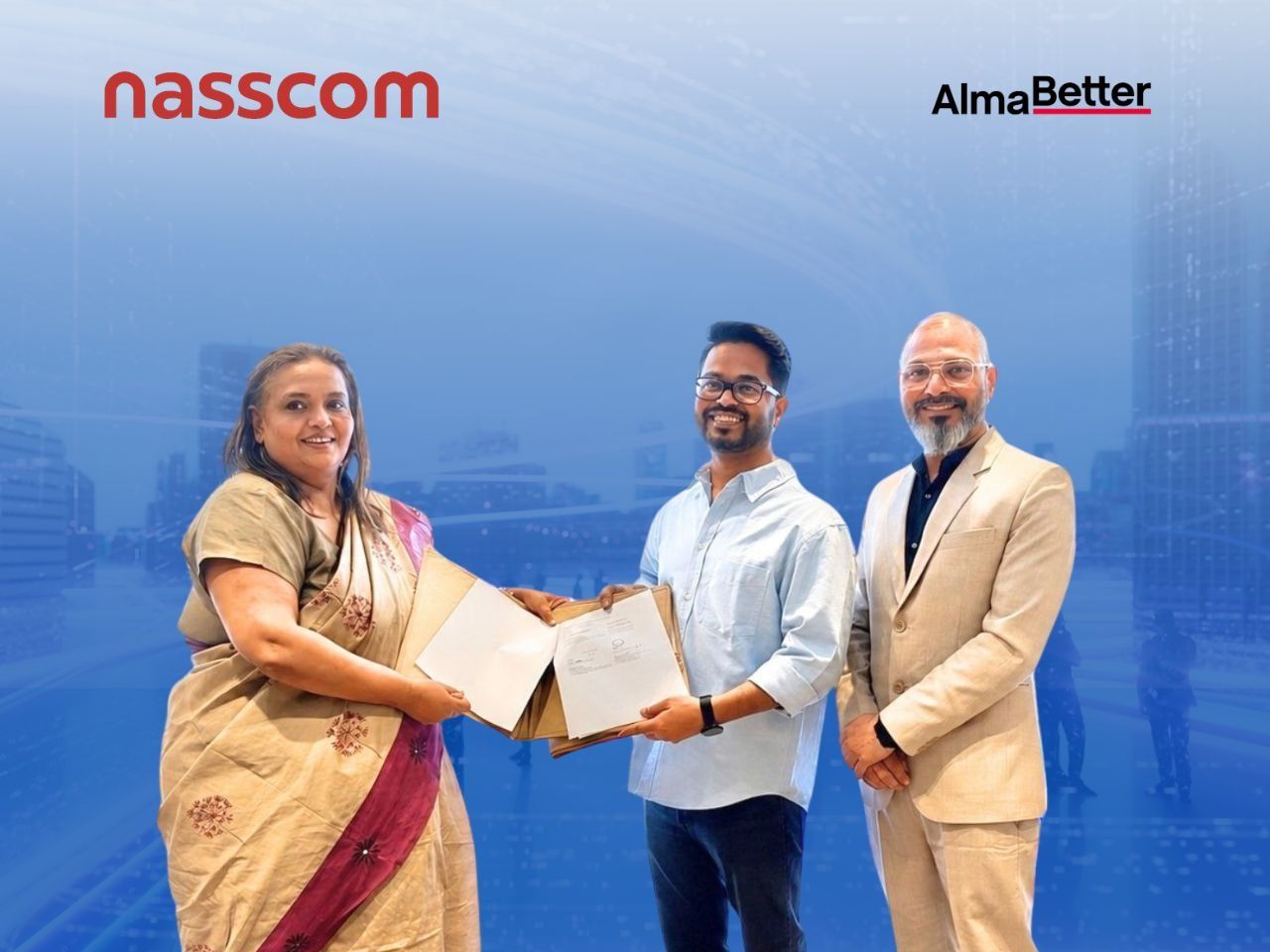
AlmaBetter joins hands with NASSCOM to build India’s future AI workforce
Backed by early investor Kalaari Capital, AlmaBetter has announced a strategic partnership with NASSCOM to upskill and certify 2 lakh professionals in Artificial Intelligence and emerging technologies by FY2030.
Alongside the partnership announcement, the edtech company has also secured fresh strategic funding of INR 2 crore from a High Net-Worth Individual (HNI) educationist.
The company said the newly raised funds will be deployed toward expanding upskilling initiatives and improving access to learning opportunities across India.
The numbers behind India’s growing AI talent shortage
The partnership arrives at a time when industry data points toward a widening gap between talent demand and supply.
According to the NASSCOM AI Talent Demand-Supply Report, the shortage in AI and Big Data Analytics remains significant, with demand for digital talent nearly eight times larger than the available fresh talent pool.
Adding to this concern, the ManPowerGroup Global Talent Shortage Survey reveals that nearly 82% of Indian employers are finding it difficult to hire skilled professionals.
These numbers underline a challenge many businesses are already experiencing — technological growth is moving faster than workforce readiness.
Bringing industry learning directly into the skilling ecosystem
To bridge this employability gap, AlmaBetter’s specialised programmes will now become part of NASSCOM’s larger national skilling ecosystem, including the government-backed FutureSkills Prime platform.
Through this initiative, learners and working professionals will receive joint certifications from AlmaBetter and NASSCOM aligned with National Occupational Standards (NOS).
Apart from certifications, participants will gain access to real-world projects, mentorship opportunities, and structured career pathways intended to prepare them for emerging technology roles.
The partnership was formalised after the AI Impact Summit in New Delhi, where policymakers and industry leaders highlighted the need for a stronger and future-ready AI talent pipeline.
Building skills beyond the classroom
Sharing his views on the collaboration, Ravi Kumar Gupta, Co-founder and CEO of AlmaBetter, said:
“India’s AI ambitions depend on building talent that can apply technology in real-world environments. Through our collaboration with NASSCOM, we are combining industry-validated credentials, hands-on learning, and placement pathways to create job-ready AI professionals. Backed by fresh strategic funding, we are focused on accelerating product innovation, expanding access, and scaling industry-ready AI talent across India.”
Under this initiative, AlmaBetter will focus on delivering project-based and experiential learning programmes across high-growth domains including Artificial Intelligence, Generative AI, Cloud Computing, Quantum Computing and Data Analytics.
The curriculum, certified by NASSCOM and designed with industry practitioners, will expose learners to practical deployment scenarios rather than relying only on theoretical concepts.
Reaching women, career switchers and learners beyond metro cities
One of the important aspects of the initiative is its emphasis on inclusivity and accessibility.
The programme intends to create opportunities for women professionals, first-generation technology aspirants and individuals seeking career transitions into technology roles.
The collaboration will also focus on expanding access to learners from Tier-2 and Tier-3 cities, where aspirations for technology careers continue to rise despite limited access to industry-focused learning resources.
By building a verified talent pool with recognised credentials, the initiative also aims to help enterprises recruit professionals capable of supporting AI-driven transformation across sectors.
AlmaBetter’s larger mission to bridge the industry-academia divide
Over the last five years, AlmaBetter says it has upskilled thousands of learners through an industry-led employability model.
Its framework combines competency-based learning with applied capstone projects and a dedicated placement ecosystem.
The company currently works with a network of more than 200 industry mentors and has hiring collaborations across over 5,000 companies.
As AI continues reshaping industries and redefining future jobs, the challenge for India may not simply be creating advanced technologies — it may increasingly become about building enough skilled professionals to power that transformation.
And with talent now becoming the foundation of the AI economy, efforts such as this could play an important role in shaping the workforce of the future.