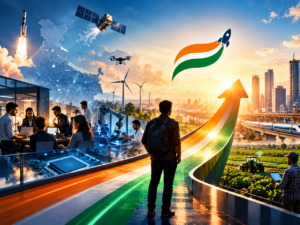

India’s economic and startup ecosystem continues to move at full speed as government policy, deep-tech innovation, market momentum, and infrastructure expansion converge to shape the country’s next growth chapter. From semiconductor investments and startup funding to economic resilience amid global uncertainty, today’s developments reflect a broader transformation underway across sectors.
On May 06, 2026, the focus remained firmly on India’s ambition to become a global innovation powerhouse. Government-backed manufacturing pushes, startup ecosystem expansion, fintech innovation, and capital market optimism dominated the headlines. Here’s a detailed roundup of the biggest developments from the worlds of startups, government, economy, technology, and business.
Top News of the Day
1. Government Clears ₹3,936 Crore Semiconductor Projects
In a significant boost to India’s semiconductor ambitions, the Centre approved two semiconductor manufacturing projects worth ₹3,936 crore under the India Semiconductor Mission. The move strengthens India’s push toward technological self-reliance and domestic chip manufacturing amid growing global supply chain concerns.
The approvals come as India aggressively positions itself as a global semiconductor destination, especially in chip packaging, testing, and fabrication support infrastructure.
2. Indian Markets Rally on Global Peace Hopes
Indian equity markets surged sharply on Wednesday after easing geopolitical tensions in West Asia lifted investor sentiment globally. The Sensex climbed over 1.2%, while the Nifty crossed the 24,300 mark.
Banking and financial stocks led the rally, supported by the government’s newly approved credit guarantee scheme aimed at supporting businesses impacted by international disruptions. Falling crude oil prices further boosted investor confidence.
3. India’s Economy Shows Resilience Despite Global Shocks
The Finance Ministry’s latest economic review highlighted that India remains “resilient, though not shock-free” amid ongoing global instability and oil price volatility.
Strong domestic demand, healthy banking systems, policy responsiveness, and solid forex reserves continue to act as economic buffers. The report reinforces confidence that India remains among the world’s fastest-growing major economies despite geopolitical uncertainty.
4. Bengaluru Startup BigEndian Semiconductors Raises $6 Million
Deep-tech startup BigEndian Semiconductors secured $6 million in fresh funding led by IAN Alpha Fund and Vertex Ventures.
The Bengaluru-based company plans to commercialise its indigenous VisionAI chips and scale domestic semiconductor innovation. The funding reflects growing investor appetite for Indian hardware and semiconductor startups.
5. Startup India Crosses 2.23 Lakh Recognised Startups
India’s startup ecosystem achieved another milestone with more than 55,200 startups recognised in FY26 alone — the highest ever in a single year since Startup India launched in 2016.
The total number of recognised startups has now crossed 2.23 lakh, collectively generating over 23 lakh direct jobs. Nearly 48% of these startups have at least one woman founder or director, indicating rising diversity in entrepreneurship.
6. IIT Madras Hosts First-Ever Technology Summit in Delhi
IIT Madras hosted its first technology summit in New Delhi, bringing together policymakers, industry leaders, and researchers to accelerate innovation partnerships.
The summit showcased deep-tech research, startup incubation initiatives, and industry-ready innovations emerging from the institute’s Centres of Excellence.
7. Bengaluru Unveils Vision to Become a Global Economic Hub
Karnataka unveiled an ambitious economic masterplan for Bengaluru aiming to transform the city into a world-class economic hub by 2037.
The proposed roadmap focuses on sustainability, mobility, satellite town development, and economic decentralisation. Bengaluru currently contributes nearly $149 billion to India’s GDP and remains one of the world’s leading AI talent hubs.
8. Fintech Innovation Takes Centre Stage in Bengaluru
The second edition of the World Fintech Summit concluded in Bengaluru with discussions centred around AI-led banking, cybersecurity, digital payments, and financial inclusion.
Industry leaders highlighted India’s growing influence in global fintech innovation and the increasing adoption of AI-driven financial infrastructure.
9. Government Launches 5-Year Cotton Productivity Mission
The Union Cabinet approved a long-term cotton productivity mission aimed at improving output, modernising farming practices, and strengthening India’s textile value chain.
The initiative aligns with the government’s broader “5F Vision” — Farm to Fibre to Factory to Fashion to Foreign markets.
10. Chhattisgarh Pushes Startup Growth in Bastar
The Chhattisgarh government announced expanded startup and innovation initiatives under its Startup Policy 2025–30 to encourage entrepreneurship among youth in Bastar.
The programme will offer funding access, mentorship, market linkages, and skill development support for emerging entrepreneurs in the region.
11. India’s Startup Ecosystem Expands Beyond Metro Cities
Industry reports released today highlighted how India’s startup momentum is increasingly shifting toward Tier-2 and Tier-3 cities.
Startups in manufacturing, agritech, sustainability, and regional commerce are emerging as major drivers of economic growth beyond traditional metro-centric tech ecosystems.
12. AI and Deep-Tech Continue to Dominate India’s Innovation Narrative
India’s policy and investment ecosystem is increasingly leaning toward AI, semiconductors, and deep-tech innovation. The momentum follows major initiatives such as the India AI Mission and growing investments into indigenous technologies.
Analysts believe the next wave of Indian unicorns could emerge from infrastructure technology, enterprise AI, robotics, and chip manufacturing rather than consumer internet businesses.
Conclusion
Today’s developments underscore a larger shift in India’s economic and innovation story. The country is no longer focused solely on creating startups — it is now building infrastructure for long-term technological leadership. Semiconductor manufacturing, AI innovation, fintech transformation, and regional entrepreneurship are becoming central pillars of India’s growth strategy.
At the same time, government policy support and private capital continue to reinforce investor confidence even amid global uncertainty. As India pushes toward becoming a $5 trillion economy, the convergence of policy, capital, and innovation is likely to define the next decade of growth.
From deep-tech funding to economic resilience and startup expansion beyond metros, May 06, 2026, reflected one clear trend: India’s innovation economy is entering a far more mature and globally competitive phase.