In 2015, Ethereum co-founder Charles Hoskinson left the project he helped build and started over. Apparently, his vision was a blockchain built differently. That project became Cardano.
If you continue reading, this guide explains the Cardano blockchain from first principles. You will also see how it works, what ADA does, and what the ecosystem is actually being used for.
What is Cardano? (Definition & Overview)
Cardano is a third-generation, proof-of-stake blockchain platform. Developers designed this type mainly for smart contracts, decentralized applications, and financial infrastructure. Charles Hoskinson and Jeremy Wood founded the project in 2015. At the same time, Input Output Global (IOG) built the platform and officially launched it in 2017.
The name comes from the Italian mathematician Gerolamo Cardano. The native coin, ADA crypto, is named after Ada Lovelace, widely regarded as the world’s first computer programmer.
So what does this platform do that other blockchains don’t? Its defining characteristic is that every protocol upgrade is developed through peer-reviewed research and formal verification. Moreover, at the moment, the ADA price prediction is looking solid.
A Brief History of Cardano & Hard Forks
The development team structured Cardano’s roadmap into five named eras. It is very important to know that a hard fork introduced each of these eras.
Byron (2017): The genesis era. The project launched with basic transaction capability.
Shelley came out in 2020. That is when decentralization really started to happen. This is when stake pools were introduced. Now any person who holds ADA can give their coins to these pools and get rewards for doing
The Goguen Alonzo Hard Fork happened in 2021. It was a really big deal for the ecosystem. This is when they started supporting contracts. They did this by doing the Alonzo fork in September 2021.
The Basho Vasil Hard Fork took place in 2022. This made the network’s smart contract language, which is called Plutus, work better and faster.
The Voltaire Chang Hard Fork happened in 2024. That is when the platform got decentralized governance. As of the beginning of 2026, the next big upgrade that the developers are working on is called Ouroboros Leios.
This is a way of structuring blocks that can handle a lot of transactions at the same time. It is designed to be able to handle, up to 10,000 transactions every second.

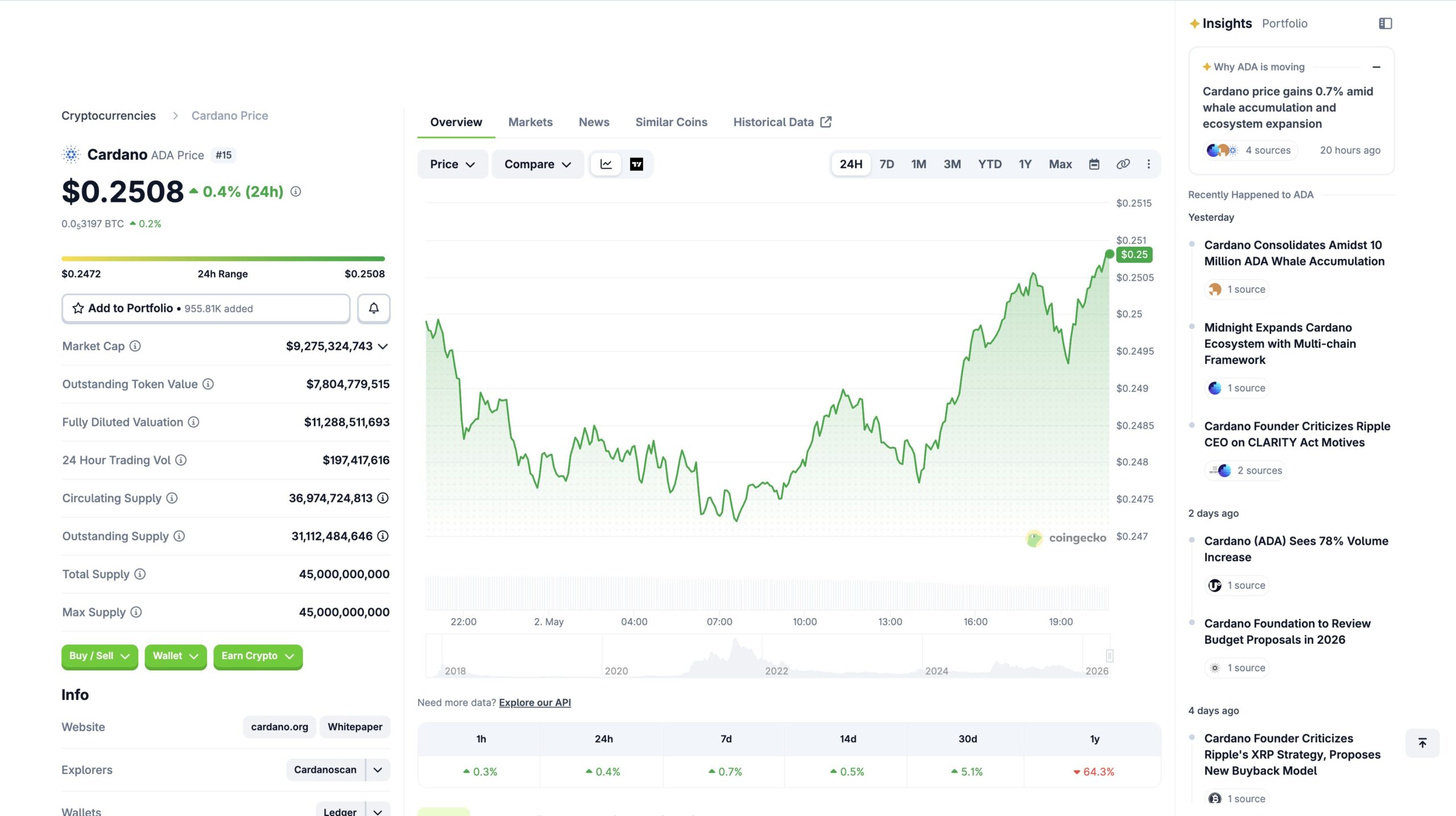
Image from CoinGecko
How Does the Cardano Blockchain Work?
Three foundational pillars support the Cardano blockchain: its consensus mechanism, its layered architecture, and its formal development methodology. Understanding these three things answers most of the question of how does Cardano work at a technical level.
The Ouroboros Proof-of-Stake Mechanism
The system works with a consensus mechanism called Ouroboros. This is a system that helps the blockchain make decisions. It was the first of its kind that experts checked and approved in a big cryptography meeting, Crypto 2017.
The protocol uses Ouroboros to figure out which computers get to add blocks of information and when they can do it. Ouroboros breaks time down into parts called epochs and slots. An epoch is like a chunk of time that lasts about five days. The network has lots of these epochs. For each slot, the protocol randomly selects a stake pool to produce a block.
At the same time, it has a selection probability weighted by the amount of ADA delegated to that pool. Because of this, it makes the system both decentralized and energy-efficient.
The Two-Layer Architecture (CSL vs. CCL)
One of Cardano’s most distinctive architectural decisions is its separation of concerns into two layers:
Cardano Settlement Layer (CSL): Handles ADA transactions. This layer manages who owns what, settling transfers and tracking balances. It is optimized purely for value transfer.
Cardano Computation Layer (CCL): Handles smart contract logic. Decentralized applications, DeFi protocols, and custom tokens all run on this layer. Separating computation from settlement means bugs or congestion on the smart contract layer cannot directly compromise the base monetary layer.
This design is very different from Ethereum, where everything runs on a single layer. The Cardano blockchain separation gives developers more flexibility. Also, it theoretically makes the system easier to upgrade and audit over time.
What is ADA Crypto? (The Native Coin)
ADA is the native coin of the Cardano blockchain. Every transaction, smart contract interaction, and governance vote on the network is powered by what is ADA crypto in practice. For anyone, this is a utility and governance token with a hard supply cap of 45 billion coins.
ADA has three primary functions:
- Transaction fees: Every on-chain action requires a small ADA fee. This is then paid to validators who process the block.
- Staking: ADA holders can delegate to stake pools and earn rewards proportional to their stake. Altcoin Buzz reports that 21.78 billion ADA roughly 57% of circulating supply is currently staked.
- Governance: Post-Chang hard fork, ADA holders vote directly on protocol upgrades, treasury spending, and the Cardano constitution.
What is Cardano Used For? (Ecosystem & Utility)
Understanding what is Cardano used for requires looking at the ecosystem that has grown around it. Cardano utility is within DeFi, digital identity, supply chain tracking, and financial inclusion.
Cardano Smart Contracts and dApps
The network’s smart contracts are written in Plutus. Plutus is a Haskell-based language designed for formal verification. In this case, contracts can be mathematically proven correct before deployment.
The DeFi ecosystem is anchored by Minswap and Liqwid Finance. TradingKey’s March 2026 report confirms Cardano’s total TVL crossed $1.1 billion, significantly above the $680 million recorded in late 2025.
The NFT ecosystem supports over 8,000 active projects, with jpg.store serving as the primary marketplace. Marlowe, on the other hand, is Cardano’s domain-specific language for financial contracts.
Real-World Applications
One of the clearest answers to what does Cardano do beyond DeFi is its real-world application work. Cardano has deployed blockchain-based credential verification in Ethiopia.
In this place, the government partnered with IOG to issue tamper-proof academic records to five million students. In the process of doing this, the government used the Atala PRISM identity system.
Agricultural companies also use the blockchain to track produce from farm to consumer. At the same time, retailers use it to verify product authenticity.
Cardano vs. Ethereum vs. Bitcoin
When people ask how does Cardano work compared to its main competitors and the coin price prediction, three dimensions stand out:
- vs. Bitcoin: Bitcoin is a monetary network optimized for one thing: decentralized value storage. It has no smart contract layer and doesn’t try to be one. Cardano’s proof-of-stake consumes a fraction of Bitcoin’s energy. Simultaneously, it supports a full programmable layer on top.
- vs. Ethereum: Ethereum is the main smart contract platform with a deeper DeFi and developer ecosystems. It runs on proof-of-stake post-Merge. Cardano’s edge is its formal verification approach and academic rigor. Ethereum’s edge is network effects. Apparently, it has far more TVL, developer tooling, and institutional integration. CoinLaw’s 2025 Cardano statistics put Cardano’s developer community at over 12,000 active contributors.
- vs. Solana: Solana prioritizes raw speed and low fees. Cardano prioritizes correctness and decentralization over throughput.

Image from CoinLaw
Is Cardano a Good Investment? (Pros & Cons)
The question of is Cardano a good investment doesn’t have a single answer. It depends on your time horizon, risk tolerance, and what you believe about adoption curves in blockchain.
Arguments in favour:
- Strong technical foundation
- High staking participation
- Growing treasury
- Real-world deployments
Arguments against:
- Slow ecosystem growth
- Competition
- Price volatility
Conclusion: The Future of Cardano
Cardano is a blockchain that has been building its base for a time about ten years. Now it is doing things because of that base.
People still ask the same questions they have always asked about Cardano’s long-term purpose. What do people actually use Cardano for?
Can the platform get a lot of developers to work on it. Can it get a lot of money moving around like Ethereum does?
FAQs About Cardano ADA
What is Cardano in simple terms?
What is Cardano? Developers built this blockchain platform for smart contracts. At the same time, people also use it within decentralized finance and real-world applications.
What is Cardano ADA used for?
Cardano utility also extends to powering dApps, DeFi protocols, and NFT marketplaces. Another thing is that organizations can use it for real-world identity and supply chain systems built on the Cardano blockchain.
How does Cardano work differently from Ethereum?
The key difference in how does Cardano work vs ETH is development methodology and architecture. ADA uses formal verification and peer-reviewed research for upgrades.
What language do developers use to build Cardano crypto smart contracts?
Developers primarily write Cardano crypto smart contracts in Plutus.
Is Cardano a good investment for beginners?
Whether is Cardano a good investment depends on your goals. It has a strong technical track record and real-world partnerships.
What is ADA crypto’s max supply?
The protocol caps the max supply of what is ADA crypto at 45 billion coins.
The post What is Cardano? A Beginner’s Guide to the ADA Blockchain appeared first on Ventureburn.