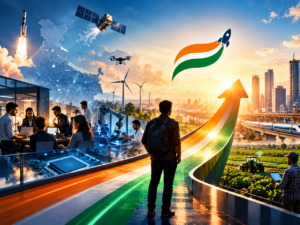

If there is one advantage India holds over most of the world today, it isn’t capital, technology, or even infrastructure.
It is people.
A young, ambitious, and rapidly growing workforce that has the potential to shape not just India’s future—but the global economy itself. But potential alone is never enough. The real question has always been: can India convert this demographic advantage into a skilled, employable, and globally competitive talent base?
Now, the country is doubling down on exactly that.
India is accelerating its push on youth skilling—positioning it as a central pillar of its long-term development vision, Viksit Bharat @2047.
And this is not a scattered effort. It is a coordinated, multi-sector transformation aimed at reshaping how education, training, and employment come together.
A Workforce in Transition
Recent data offers a glimpse into how the labour market is evolving.
India’s Labour Force Participation Rate (LFPR) for individuals aged 15 and above stood at 55.9% in February 2026, according to the Periodic Labour Force Survey.
But the numbers tell a deeper story.
- Workforce participation among women is rising
- Unemployment rates are declining across rural and urban areas
These are not just indicators of recovery—they signal a structural strengthening of the labour market.
At the same time, the nature of work itself is changing. Industries are evolving, technologies are advancing, and the demand for skills is becoming more specialised than ever before.
India’s response? Build a system that can keep up.
Reimagining Skilling: From Classrooms to Corridors
One of the most ambitious shifts underway is the creation of integrated “University Townships.”
These are not traditional campuses.
They are ecosystems—bringing together higher education institutions, research centres, and skill development hubs, strategically located near industrial and logistics corridors.
The idea is simple but powerful:
Bring education closer to industry.
This allows students to gain real-world exposure, align their learning with market needs, and transition more seamlessly into employment.
At the same time, efforts to improve access—such as setting up girls’ hostels across districts—are expected to increase participation in higher education, especially in STEM fields.
Investing in the Future of Science
Beyond employability, India is also investing in inspiration.
Large-scale scientific infrastructure projects, including the National Large Solar Telescope and the Himalayan Chandra Telescope, are being developed to strengthen capabilities in astrophysics.
But their impact goes beyond research.
They are meant to spark curiosity, attract young minds to frontier sciences, and build a pipeline of talent for advanced scientific fields.
Sector by Sector: Where Jobs Will Come From
India’s skilling push is not generic. It is deeply sector-focused—targeting industries that have the potential to generate large-scale employment.
Textiles and Manufacturing
One of India’s oldest industries is being reimagined.
The textile sector, which supports over 45 million jobs, is undergoing modernization through initiatives like Mega Textile Parks, the National Fibre Scheme, and Samarth 2.0.
The focus is on:
- Upgrading traditional clusters
- Promoting sustainable and technical textiles
- Expanding opportunities for women and rural workers
Healthcare and the Care Economy
As demand for healthcare rises, so does the need for skilled professionals.
Plans are in place to:
- Add 100,000 allied health professionals
- Train 1.5 lakh caregivers with multi-disciplinary skills
This includes emerging areas like wellness and assistive technologies—signaling a shift toward a more holistic care ecosystem.
Creative and Digital Industries (AVGC)
India’s creative economy is quietly becoming a major opportunity engine.
With the Animation, Visual Effects, Gaming, and Comics (AVGC) sector projected to need nearly 2 million professionals by 2030, the government is investing early.
- 15,000 schools
- 500 colleges
are set to host Content Creator Labs—designed to nurture talent from a young age and position India as a global content powerhouse.
Tourism and Hospitality
Already supporting over 8 crore jobs, tourism remains a critical employment driver.
New initiatives aim to:
- Upgrade hospitality education
- Train tourist guides at scale
- Build a National Destination Digital Knowledge Grid
This not only creates jobs but also opens opportunities for historians, researchers, and digital creators.
Sports Ecosystem
Sports is no longer just about performance—it’s becoming a career ecosystem.
Through programmes like Khelo India, the focus is on:
- Building structured talent pipelines
- Integrating sports science and technology
- Improving infrastructure and coaching standards
This creates new avenues for youth beyond traditional career paths.
Strengthening the Backbone of Skilling
At the core of this transformation are India’s flagship skilling programmes.
- Pradhan Mantri Kaushal Vikas Yojana (PMKVY 4.0) has trained over 27 lakh candidates across 38 sectors, including emerging areas like AI, Industry 4.0, and green technologies.
- National Apprenticeship Promotion Scheme (NAPS) has engaged over 54 lakh apprentices, promoting an “earn while you learn” model.
- Jan Shikshan Sansthan (JSS) has trained more than 36 lakh individuals, with a strong focus on rural and tribal communities.
Meanwhile, Industrial Training Institutes (ITIs) are being modernised with better infrastructure, updated courses, and stronger industry partnerships—ensuring that vocational training remains relevant and scalable.
Inclusion at the Core
What sets this strategy apart is its emphasis on inclusion.
The skilling push is not limited to urban centres or high-growth sectors.
There is a conscious effort to:
- Reach underserved regions
- Empower women
- Support traditional industries like handloom, handicrafts, livestock, and AYUSH
Digital tools and real-time monitoring systems are also being integrated to improve transparency and efficiency—ensuring that programmes deliver real outcomes.
The Road to 2047
As India moves toward its vision of becoming a developed nation by 2047, one thing is becoming increasingly clear:
Infrastructure can be built.
Capital can be raised.
Technology can be imported.
But human capital must be developed.
India’s intensified focus on youth skilling reflects a broader shift in thinking—one where the country is not just preparing people for jobs, but preparing them for the future of work itself.
If executed well, this could redefine India’s position in the global economy.
Because in the long run, the strength of a nation is not measured by what it produces—
but by what its people are capable of creating.