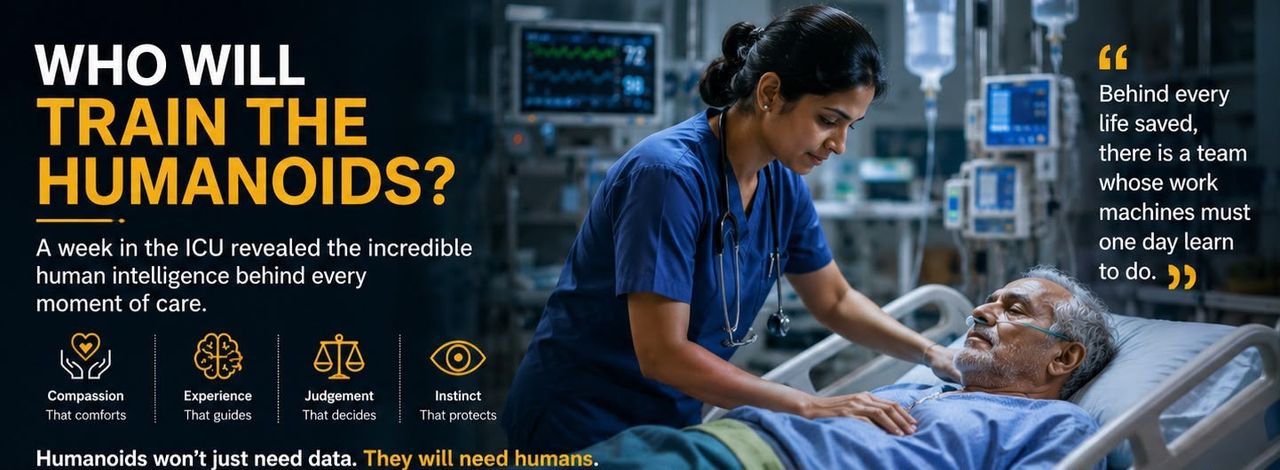

Over the past week, I have spent more time inside an ICU, Hsopital. Like every son, my focus was on the treatment and recovery of my mother. Yet, amidst the uncertainty, I found myself observing something remarkable – the invisible workforce that keeps a hospital functioning every single minute.
We often think of healthcare as doctors and nurses. But behind every successful treatment is an entire ecosystem: attendants moving patients with extraordinary care, housekeeping staff maintaining infection control, technicians monitoring critical equipment, ward assistants anticipating the next requirement, pharmacists, security personnel, transport teams and countless others.
Each of them performs hundreds of decisions every day. Many of these decisions are instinctive, built over years of experience rather than learnt from a textbook.
It made me wonder…
Everyone asks,
“Will AI replace healthcare workers?” I believe we’re asking the wrong question. The better question is Who will train the humanoids?
Today, Artificial Intelligence learns from data.
Tomorrow, Humanoid robots will learn from people.
A healthcare humanoid cannot simply read medical literature and become useful. It has to learn how to safely lift a patient, reposition someone without disturbing IV lines, prepare equipment before a doctor arrives, navigate a busy ICU, recognise discomfort before a monitor alarms, respond calmly in high-pressure situations and most important how to talk to a patient…The words these workforce say lifts morales of patients..
These aren’t just procedures.
They are human judgement, muscle memory, experience and empathy accumulated over years.
Recently I read an excellent article describing India’s hidden role in the AI revolution. It highlighted how millions of Indians quietly power today’s AI economy through data annotation which i labelling images, videos and text that become the training material for AI models worldwide.
The article argues that India should recognise this invisible workforce as a strategic national asset.I believe the next opportunity is even bigger.
From Data Annotation to Human Knowledge Annotation
The next generation of AI won’t simply require labelled data. It will require labelled human expertise. Every experienced hospital attendant, nursing assistant, technician and frontline healthcare worker carries practical knowledge that no textbook completely captures. That experience can become the foundation upon which healthcare humanoids learn.
/tice-news-prod/media/post_attachments/3d93cf3e-dec.jpg)
A Once-in-a-Generation Opportunity
Many frontline healthcare workers belong to lower-income or lower-middle-income households. Their work is physically demanding, emotionally exhausting and often under-recognised.
What if we viewed them differently?
Not as workers who may one day be replaced by humanoids…But as the very people who will teach those humanoids. Imagine entirely new professions emerging:
* Clinical AI Trainer
* Healthcare Humanoid Instructor
* Human Demonstration Specialist
* AI Safety Supervisor
* Clinical Simulation Coach
* Humanoid Operations Manager
Their years of experience would become intellectual capital. We also need their empathy and understanding as thats the emotional capital. Their daily work would become training both intelligence. Their knowledge would become India’s competitive advantage. Instead of fearing automation, they move up the value chain.
India’s Next Global Export
India exported nursing, medical staff to the world and India became known for software. India is becoming known for AI data services.
The next opportunity could be even larger:
Human expertise for Embodied AI. Healthcare is only the beginning.
The same model can apply across manufacturing, hospitality, logistics, retail, airports, construction and public services. The people closest to the work possess the knowledge AI desperately needs.
If India builds the right ecosystem today, we could become the global hub for training the world’s humanoid workforce.
Gratitude Before Automation
As hospitals begin adopting humanoids over the coming decade, I hope we remember something. Every intelligent machine will stand on the shoulders of thousands of healthcare workers whose knowledge quietly shaped it. Before celebrating the robot, let us recognise the human who taught it.
Perhaps the future isn’t Humans versus AI. Perhaps the future belongs to humans who teach AI.
And perhaps India’s greatest AI opportunity isn’t simply building humanoids. It’s empowering millions of people to build the intelligence inside them.