You set up a swap on a DEX, approve the transaction, and then your wallet shows you paid 3% more than the price displayed two seconds earlier. No error. No warning. Just a worse deal than you expected. That gap has a name: slippage in crypto.
It happens on every exchange and it costs traders more than most realize. Kaiko Research data compiled by SEI shows aggregate execution costs across all exchanges reached $2.7 billion in 2024. Understanding this concept isn’t optional if you trade seriously. It’s one of the most direct ways to stop leaving money behind on every trade.
What Does Slippage Mean in Crypto? (Definition)
So what does slippage mean in crypto? It’s the difference between the price you expected to pay for a token and the price at which your trade actually executed. The gap can be a few cents on a large-cap coin or a few hundred dollars on a low-liquidity altcoin, and it compounds quickly across multiple trades.
Slippage is not a fee charged by the exchange. It’s a natural market phenomenon that reflects real-time supply and demand dynamics during order execution. Every market, crypto or otherwise experiences it. Crypto markets experience it more intensely because of their volatility and fragmented liquidity.
On a centralized exchange (CEX), what is price slippage in practice? When you place a market order, the exchange fills it against available orders in the order book. If your order is large enough to exhaust the best-priced offers, it spills into the next price level and the next. Your average fill price ends up worse than the top-of-book price you saw. Binance Research data cited by SEI’s slippage guide shows retail traders experience on average 0.4% more slippage than institutional traders, primarily due to poor order sizing and execution timing.
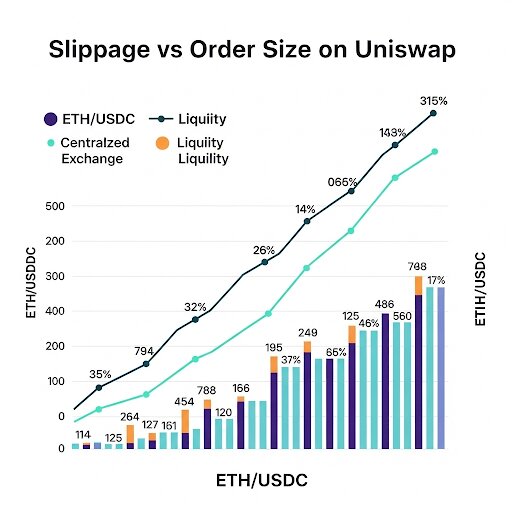
On a decentralized exchange (DEX) like Uniswap or PancakeSwap, the mechanics differ. There’s no order book. Prices are set by automated market makers (AMMs) using the constant product formula: x × y = k. When you trade a large amount relative to a pool’s size, you shift the token ratio inside that pool, and the price moves against you automatically. The larger your trade relative to the pool, the worse your price impact becomes. Whether you use the best decentralized crypto exchanges or prefer centralized platforms, this phenomenon affects every trade. The difference is how it manifests and how much control you have over it.

Image from Sei
Positive vs. Negative Slippage: What is the Difference?
Not all price deviation works against you. There are two types, and the distinction matters for how you interpret your trade history.
Negative slippage is what most traders experience. Your order fills at a worse price than displayed. This happens when prices move against you between quote and execution, or when your order size consumes multiple price levels.
Positive slippage means your trade executed at a better price than expected. A sudden drop in token price just before your buy order confirms means you pay less than quoted. A sudden price spike when selling means you receive more. Positive slippage crypto is real but rare.
Understanding what is slippage in trading in both directions matters especially if you’re tracking P&L carefully. A strategy that looks profitable on paper can show consistent losses in practice once slippage is properly accounted for. Even a 0.5% variance per trade compounds significantly over hundreds of trades.
Why Does High Slippage in Crypto Occur?
Most traders encounter high slippage in crypto without fully understanding why it happened. There are two primary drivers.
High Market Volatility
Price moves fast in crypto. The moment between your swap confirmation and block confirmation on-chain can be measured in seconds but in a volatile market, token prices can shift meaningfully in that window. If Bitcoin jumps $500 in seconds, market orders fill at prices far above the displayed quote.
During the 2021–2022 NFT boom, FinanceFeeds’ slippage analysis notes traders regularly encountered high slippage in crypto of 10–15% when swapping tokens in shallow pools during volatile periods. Monitoring coin price predictions and avoiding swaps during major news events or market-moving moments is one of the simplest ways to reduce this specific cause of slippage crypto.
Low Liquidity on DEXs
The second major cause of high slippage in crypto is thin liquidity particularly on DEX pools for smaller tokens. AMMs price trades based on pool ratios. A small pool means even a medium-sized order shifts the ratio significantly, creating large price impact.
If you prefer platforms that avoid some of these DEX-specific risks, checking the best no KYC crypto exchanges can surface alternatives with deep liquidity and fewer MEV concerns.
What is Slippage Tolerance in Crypto?
On DEXs like Uniswap and PancakeSwap, you set a slippage tolerance in crypto before executing a swap. This tells the smart contract the maximum price deviation you’re willing to accept.
Understanding what is slippage tolerance in crypto is critical for DEX users because the default setting is often a compromise. MC² Finance’s slippage breakdown notes that Uniswap’s interface uses auto-slippage ranging from 0.1% to 5% depending on trade and network conditions. PancakeSwap defaults to 0.5% for most pairs and 1% for others. Slippage in crypto PancakeSwap settings follow this same logic.
Recommended tolerance ranges based on what you’re trading:
- 0.1–0.5%: High-liquidity pairs like ETH/USDC or BTC/USDT. Deep pools mean minimal price movement between quote and execution.
- 1%: Mid-cap tokens with moderate liquidity. A safe middle ground for most standard DEX swaps.
- 3–5%: Low-liquidity tokens or during periods of high volatility. Use cautiously wider tolerance increases sandwich attack risk.
- 10%+: New token launches or micro-cap pools. Approaching this level means the slippage limit in crypto is essentially meaningless as a protection, the risk is very high.
The slippage limit in crypto you set is also your primary defence against overpaying. Think of it as a price ceiling on your buy order. If the market moves beyond it before your transaction confirms, the trade fails cleanly rather than filling at a price you never agreed to. Managing what is slippage fee in crypto exposure starts here. The tolerance setting is the one variable entirely in your control on a DEX.

Image from X
How to Avoid Price Slippage When Trading Crypto
None of these strategies eliminate what is price slippage entirely; it’s a structural feature of all liquid markets. But the right combination can reduce your average slippage in crypto from a significant ongoing cost to a manageable baseline.
- Trade on Highly Liquid Markets
The single most effective way to reduce slippage crypto costs is to trade the most liquid pairs on the most liquid platforms. Deep order books and large liquidity pools absorb your order with minimal price impact. Choosing the right venue matters as much as the trade itself.
- Break Down Large Orders
Large orders move markets. A single $500,000 swap in a pool with $2 million TVL will move the price significantly against you.
- Use Limit Orders Instead of Market Orders
Market orders accept whatever price is available at execution. Limit orders set a maximum buy price or minimum sell price your order only fills if the market meets your terms. On CEXs, limit orders are straightforward.
Conclusion: Managing Your Slippage Cost
What is slippage in crypto, ultimately? It’s the unavoidable cost of executing a trade in a market where prices move continuously, and liquidity is never perfectly distributed. Every trader pays it. The ones who lose the least are those who understand where it comes from and build their execution habits around minimizing it.
Set appropriate tolerances. Trade liquid pairs. Break large orders. Use limit orders where possible. And always check coin price predictions and market conditions before entering a position during high-volatility windows. These habits don’t eliminate what is slippage in crypto but they keep it from becoming your single largest trading cost.
FAQs About Crypto Slippage
What is slippage in crypto in simple terms?
What is slippage in crypto? It’s the difference between the price you saw when placing a trade and the price you actually paid when it executed.
What does slippage mean in crypto on a DEX?
On a DEX, what does slippage mean in crypto is directly tied to pool size and trade volume. Your trade shifts the token ratio in the liquidity pool, automatically moving the price against you. The bigger your trade relative to the pool, the worse the slippage in crypto you experience.
What is a good slippage tolerance in crypto?
What is slippage tolerance in crypto set correctly? For major pairs like ETH/USDC: 0.1–0.5%. For mid-cap tokens: 1%. For low-liquidity altcoins: 3–5%.
What is slippage fee in crypto?
There is no formal slippage fee in crypto slippage isn’t a charged fee. It’s an execution cost: the difference between your expected and actual fill price. Knowing what is slippage in trading is very important.
How does slippage in crypto PancakeSwap work?
Slippage in crypto PancakeSwap works like any DEX: you set a tolerance percentage in the swap settings before confirming.
The post What is Slippage in Crypto & How to Avoid It? (Guide) appeared first on Ventureburn.