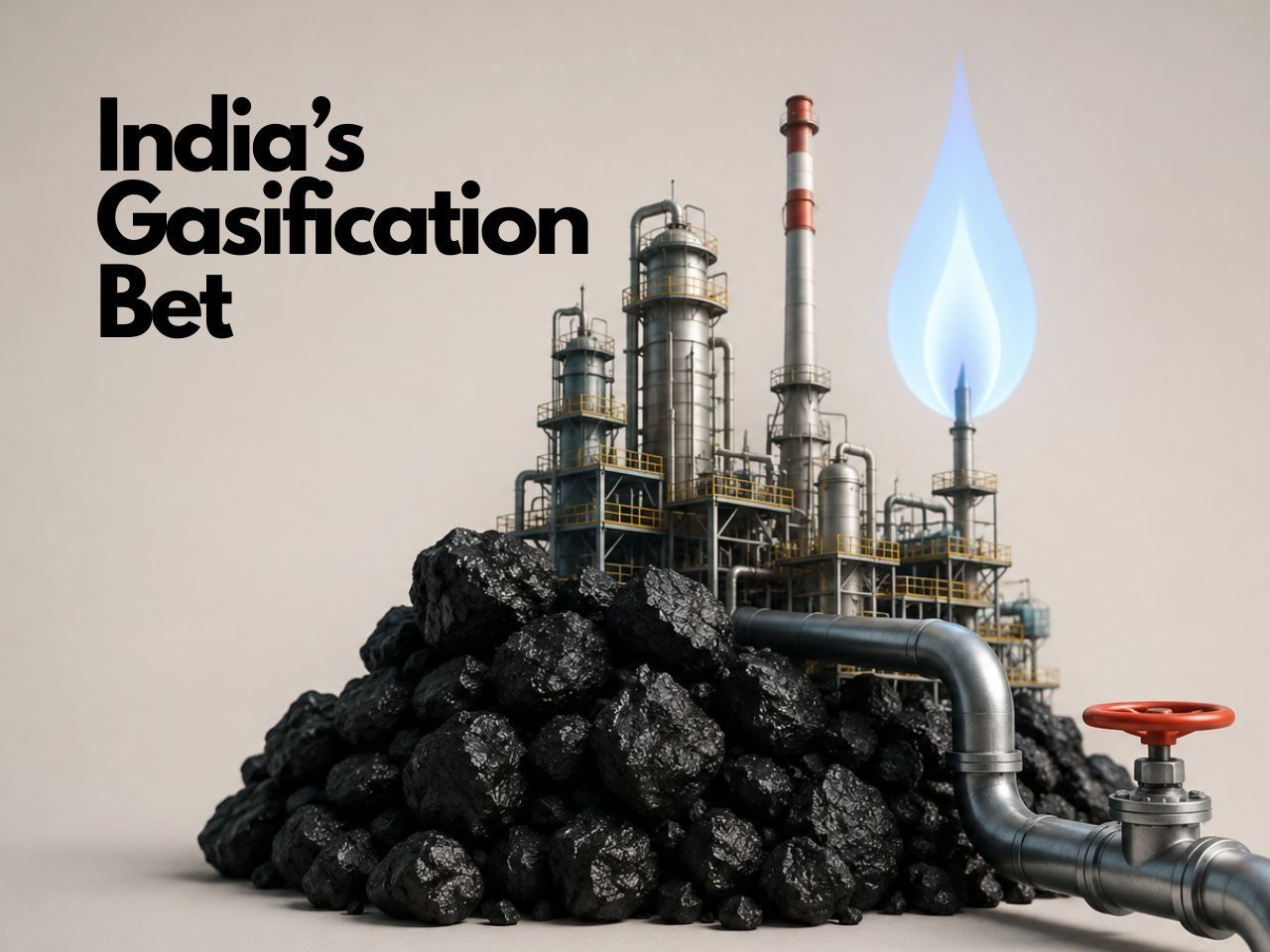

As geopolitical tensions continue to shake global energy markets and fuel supply chains remain under pressure, India is preparing one of its biggest domestic energy transformation bets in recent years.
In a major policy move aimed at strengthening energy security and reducing dependence on imports, the Union Cabinet chaired by Prime Minister Narendra Modi has approved a massive ₹37,500-crore coal gasification scheme focused on converting the country’s vast coal reserves into cleaner and strategically important fuel alternatives.
The decision comes at a time when rising tensions in West Asia are once again exposing the vulnerabilities of countries heavily dependent on imported fuels and industrial feedstock. For India — one of the world’s fastest-growing energy consumers — the challenge is becoming increasingly urgent.
The government believes coal gasification could become a critical piece of India’s long-term energy independence strategy.
Announcing the Cabinet decision, Union Minister Ashwini Vaishnaw described the move as both “important and timely,” especially amid rapidly growing gas demand and ongoing geopolitical uncertainty.
“Today, we took a very important and timely decision on coal gasification to help India become self-reliant amid rising gas demand and the current geopolitical situation,” Vaishnaw said after the Cabinet meeting.
Why India Is Suddenly Focusing on Coal Gasification
India has one of the world’s largest coal reserves, estimated at nearly 401 billion tonnes, along with around 47 billion tonnes of lignite reserves. Despite the global push towards cleaner energy sources, coal still contributes more than 55 per cent of India’s energy mix.
Now, instead of using coal only for direct combustion and power generation, the government wants to increasingly convert it into synthesis gas — commonly known as syngas.
Syngas can be used as an alternative to natural gas and serves as a key input for fertilisers, industrial chemicals, power generation, LPG-equivalent fuels, methanol production, and several downstream industries.
The larger idea is simple: use India’s abundant domestic coal reserves to replace expensive imported products.
And the timing is significant.
Global energy markets have remained volatile due to continuing instability in West Asia, one of the world’s most strategically important energy-producing regions. Supply chain disruptions and price fluctuations have already impacted import-dependent countries across sectors such as LNG, fertilisers, chemicals, and industrial manufacturing.
India currently imports over 50 per cent of its LNG requirements, almost 100 per cent of ammonia demand, nearly 80–90 per cent of methanol consumption, and around 20 per cent of urea needs.
According to government estimates, India’s import bill for LNG, ammonia, methanol, urea, coking coal, and related products touched nearly ₹2.77 lakh crore in FY2025 alone.
That growing dependence has now become a major economic and strategic concern.
What the ₹37,500-Crore Scheme Includes
Under the newly approved programme, the government will offer financial incentives of up to 20 per cent of plant and machinery costs for upcoming coal gasification projects.
The scheme aims to support gasification of around 75 million tonnes of coal and lignite, while contributing to India’s broader target of gasifying 100 million tonnes of coal by 2030.
Officials believe the initiative could eventually mobilise investments worth nearly ₹2.5 lakh crore to ₹3 lakh crore across the energy and industrial ecosystem.
To improve investor confidence and long-term viability, the Centre has also extended coal linkage tenure up to 30 years under the “Production of Syngas leading to Coal Gasification” category.
This policy certainty is expected to encourage large-scale participation from energy companies, industrial groups, infrastructure players, and technology providers.
A Bigger Push for Energy Self-Reliance
The government has positioned the scheme as part of its broader Atmanirbhar Bharat and Make in India vision.
Officials say the programme could substantially reduce India’s exposure to global fuel price volatility while simultaneously strengthening domestic manufacturing and industrial supply chains.
The coal gasification push is also expected to create major economic activity in coal-bearing regions.
According to the Cabinet note, nearly 50,000 direct and indirect jobs could be generated across around 25 projects under the scheme. In addition, the government estimates annual revenue generation of roughly ₹6,300 crore through coal and lignite utilisation, apart from GST collections and downstream tax revenues.
The initiative builds on the National Coal Gasification Mission launched in 2021 and the earlier ₹8,500-crore support scheme approved in January 2024. Under that earlier programme, eight projects worth ₹6,233 crore are already under implementation.
Technology, Scale, and Strategic Positioning
Interestingly, the government has described the new programme as “technology-agnostic,” meaning multiple technological approaches can be adopted depending on efficiency and industrial requirements.
At the same time, policymakers are also encouraging the use of indigenous technologies to reduce dependence on foreign engineering firms and overseas technology providers.
That focus reflects India’s growing effort to build domestic capabilities across strategic sectors — particularly those linked to energy security and industrial resilience.
For the government, coal gasification is no longer being viewed merely as a coal-sector reform. It is increasingly being positioned as a strategic industrial policy tool capable of supporting energy independence, manufacturing growth, fertiliser security, chemical production, and large-scale economic activity.
And as global geopolitical risks continue to reshape energy priorities worldwide, India appears determined to ensure that its next phase of growth is powered more by domestic resources than imported uncertainty.