
India’s startup ecosystem is no longer chasing growth alone—it is increasingly solving some of the country’s biggest environmental and social challenges. From reducing plastic waste and reimagining sustainable fashion to improving water conservation and building circular economy solutions, a new generation of entrepreneurs is proving that profitability and purpose can go hand in hand.
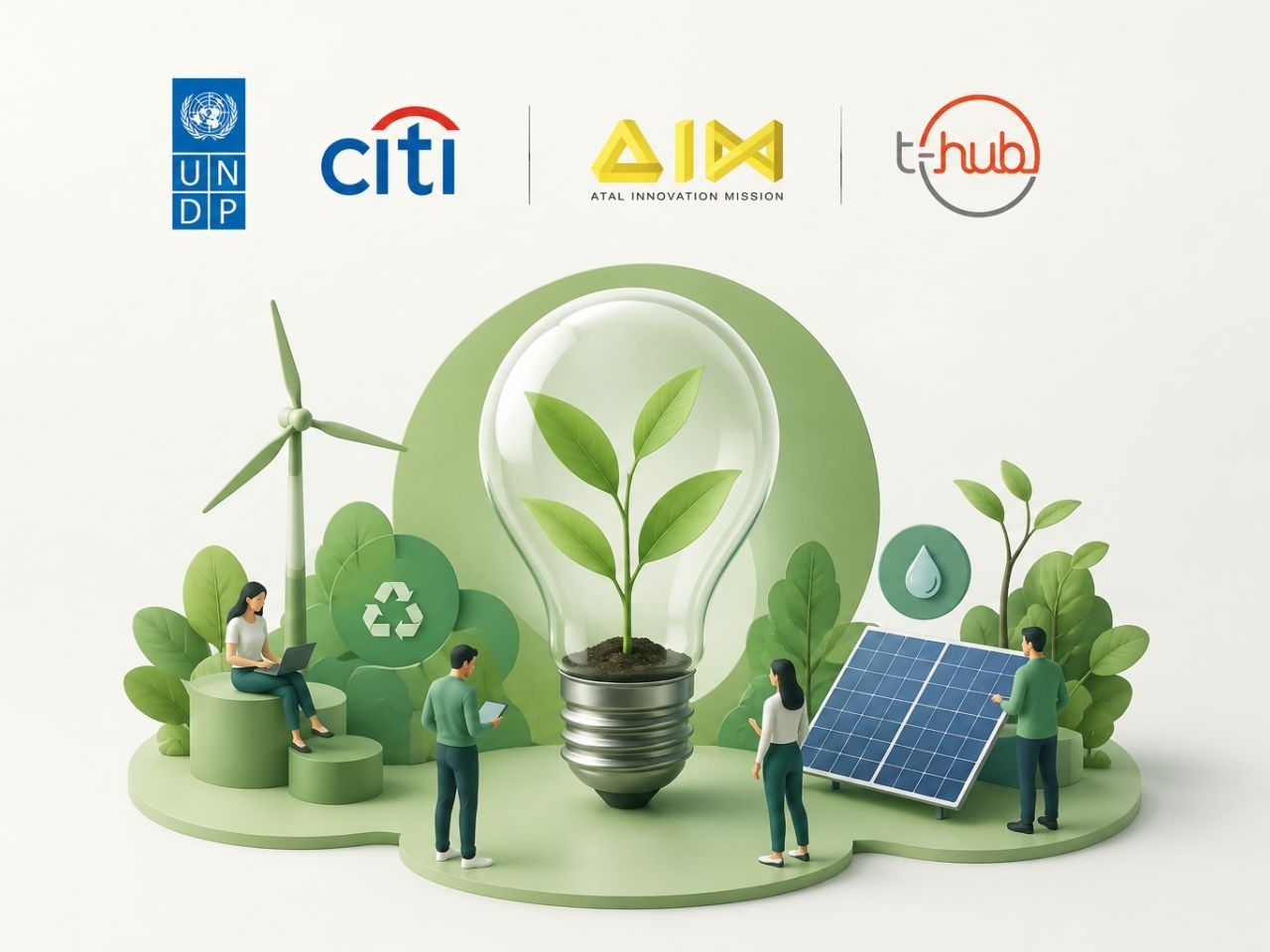
This growing wave of impact-driven innovation was on full display at the 8th edition of the Youth Co:Lab National Innovation Challenge 2026, where six youth-led startups emerged as winners after a nationwide competition that attracted hundreds of aspiring founders. The initiative, jointly led by the United Nations Development Programme (UNDP) India and Citi Foundation, in partnership with the Atal Innovation Mission (AIM), NITI Aayog, and implemented by T-Hub Foundation, aims to nurture young entrepreneurs working on solutions aligned with the Sustainable Development Goals (SDGs).
The programme not only provides funding but also connects founders with mentors, investors, policymakers and industry experts, creating a strong launchpad for startups working on sustainability and climate innovation.
More Than 350 Startups Competed From Across India
The 2026 edition witnessed participation from more than 350 startups representing 28 states, highlighting the growing interest among young entrepreneurs in building businesses that create measurable environmental and social impact.
The participating startups presented innovations across multiple sustainability-focused sectors, including:
- Circular economy solutions
- Sustainable textiles and fashion
- Sustainable food systems
- Water conservation technologies
The diverse participation reflected how sustainability is becoming a mainstream opportunity for Indian startups rather than a niche segment.
A Three-Month Accelerator to Build Stronger Businesses
The competition extended far beyond a simple pitch event.
Following a rigorous screening process, 50 high-potential startups were selected for the National Springboard Programme, a three-month virtual accelerator designed to strengthen both business viability and impact potential.
Supported by 16 industry mentors and sector specialists, participating founders refined their business models, validated their strategies and prepared investor-ready pitches before presenting their ideas during the National Innovation Dialogue held on June 4, 2026.
The programme focused on helping founders transform innovative ideas into scalable ventures capable of delivering long-term environmental and economic value.
Hyderabad Bootcamp Brought Together India’s Innovation Ecosystem
The journey continued with the top 20 startups advancing to an intensive Regional Immersion Bootcamp hosted at T-Hub, Hyderabad, between June 15 and June 19.
The bootcamp served as a collaborative platform where founders engaged with:
- Investors
- Policymakers
- Sustainability experts
- Startup ecosystem leaders
- Industry mentors
Through masterclasses, mentorship sessions, networking opportunities and site visits, participants gained practical insights into scaling sustainable businesses while expanding their professional networks.
Six Startups Recognised for High-Impact Innovation
After the final jury evaluation conducted on June 18, six startups were selected for their innovative and scalable sustainability solutions.
Winners
- NavaPrayoga Labs LLP (Grassip)
- UnBubble
- Ecorenowa Solutions Pvt. Ltd.
Each of the three winning startups received:
- Seed grants of ₹3.5 lakh
- Capacity-building support
- Access to innovation and entrepreneurial networks
Runners-Up
- Eco Cushion
- Vasudeva Innovations
- WomenasticCO
The runners-up were awarded ₹2.2 lakh each in recognition of their promising solutions and growth potential.
The financial support is expected to help these ventures strengthen product development, expand market reach and accelerate their sustainability impact.
Youth Innovation Can Drive India’s Green Future
Speaking during the event, Meraj Faheem, CEO of Telangana Innovation Cell (TGIC), emphasised that young entrepreneurs have a critical role to play in building a sustainable economy.
He highlighted that initiatives like Youth Co:Lab demonstrate how innovation, collaboration and youth leadership can contribute meaningfully to solving pressing development and climate challenges while creating scalable businesses.
Bridging the Startup Opportunity Gap
While India’s startup ecosystem has expanded rapidly over the past decade, access to funding, mentorship and networks remains uneven.
Addressing this challenge, Prateek Deshmukh, Program Director at AIM, NITI Aayog, stressed the importance of ensuring that entrepreneurial opportunities are distributed more equitably across the country.
He noted that programmes like Youth Co:Lab help bridge gaps faced by founders from:
- Tier-III cities
- The North-East region
- Women-led startups
- Socially disadvantaged communities
By widening access to capital and mentorship, such initiatives aim to make India’s innovation ecosystem more inclusive and representative.
Women-Led Innovation Gains Momentum
India’s demographic advantage remains one of its greatest strengths, and empowering young innovators is increasingly seen as essential to achieving both development and climate goals.
Highlighting this, Dr. Angela Lusigi, Resident Representative, UNDP India, pointed out that more than 40% of the selected ventures in this year’s cohort are women-led.
The figure reflects the growing participation of women entrepreneurs in sustainability and impact innovation, signalling a more diverse and inclusive startup landscape.
Conversations Beyond Funding
The finale was not limited to announcing winners.
It also hosted discussions on building inclusive innovation ecosystems and understanding what investors expect from the next generation of impact-driven founders.
Startup founders, investors, policymakers and development experts participated in panel discussions exploring strategies to scale socially impactful enterprises while creating sustainable business models.
These conversations reinforced the idea that climate-focused entrepreneurship requires not only capital but also long-term ecosystem support.
A Platform That Continues to Shape Youth Entrepreneurship
Co-created in 2017 by UNDP and Citi Foundation, Youth Co:Lab has grown into one of the Asia-Pacific region’s leading youth entrepreneurship platforms.
In India, the initiative continues to strengthen the startup ecosystem by enabling young founders to build market-ready solutions addressing:
- Climate change
- Resource efficiency
- Sustainable production
- Social inclusion
The 2026 edition further highlights a significant shift in India’s startup landscape, where young entrepreneurs are increasingly leveraging innovation and technology to tackle environmental and developmental challenges while creating scalable businesses.
As sustainability moves from policy discussions to real-world implementation, programmes like Youth Co:Lab are helping ensure that the country’s next generation of founders is equipped not just to build successful startups, but to build solutions that create lasting impact for people and the planet.